
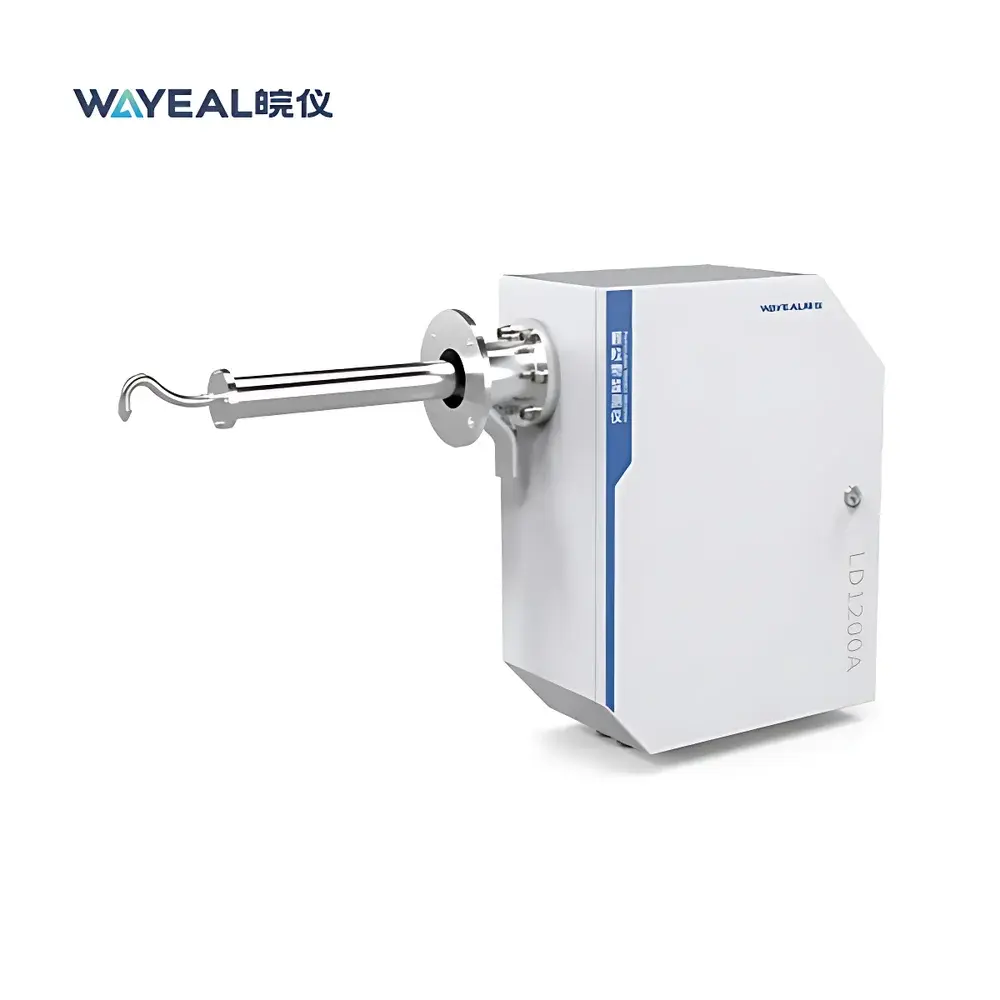
WAYEAL LD1200A Ultra-Low Concentration Particulate Matter Monitor
| Brand | WAYEAL |
|---|---|
| Origin | Anhui, China |
| Manufacturer Type | Direct Manufacturer |
| Country of Origin | China |
| Model | LD1200A |
| Pricing | Upon Request |
| Measurement Principle | Laser Forward Light Scattering |
| Safety Rating | Non-Explosive |
| Measurement Range | 0–15 mg/m³ |
| Resolution | 0.1 mg/m³ |
| Accuracy | ±10% of reading |
| Relative Error | ±2% |
Overview
The WAYEAL LD1200A Ultra-Low Concentration Particulate Matter Monitor is an industrial-grade continuous emission monitoring system (CEMS) engineered for real-time, in-situ measurement of ultra-low concentration particulate matter (PM) in flue gas streams. It operates on the principle of laser forward light scattering—a well-established optical technique where a collimated laser beam interacts with suspended particles, and the intensity of scattered light at a defined forward angle (typically 15°–45°) is quantitatively correlated to mass concentration via calibrated Mie scattering models. Unlike nephelometric or beta attenuation methods, this approach delivers rapid response (<3 s T90), minimal drift, and immunity to water vapor interference—critical for compliance monitoring in wet-stack applications such as coal-fired power plants, waste incinerators, and chemical process heaters. The system employs full-path high-temperature sampling (up to 120 °C), eliminating condensation, adsorption, and thermophoretic losses that commonly compromise low-concentration accuracy in conventional cooled extractive systems.
Key Features
- High-temperature extractive sampling path maintained continuously at ≥120 °C from probe tip to detector chamber, preventing particle loss due to wall deposition or hygroscopic growth.
- Proprietary “shear-flow” optical design isolates the measurement zone using a concentric high-temperature air curtain, protecting the laser window from fouling without mechanical wipers or consumables.
- Integrated thermal-conductive heated sampling probe with built-in high-capacity pneumatic ball valve—automatically isolates the analyzer during zero-flow or power interruption to prevent contamination and thermal shock.
- Zero-maintenance optical detection unit: no moving parts, no purge gas consumption beyond the protective air curtain, and no periodic lens cleaning required under normal operating conditions.
- Onboard automated full-system zero calibration using integrated reference attenuator; executed without external tools or manual intervention, ensuring traceable baseline stability per ISO 12103-1 and EPA Method 9 guidelines.
Sample Compatibility & Compliance
The LD1200A is validated for use with flue gases containing up to 30% v/v water vapor, temperatures up to 200 °C at the stack interface, and particulate loadings from ambient background (sub-0.1 mg/m³) up to 15 mg/m³—covering regulatory thresholds for ultra-low emission standards (e.g., China’s GB 13223-2011 Tier 3, EU BREF LCP Annex VIII, and US EPA PM CEMS Performance Specification 11). Its non-explosive classification (IEC 60079-0 compliant design) permits installation in Zone 2/Class I, Division 2 environments when paired with appropriate barrier systems. Data output meets EN 14181 QAL1/QAL2 requirements for automated CEMS validation and supports audit-ready electronic records compliant with 21 CFR Part 11 when interfaced with validated SCADA or DCS platforms.
Software & Data Management
The embedded firmware provides dual-mode operation: standalone local display with touch-enabled HMI (including real-time scatter signal diagnostics, temperature profiles, and valve status) and industrial Ethernet (Modbus TCP / OPC UA) connectivity for centralized data acquisition. All calibration events, zero checks, and fault logs are time-stamped and stored with immutable audit trails—including operator ID, parameter changes, and system health metrics. Raw scattering voltage, temperature-compensated concentration, and diagnostic flags are streamed at 1 Hz resolution. Optional cloud-based remote monitoring enables predictive maintenance alerts based on optical signal decay trends and heater duty cycle analysis—fully compatible with ISO/IEC 17025 accredited QA/QC workflows.
Applications
- Continuous compliance monitoring of PM2.5 and PM10 emissions from coal-, biomass-, and waste-fired boilers subject to sub-5 mg/m³ regulatory limits.
- Process optimization support in cement kilns and lime calciners where real-time particulate feedback informs ESP or baghouse control logic.
- Performance verification of wet electrostatic precipitators (WESPs) and advanced filtration systems requiring detection sensitivity below 1 mg/m³.
- Research-grade emission characterization in pilot-scale combustion facilities where high temporal resolution and water vapor resilience are essential.
- Stack testing and source apportionment studies requiring portable yet metrologically robust field-deployable instrumentation.
FAQ
What is the recommended maintenance interval for the LD1200A?
Under typical flue gas conditions (≤15 mg/m³, ≤30% H₂O), no routine optical maintenance is required; only annual verification of probe heater calibration and pneumatic valve actuation per manufacturer’s SOP.
Can the LD1200A be used for ambient air monitoring?
No—it is designed exclusively for hot, humid, and corrosive industrial flue gas; ambient applications require dedicated low-concentration aerosol spectrometers (e.g., GRIMM or TSI models) with diffusion dryers and laminar flow control.
Does the system support automatic span calibration?
Span calibration is performed externally using NIST-traceable aerosol generators (e.g., polydisperse PSL or ammonium sulfate); the LD1200A supports scheduled zero-only auto-calibration internally.
Is the output data compliant with Chinese national emission standards?
Yes—the instrument meets technical specifications outlined in HJ 76-2017 and HJ 75-2017 for CEMS performance evaluation and data reporting in China’s national emission permit system.
How is data integrity ensured during power fluctuations?
The embedded controller includes supercapacitor-backed RAM and write-protected flash storage; all critical parameters and event logs survive brownout conditions exceeding 20 ms duration.
Related Products







