
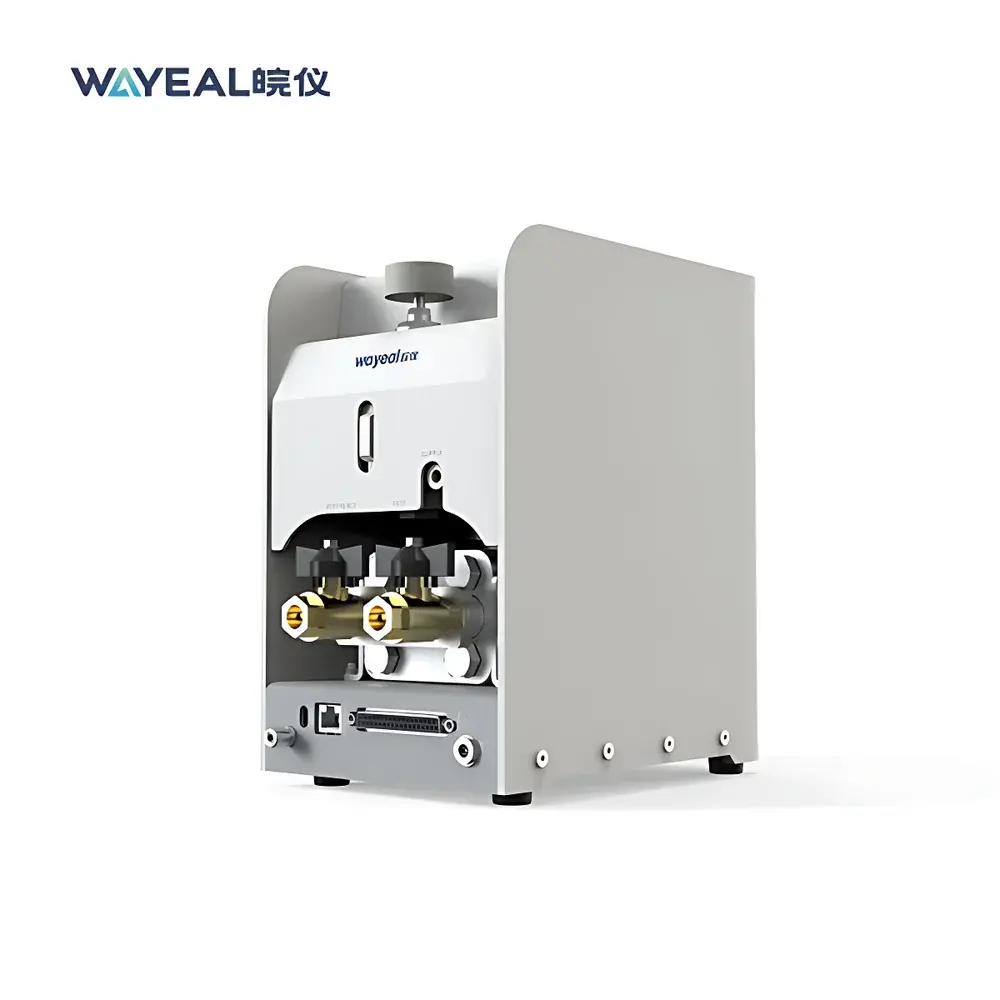
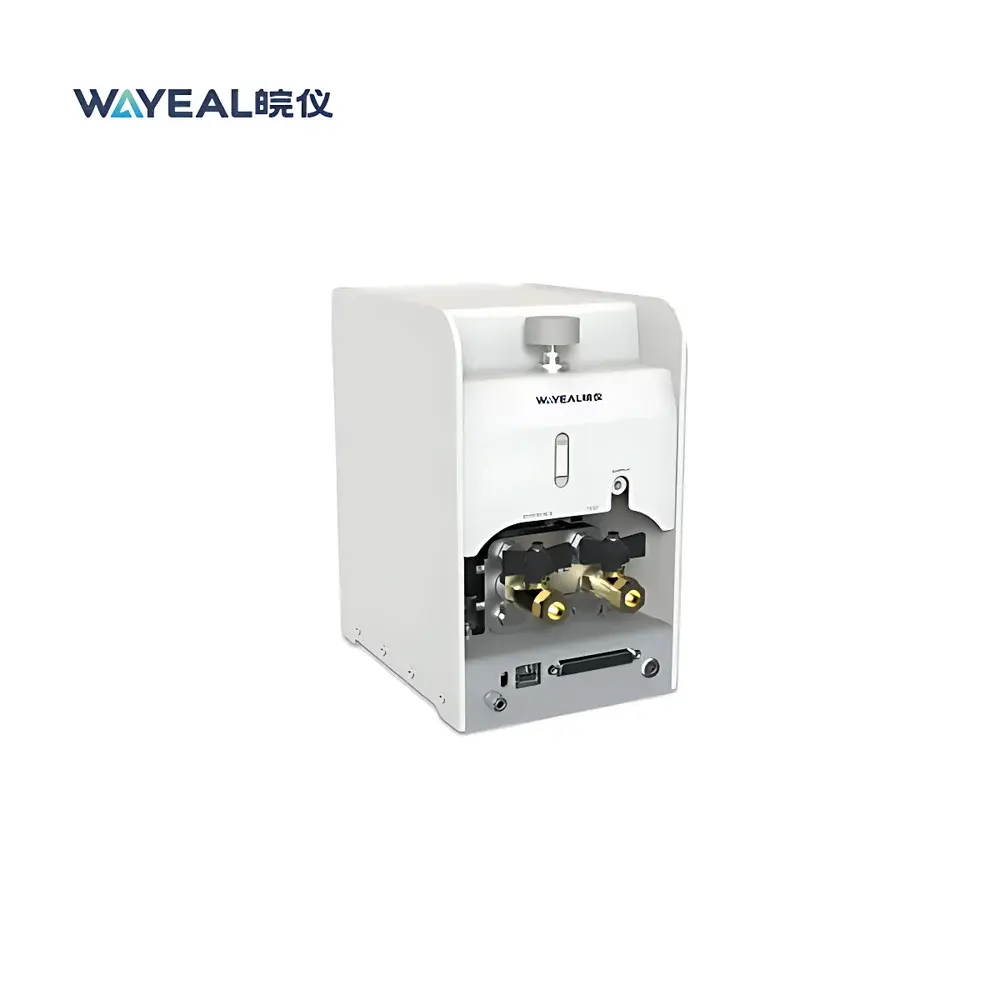
WAYEAL Modular Differential Pressure Helium Mass Spectrometer Leak Detector
| Brand | WAYEAL |
|---|---|
| Origin | Anhui, China |
| Manufacturer Type | Original Equipment Manufacturer (OEM) |
| Regional Classification | Domestic (PRC) |
| Model | Modular Differential Pressure Airtightness Leak Tester |
| Pricing | Upon Request |
Overview
The WAYEAL Modular Differential Pressure Helium Mass Spectrometer Leak Detector is an integrated vacuum-based leak detection system engineered for high-reliability airtightness verification in industrial manufacturing environments. Unlike standalone helium sniffing or tracer gas accumulation methods, this instrument employs differential pressure measurement combined with helium mass spectrometry to deliver quantitative, trace-level leak rate detection down to 1×10⁻⁹ mbar·L/s (typical sensitivity under optimized calibration and test conditions). The core architecture leverages a quadrupole mass filter operating at unit mass resolution (m/z = 4), selectively detecting helium ions while rejecting background gases such as H₂, H₂O, and N₂ via dynamic pressure discrimination and ion optics optimization. Its dual-sensor configuration—comprising a reference chamber and test chamber—enables real-time comparative pressure monitoring, eliminating thermal drift and ambient barometric interference inherent in single-chamber systems.
Key Features
- Modular mechanical design: Interchangeable pressure control modules (pneumatic valves, calibrated restrictors, vacuum pumps) allow field reconfiguration for varying test volumes (0.1–50 L) and pressure ranges (0–10 bar gauge).
- Dual-channel differential transducer: High-stability capacitive pressure sensors with ±0.05% FS accuracy provide synchronized, noise-immune pressure delta acquisition at 100 Hz sampling rate.
- Helium-specific mass spectrometer: Quadrupole analyzer with electron impact ionization (70 eV), bakeable stainless-steel ion source, and Faraday cup detector ensure long-term signal stability and low contamination risk.
- Integrated vacuum architecture: Onboard two-stage rotary vane pump and optional turbomolecular pump upgrade support base pressures <1×10⁻³ mbar, enabling rapid evacuation cycles (<30 s for 5 L volume).
- Industrial I/O interface: Standard EtherCAT and RS-485 ports facilitate direct integration into PLC-controlled assembly lines; supports Modbus TCP and OPC UA protocols for MES/SCADA interoperability.
Sample Compatibility & Compliance
The system accommodates rigid and semi-rigid components across automotive powertrain assemblies (e.g., EV battery enclosures, fuel rails), medical device housings (ISO 11607-compliant packaging), HVAC heat exchangers, and semiconductor process chambers. Test fixtures are customizable per ISO 10648-2 guidelines for leak testing methodology validation. The instrument meets electromagnetic compatibility requirements per EN 61326-1:2013 and safety standards per IEC 61010-1:2010. All firmware and calibration records comply with GLP audit trails and support FDA 21 CFR Part 11 electronic signature readiness when deployed with validated software configurations.
Software & Data Management
WAYEAL LeakTest Studio v3.2 provides full-cycle test sequence programming—including pre-evacuation, helium injection timing, differential pressure ramping, and mass spec integration windows—with configurable pass/fail thresholds per test step. Raw sensor data (pressure delta, ion current, time stamp) is logged in HDF5 format with embedded metadata (operator ID, fixture ID, environmental temperature/humidity). Audit logs record all user actions, parameter changes, and calibration events with SHA-256 hashing. Export options include CSV, PDF test reports (with digital signature fields), and direct database push to SQL Server or PostgreSQL via ODBC drivers.
Applications
- Automotive: Validation of hermeticity in ADAS radar modules, brake master cylinders, and hydrogen fuel cell stacks per SAE J2046 and ISO 16750-4.
- Medical devices: Final packaging integrity testing of Class III implantable devices per ASTM F2338-22 and ISO 11607-2 Annex B.
- Aerospace: Pre-flight verification of satellite propulsion system manifolds and cryogenic valve assemblies per ECSS-Q-ST-70-02C.
- Consumer electronics: In-line leak screening of waterproof smartphones (IP68/IP69K) using accelerated helium pressurization protocols.
- Energy storage: Batch-level qualification of lithium-ion battery module casings prior to electrolyte filling, aligned with UL 2580 Section 12 requirements.
FAQ
What leak rate sensitivity can be achieved with the differential pressure + helium MS hybrid method?
Under controlled environmental conditions (±0.5°C temperature stability, <30% RH), typical minimum detectable leak rates range from 5×10⁻¹⁰ to 1×10⁻⁹ mbar·L/s depending on test volume, helium concentration, and integration time.
Is external helium supply required, or does the system include onboard gas handling?
The instrument requires an external regulated helium source (99.999% purity, 0.1–1.0 MPa inlet pressure); no internal gas storage or mixing manifold is provided to maintain intrinsic safety and calibration traceability.
Can the system perform both gross and fine leak testing in a single cycle?
Yes—via programmable multi-stage test sequences: initial pressure decay screening (gross leaks >1×10⁻⁴ mbar·L/s) followed by helium mass spec confirmation (fine leaks <1×10⁻⁷ mbar·L/s) without manual intervention.
How is calibration maintained across production shifts?
Automatic daily zero-point compensation is performed during idle periods; certified leak standards (NIST-traceable glass capillary or metal orifice) are used for quarterly full-range verification per ISO/IEC 17025 procedures.
Does the modular design support retrofitting into existing leak test stations?
Yes—the chassis conforms to DIN 43650-A electrical interface standards and mounts on standard 19-inch rack rails; pneumatic interfaces use ISO 8573-1 Class 2 quick-connect fittings.
Related Products





