
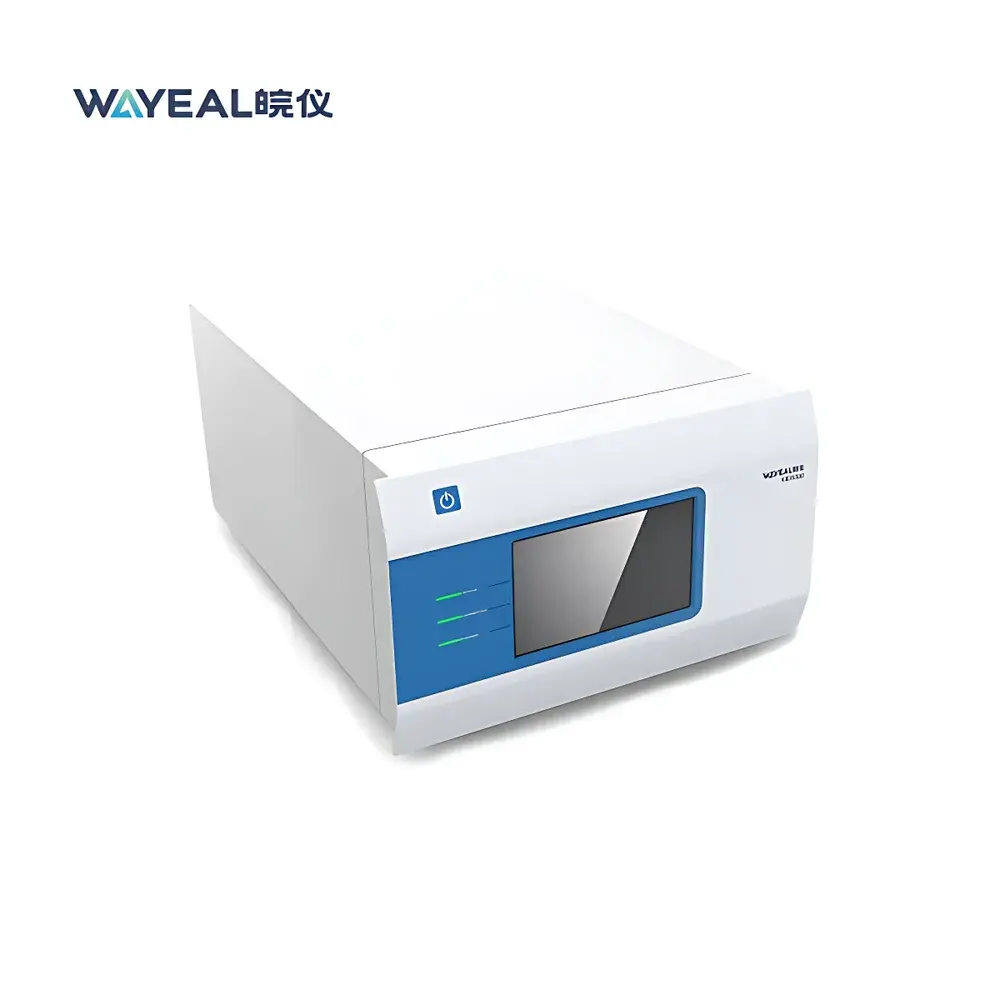
WAYEAL RID-2000 Refractive Index Detector
| Brand | WAYEAL |
|---|---|
| Origin | Anhui, China |
| Manufacturer Type | Original Equipment Manufacturer (OEM) |
| Product Category | Domestic |
| Model | RID-2000 |
| Detector Type | Refractive Index Detector (RID) |
| Signal Channels | 2 |
| Compatible System | HPLC |
| Output Modes | Digital Protocol (RS-485/Modbus) & Analog (0–5 V / 4–20 mA) |
| Display | 7-inch Capacitive Touch LCD |
| Light Source | Long-life High-Stability LED |
| Temperature Control | Precision Heated Flow Cell with PID Regulation |
| Leak Detection | Integrated Photoelectric Sensor with Real-time Alert |
| Compliance | Designed for ISO/IEC 17025-aligned QC labs |
Overview
The WAYEAL RID-2000 Refractive Index Detector is a high-stability, dual-channel universal detector engineered for integration into analytical and preparative high-performance liquid chromatography (HPLC) systems. Operating on the principle of differential refractometry, the RID-2000 measures minute changes in the refractive index of the mobile phase as analytes elute from the column—enabling detection of compounds lacking chromophores or electrochemical activity, such as carbohydrates, polymers, lipids, and small organic molecules. Unlike UV-Vis or fluorescence detectors, the RID-2000 provides truly universal response across non-absorbing species without derivatization. Its optical architecture employs a precisely collimated, thermally stabilized LED light source and a balanced dual-beam interferometric path, minimizing baseline drift and enhancing long-term signal reproducibility. The flow cell is constructed from chemically resistant sapphire windows and stainless-steel housing, rated for pressures up to 10 MPa and compatible with common HPLC solvents including THF, chloroform, acetonitrile, and aqueous buffers.
Key Features
- Stabilized LED light source with >20,000-hour operational lifetime and <0.005% intensity drift per hour—eliminating lamp replacement cycles and associated calibration recalibration.
- Precision temperature-controlled flow cell featuring PID-regulated heating (range: ambient +5 °C to 65 °C, ±0.02 °C stability), significantly reducing thermal-induced baseline noise and improving retention time reproducibility.
- Dual independent signal channels support simultaneous monitoring of reference and sample streams—or parallel analysis of two separate chromatographic outputs—enhancing throughput in method development and QC validation workflows.
- Integrated photoelectric leak detection system continuously monitors optical path integrity; triggers immediate visual and relay-based alerts upon micro-leak onset (<5 µL/min), preventing solvent loss, column damage, and data corruption.
- Flexible output architecture: configurable RS-485 Modbus RTU protocol for direct integration with PLCs, SCADA, or third-party CDS platforms (e.g., Empower, Chromeleon, OpenLab), plus isolated analog outputs (0–5 V DC or 4–20 mA) for legacy DAQ systems.
- Intuitive 7-inch capacitive touch interface with multi-language firmware (English, Chinese, Spanish), context-sensitive help, real-time chromatogram preview, and on-device method storage (up to 128 protocols).
Sample Compatibility & Compliance
The RID-2000 accommodates standard 1/16″ stainless-steel or PEEK capillary connections (zero-dead-volume fittings) and accepts flow rates from 0.1 to 5.0 mL/min. It is compatible with both reversed-phase and normal-phase HPLC mobile phases—including aggressive solvents such as tetrahydrofuran (THF), dichloromethane, and ethyl acetate—provided system backpressure remains within specification. All wetted materials comply with USP Class VI biocompatibility standards. The detector’s firmware architecture supports audit trail logging, electronic signature enforcement, and user role-based access control—meeting core requirements of FDA 21 CFR Part 11, EU Annex 11, and ISO/IEC 17025 for accredited testing laboratories. Calibration verification is traceable to NIST-traceable sucrose standards.
Software & Data Management
The RID-2000 operates natively with WAYEAL’s ChromoLink™ PC software (Windows 10/11, 64-bit), which provides full remote configuration, real-time signal visualization, peak integration, and export to CSV, ASCII, or AIA (.cdf) formats. Raw detector data includes timestamped analog voltage values, temperature logs, and diagnostic status flags—structured for seamless ingestion into LIMS or ELN platforms. For enterprise deployment, optional OPC UA server integration enables bidirectional communication with laboratory-wide automation frameworks. All firmware updates are delivered via signed binary packages with SHA-256 checksum validation to ensure integrity and compliance continuity.
Applications
- Quantitative analysis of polysaccharides (e.g., dextran, inulin) and oligosaccharides in food and pharmaceutical excipient characterization.
- GPC/SEC of synthetic polymers (PMMA, PS, PEG) where molar mass distribution requires universal detection orthogonal to UV response.
- Quality control of glycerin, propylene glycol, and other non-UV-active excipients per USP and Ph. Eur. 2.2.57.
- Process analytical technology (PAT) applications in continuous manufacturing, leveraging dual-channel capability for feed-stream vs. effluent comparison.
- Method transfer between laboratories using different detector types—RID serves as a stable reference for retention time alignment and peak area cross-validation.
FAQ
Is the RID-2000 compatible with UHPLC systems?
Yes—the flow cell design and pressure rating (10 MPa) support operation at typical UHPLC flow rates (0.2–1.0 mL/min) and gradient conditions, though dwell volume optimization may be required for sub-2-µm columns.
Does the detector support automatic zeroing or baseline compensation?
It features programmable auto-zero routines triggered by user-defined time intervals or solvent composition events (e.g., post-gradient re-equilibration), reducing manual intervention in unattended runs.
Can the dual channels be used for ratio-metric measurement (e.g., reference subtraction)?
Yes—firmware v2.3+ enables real-time channel subtraction mode, improving signal-to-noise ratio in high-background solvent systems such as THF/water mixtures.
What maintenance is required for long-term stability?
Annual verification using certified sucrose standards and inspection of optical window cleanliness are recommended; no consumable lamps or deuterium sources require replacement.
Is 21 CFR Part 11 compliance fully implemented out-of-the-box?
Audit trail, electronic signatures, and role-based permissions are enabled by default; full compliance requires proper network authentication infrastructure and documented SOPs per your organization’s validation protocol.




