
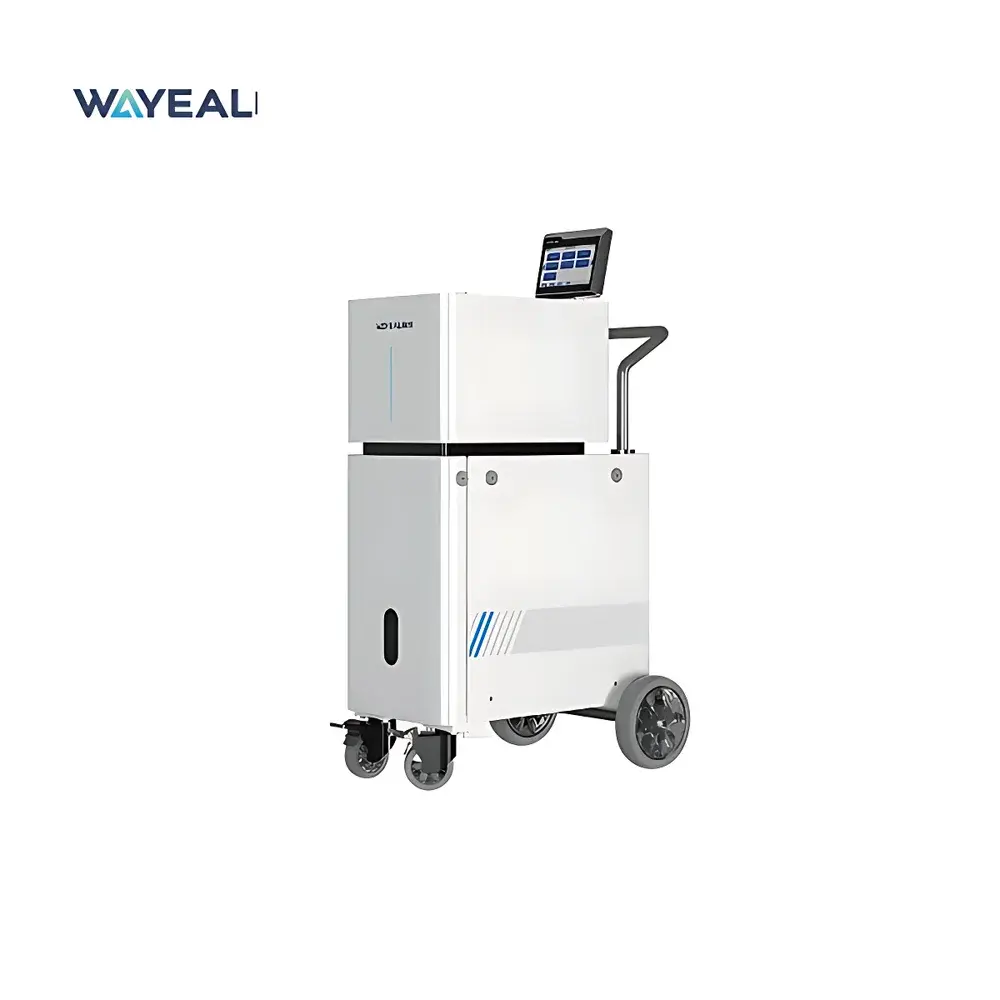
WAYEAL SFJ-16C/D Portable Helium Mass Spectrometer Leak Detector
| Brand | WAYEAL |
|---|---|
| Origin | Anhui, China |
| Manufacturer Type | Direct Manufacturer |
| Regional Classification | Domestic (China) |
| Model | SFJ-16C/D |
| Pricing | Upon Request |
| Base Pump (SFJ-16C) | Rotary Vane Vacuum Pump |
| Base Pump (SFJ-16D) | Scroll Vacuum Pump |
| Minimum Detectable Leak Rate (Helium Mode, Vacuum Method) | 5.0 × 10⁻¹³ Pa·m³/s |
| Minimum Detectable Leak Rate (Helium Mode, Sniffer Method) | 2.5 × 10⁻⁹ Pa·m³/s |
| Maximum Allowable Test Pressure | 1800 Pa |
| Human-Machine Interface | 7-inch Color LCD Touchscreen |
| Leak Port Flange | DN25 KF |
| Dimensions (W × D × H) | 475 × 714 × 1168 mm |
| Power Supply | AC 220 V (±10%), 50/60 Hz |
| Response Time | <1 s |
| Pump-Down / Startup Time | <95 s |
| Detectable Masses | m/z = 2 (H₂), 3 (³He), 4 (⁴He) |
| Ion Source | Dual Filament, Yttrium Oxide-Coated Iridium, Auto-Switching |
| I/O Interfaces | RS232, RS485, LAN |
| MES Integration | Standard |
| Operating Temperature Range | 0–40 °C |
| Display Languages | English & Chinese |
| Leak Rate Visualization | Numeric, Bar Graph, Real-Time Trend Curve |
Overview
The WAYEAL SFJ-16C/D is a portable helium mass spectrometer leak detector engineered for high-sensitivity, field-deployable vacuum integrity verification in regulated industrial environments. It operates on the principle of magnetic sector mass spectrometry, selectively ionizing and separating helium atoms (m/z = 4) from background gas species under high vacuum conditions. The instrument leverages quadrupole-free magnetic deflection to achieve stable ion transmission and low-noise signal amplification—critical for detecting ultra-low leak rates down to 5.0 × 10⁻¹³ Pa·m³/s using the vacuum (hard-line) method. Its dual-mode architecture supports both vacuum-integrated testing (e.g., chamber evacuation with helium spraying) and localized sniffer probing, enabling flexible deployment across production lines, cleanrooms, and maintenance bays without requiring permanent installation or dedicated pumping infrastructure.
Key Features
- Portable trolley-based chassis designed per ISO 14122 ergonomic guidelines—optimized weight distribution, lockable casters, and integrated cable management for safe operation in dynamic factory settings.
- Dual base pump configuration: SFJ-16C integrates an oil-sealed rotary vane pump for cost-effective general-purpose use; SFJ-16D employs an oil-free scroll pump to eliminate hydrocarbon contamination risk—ideal for semiconductor tooling, medical vacuum systems, and UHV-compatible applications.
- Auto-switching dual filament ion source (yttrium oxide-coated iridium) ensures extended service life and consistent ionization efficiency across varying helium partial pressures and ambient humidity levels.
- Real-time multi-format leak rate visualization: numeric readout (logarithmic scale), dynamic bar graph, and time-stamped trend curve—all rendered on a 7-inch capacitive touchscreen with glove-compatible responsiveness.
- Embedded ARM Cortex-A9 CPU paired with 24-bit ADC enables sub-second response latency (<1 s) and deterministic alarm triggering aligned with ASTM E1987 and ISO 10077-2 timing requirements.
- Standard industrial connectivity suite—including isolated RS232/RS485 serial ports, 10/100 Mbps Ethernet (TCP/IP stack), and native MES protocol support (OPC UA over Ethernet)—enables audit-ready data export and centralized fleet monitoring.
Sample Compatibility & Compliance
The SFJ-16C/D accommodates diverse test geometries via its DN25 KF leak port and optional adapter kits (KF16, CF35, ISO-KF). It complies with key international standards governing leak detection methodology and instrumentation validation: ISO 20485 (leak detector performance testing), ASTM E493 (helium mass spectrometer leak testing), and EN 1330-8 (non-destructive testing terminology). Its firmware implements GLP/GMP-aligned event logging—including operator ID, timestamp, calibration status, and alarm history—with optional 21 CFR Part 11-compliant digital signature modules available upon request. All internal gas pathways are electropolished stainless steel with metal-sealed joints, ensuring compatibility with hydrogen (m/z = 2) and helium-3 (m/z = 3) tracer gases used in specialized aerospace and nuclear applications.
Software & Data Management
The embedded operating system provides local data storage (8 GB internal flash) with automatic cyclic overwrite protection and USB 2.0 export capability. Measurement records include raw ion current values, normalized leak rate calculations, environmental metadata (ambient temperature, barometric pressure), and user-defined test IDs. Export formats include CSV (for statistical process control analysis), PDF (for QA documentation), and XML (for LIMS integration). Remote operation is supported via web browser interface (HTTPS-enabled) or dedicated Windows client software with real-time dashboard mirroring and configurable alarm thresholds (e.g., latching vs. momentary alerts). Audit trails retain all configuration changes, calibration events, and user login/logout sequences for regulatory review cycles.
Applications
This instrument serves critical leak verification workflows across multiple high-reliability sectors: battery module housing and EV coolant loop integrity in新能源 (new energy); vacuum chamber and wafer handling component validation in semiconductor front-end fabs; hermetic seal testing of IGBT modules and GIS enclosures in power transmission; leak mapping of solar cell laminators and thin-film deposition tools in photovoltaics; sterilization cycle validation of autoclaves and lyophilizers in pharmaceutical manufacturing; and residual gas analysis during vacuum furnace qualification in advanced materials R&D. Its robust thermal design (0–40 °C operational range) and IP20-rated enclosure ensure stable performance in unconditioned production floors and outdoor service vehicles.
FAQ
What helium concentration is required for reliable detection in sniffer mode?
A minimum local helium concentration of 5 ppm (by volume) at the probe tip is sufficient to trigger detection at the instrument’s specified sensitivity of 2.5 × 10⁻⁹ Pa·m³/s.
Can the SFJ-16C/D be calibrated traceably to NIST standards?
Yes—calibration is performed using certified permeation leak standards (e.g., NIST SRM 2100 series) traceable to national metrology institutes; full calibration certificates with uncertainty budgets are issued per ISO/IEC 17025.
Is hydrogen (H₂) detection suitable for routine use?
Hydrogen detection (m/z = 2) is supported but not recommended for long-term operation due to filament oxidation risk; it is intended for intermittent troubleshooting where helium availability is constrained.
How does the auto-switching ion source improve measurement stability?
When one filament degrades or fails, the system seamlessly transitions to the backup filament without interrupting acquisition—maintaining continuous data logging and eliminating manual intervention during extended production shifts.
Does the instrument support automated pass/fail reporting for SPC compliance?
Yes—the built-in logic engine allows user-defined acceptance criteria (e.g., “leak rate < 1.0 × 10⁻¹⁰ Pa·m³/s”) with binary output signals (TTL/relay) and timestamped pass/fail logs exportable to Excel or SPC software.




