
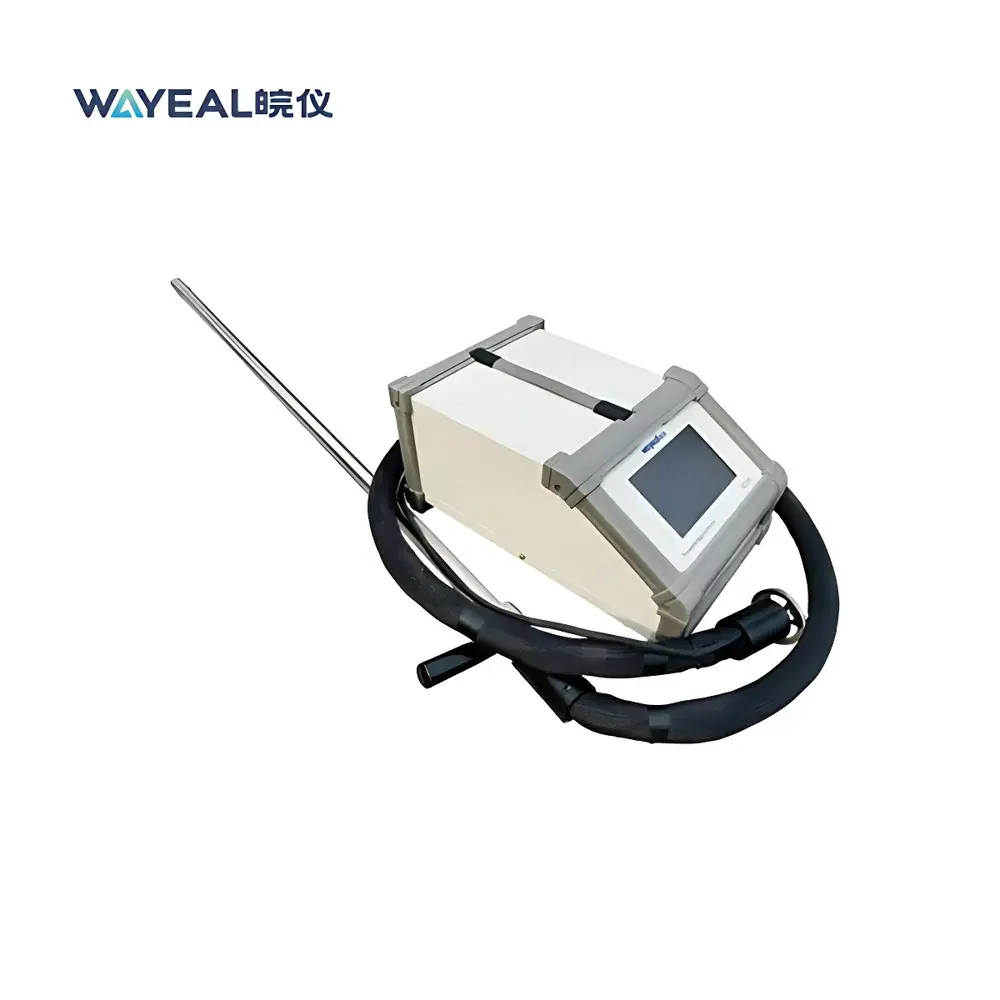
WAYEAL SG1500 Portable High-Temperature UV-Differential Optical Absorption Spectroscopy (UV-DOAS) Flue Gas Analyzer
| Brand | WAYEAL |
|---|---|
| Origin | Anhui, China |
| Manufacturer Type | Original Equipment Manufacturer (OEM) |
| Product Category | Domestic |
| Model | SG1500 |
| Instrument Type | Portable Flue Gas Analyzer |
| Measurement Accuracy | ±2% FS |
| Repeatability | ≤2% FS |
| Response Time | ≤90 s |
| Baseline Stability | ±2% FS over 24 h |
| Measured Gases | SO₂, NO, O₂, NOₓ, NH₃ |
| Optional Extension | CO₂ |
| Operating Temperature Range (Sampling Path) | Up to 180 °C |
| Display | 7″ Color TFT Touchscreen |
| Data Output | USB Export (1-min & 5-min Averaged Reports), Optional Thermal Printer Support |
| Compliance Features | Built-in Humidity Sensor (wet-to-dry basis conversion), Automatic Leak Check, Flow & Pressure Compensation, Dual-Range Selection for SO₂/NOₓ, Real-time Trend Plotting, GLP-Compliant Audit Trail Logging |
Overview
The WAYEAL SG1500 is a field-deployable, high-temperature ultraviolet differential optical absorption spectroscopy (UV-DOAS) flue gas analyzer engineered for regulatory-grade monitoring of key combustion pollutants under challenging stack conditions. Unlike conventional extractive systems relying on chilled sample conditioning — which risk SO₂ dissolution, NH₃ adsorption, and condensate-induced bias — the SG1500 implements a fully heated sampling train from probe tip to optical cell (up to 180 °C), preserving molecular integrity across the entire measurement path. Its core optical architecture integrates a custom-designed high-reflectivity multipass gas cell with a compact UV spectrometer (190–360 nm range), enabling simultaneous quantification of SO₂, NO, NO₂, NH₃, O₂, and optionally CO₂ via spectral deconvolution of overlapping absorption features. The system complies with fundamental principles outlined in EPA Method 205, ISO 12039, and EN 15267-3 for UV-based gas analysis, and supports wet-basis measurement with real-time humidity-corrected dry-basis reporting per China’s HJ 75–2017 and EU’s EN 14181.
Key Features
- Integrated high-temperature sampling: Probe, heated line, and reflective multipass cell all maintained at 180 °C — eliminating condensation, minimizing SO₂ loss, and preventing NH₃ wall adsorption.
- UV-DOAS detection engine: Resolves spectral interference from H₂O, CO, CO₂, and hydrocarbons using least-squares fitting of reference cross-sections; no chemical scrubbers or catalytic converters required.
- Onboard humidity sensing: Capacitive RH sensor enables automatic wet-to-dry conversion per ISO 14710 and HJ 75–2017, ensuring compliance during CEMS performance audits.
- Dual-range capability: Independent low- and high-range optical paths for SO₂ (0–100 mg/m³ / 0–500 mg/m³) and NOₓ (0–100 mg/m³ / 0–1000 mg/m³), optimized for both ultra-low emission (ULE) and peak-load scenarios.
- Self-validation functions: Automated leak integrity test (pressure decay method), real-time flow stabilization via PID-controlled vacuum pump, and barometric pressure compensation for non-standard stack pressures.
- Regulatory-ready data handling: Timestamped measurements with audit trail, configurable averaging intervals (1-min/5-min), trend visualization, and exportable CSV reports via USB storage — aligned with GLP documentation requirements.
Sample Compatibility & Compliance
The SG1500 is validated for continuous operation in flue gases containing up to 20% v/v water vapor, CO concentrations exceeding 10,000 ppm, and NH₃ levels up to 100 ppm — conditions commonly encountered in SCR/SNCR-equipped coal-fired boilers, waste incinerators, and cement kilns. Its heated design meets the physical sampling criteria specified in US EPA Performance Specification 2 (PS-2) for SO₂ and NOₓ analyzers. All firmware and calibration protocols adhere to ISO/IEC 17025 traceability requirements, with factory calibration certificates traceable to NIM (National Institute of Metrology, China). The device satisfies functional requirements for QA/QC under China’s “Technical Specifications for Continuous Emission Monitoring Systems (CEMS) for Fixed Pollution Sources” (HJ 75–2017 and HJ 76–2017), including zero/span drift verification, linearity assessment, and response time validation.
Software & Data Management
The embedded Linux-based operating system hosts a dedicated analytical suite supporting real-time spectral acquisition, multi-component least-squares fitting, and dynamic baseline correction. All raw spectra and processed results are stored locally with immutable timestamps and operator ID tagging. Data export conforms to ASTM D6348-18 Annex A1 format for third-party integration. The touchscreen interface provides intuitive access to calibration logs, maintenance alerts (e.g., lamp intensity decay, filter clogging), and diagnostic codes compliant with MODBUS RTU protocol for SCADA interfacing. Audit trails record all configuration changes, calibration events, and manual overrides — satisfying FDA 21 CFR Part 11 electronic record requirements when deployed in GMP-aligned environmental monitoring contexts.
Applications
- Regulatory compliance monitoring at stationary sources: power plants, steel mills, glass furnaces, and municipal waste-to-energy facilities.
- Process optimization in flue gas desulfurization (FGD) and selective catalytic/non-catalytic reduction (SCR/SNCR) systems — particularly where NH₃ slip and SO₂ breakthrough must be quantified simultaneously.
- Stack testing and CEMS performance evaluation per HJ 75–2017, EN 15267-3, and ISO 12039 Annex B.
- Emergency response deployments: rapid assessment of accidental releases involving NOₓ, SO₂, or ammonia in industrial zones.
- Research-grade emission characterization: coupling with dilution tunnels or portable meteorological stations for source apportionment studies.
FAQ
Does the SG1500 require external cooling or drying units?
No. Its fully heated sampling architecture eliminates the need for chillers, permeation dryers, or Nafion membranes — reducing failure points and maintenance frequency.
How is humidity measured and applied to concentration calculations?
An integrated capacitive humidity sensor mounted upstream of the optical cell provides real-time %RH readings; the firmware applies ISO 14710-compliant stoichiometric correction to convert wet-basis concentrations to standardized dry-basis values at 6% O₂.
Can the instrument be used for carbon emissions reporting?
Yes — optional CO₂ detection module enables concurrent measurement of CO₂ alongside regulated pollutants, supporting Tier 2 and Tier 3 reporting under China’s National Carbon Market (NCM) guidelines and ISO 14064-3 verification protocols.
What calibration standards are supported?
Certified gas standards traceable to NIM or NIST, including SO₂/N₂, NO/N₂, NH₃/N₂, and O₂/N₂ blends; zero air generated internally via catalytic purification.
Is remote diagnostics or firmware update capability available?
Firmware updates are performed via USB drive; remote diagnostics are supported through optional RS-485 or Ethernet connectivity with secure SSH/TLS tunneling for authorized service personnel.







