
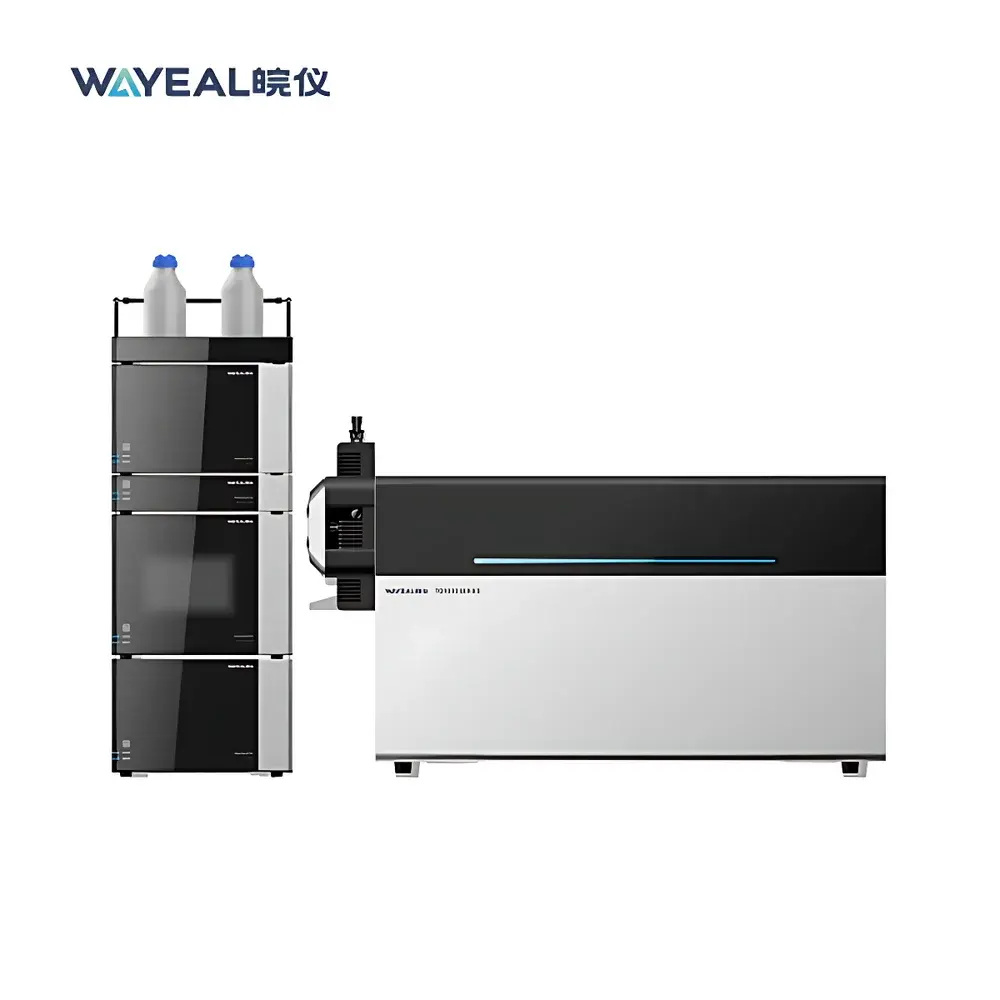
WAYEAL TQ9200 Series Triple Quadrupole Liquid Chromatography-Mass Spectrometry System
| Brand | WAYEAL |
|---|---|
| Origin | Anhui, China |
| Manufacturer Type | Original Equipment Manufacturer (OEM) |
| Country of Origin | China |
| Model | TQ9200 |
| Instrument Type | Triple Quadrupole (Tandem QqQ) Mass Spectrometer |
| Application Scope | Universal (Broad-Spectrum Quantitative & Qualitative Analysis) |
| LC Component | WAYEAL LC3600 Ultra-High-Performance Liquid Chromatograph |
| Ionization Source | Electrospray Ionization (ESI), Standard Configuration |
| Vacuum Interface | High-Durability Conical Interface with Active Desolvation |
| Detection Mode | Multiple Reaction Monitoring (MRM), Selected Reaction Monitoring (SRM), Full Scan, Product Ion Scan, Precursor Ion Scan, Neutral Loss Scan |
Overview
The WAYEAL TQ9200 Series Triple Quadrupole Liquid Chromatography-Mass Spectrometry (LC-MS/MS) System is a fully integrated, high-performance analytical platform engineered for precision quantitative and qualitative analysis in regulated and research-intensive environments. Built upon a modular architecture combining the WAYEAL LC3600 ultra-high-pressure liquid chromatograph and the TQ9200 triple quadrupole mass spectrometer, the system leverages fundamental principles of tandem mass spectrometry—specifically, mass selection in Q1, collision-induced dissociation (CID) in the RF-only hexapole collision cell (Q2), and secondary mass filtering in Q3—to deliver exceptional specificity, sensitivity, and reproducibility. The system operates under electrospray ionization (ESI), optimized via an actively heated probe and stable high-voltage supply, ensuring robust ion generation across diverse compound classes—including polar metabolites, peptides, small-molecule pharmaceuticals, environmental contaminants, and clinical biomarkers. Designed for routine operation in core laboratories, QC facilities, and contract research organizations (CROs), the TQ9200 meets the technical expectations of modern LC-MS/MS workflows requiring compliance-ready data integrity and long-term instrument stability.
Key Features
- Ultra-Stable Triple Quadrupole Architecture: Independently driven RF and DC voltages for Q1 and Q3 ensure high mass resolution, low chemical noise, and consistent MRM transition transmission over extended run times.
- Advanced LC Integration (LC3600): Equipped with dual-gradient ultra-high-pressure binary pumps (up to 1300 bar), low-dead-volume flow-through needle autosampler (<5 µL carryover), and an actively temperature-controlled column compartment (±0.1 °C stability) enabling retention time reproducibility <0.02 min RSD.
- Durable Ion Source & Vacuum Interface: ESI source features adjustable gas flows (sheath, auxiliary, sweep), programmable probe positioning, and active capillary heating (up to 550 °C); paired with a conical metal vacuum interface engineered for extended uptime and minimal maintenance between cleaning cycles.
- High-Efficiency Ion Optics: Multi-element lens stack with dynamic voltage tuning optimizes ion transmission efficiency across m/z 5–2000, supporting both positive and negative ion modes without hardware reconfiguration.
- Robust Vacuum System: Dual-stage turbomolecular pumping (70 L/s + 300 L/s) maintains base pressure <5 × 10⁻⁸ mbar in the analyzer region, critical for signal stability during high-throughput quantitation.
Sample Compatibility & Compliance
The TQ9200 supports direct injection and LC-coupled analysis of aqueous, organic, and mixed-solvent samples across a wide polarity range—from highly hydrophilic amino acids to lipophilic steroids and xenobiotics. It accommodates standard 2.1 mm and 3.0 mm ID columns, including sub-2 µm particle UHPLC media. Method development and validation align with ICH Q2(R2), USP , and ISO/IEC 17025 requirements. Data acquisition and processing comply with FDA 21 CFR Part 11 when deployed with validated software configurations, including electronic signatures, audit trail logging, and user access control. The system supports GLP/GMP-aligned workflows through configurable instrument method locking, result review workflows, and raw data immutability safeguards.
Software & Data Management
Controlled by WAYEAL MSNavigator™ v3.x, the system provides unified method building, real-time monitoring, and post-run processing. Key capabilities include automated MRM transition optimization, scheduled retention time alignment, peak integration with baseline correction algorithms, and batch report generation with customizable templates. Raw data are stored in vendor-neutral .d format (compatible with third-party tools such as Skyline, Compound Discoverer, and OpenMS). Audit trails record all parameter changes, sequence modifications, and user logins with timestamps and operator IDs. Data backups follow hierarchical retention policies, and optional networked deployment enables centralized instrument management across multi-site laboratory networks.
Applications
The TQ9200 is routinely deployed in applications demanding high selectivity and low detection limits: targeted quantitation of pesticide residues (EU MRL compliance), mycotoxins (AOAC 2012.01), and veterinary drug residues in food matrices; pharmacokinetic profiling of small-molecule drugs and metabolites (ICH M10); endogenous steroid hormone panels in clinical diagnostics; forensic toxicology screening (NPS, opioids, benzodiazepines); and environmental analysis of PFAS, pharmaceuticals, and microplastic degradation products in wastewater. Its universal design also supports method transfer from legacy platforms and facilitates cross-platform harmonization in multi-instrument labs.
FAQ
What regulatory standards does the TQ9200 support for GxP environments?
The system—when configured with MSNavigator™ v3.x in audit-trail-enabled mode—supports 21 CFR Part 11, EU Annex 11, and ISO/IEC 17025 documentation requirements, including electronic signatures, change control, and raw data preservation.
Can the TQ9200 be integrated with third-party chromatography data systems (CDS)?
Yes—via open API and .d file export, it interoperates with Thermo Chromeleon, Waters Empower, Agilent OpenLab CDS, and other major CDS platforms for centralized reporting and workflow orchestration.
Is method transfer from other triple quadrupole platforms feasible?
MRM transitions, collision energies, and LC gradient methods can be directly imported; retention time alignment and dwell time optimization may require minor empirical adjustment due to differences in dwell scheduling and detector response characteristics.
What maintenance intervals are recommended for the ion source and vacuum system?
Source cleaning is advised every 2–4 weeks under continuous operation; vacuum pump oil replacement and bearing inspection follow OEM-recommended schedules at 6-month or 2000-hour intervals, whichever occurs first.
Does the system support isotopic dilution assays (IDA) and internal standard calibration?
Yes—full support for stable isotope-labeled internal standards (SIL-IS), including co-elution verification, ratio-based quantitation, and automatic IS correction in batch processing.





