
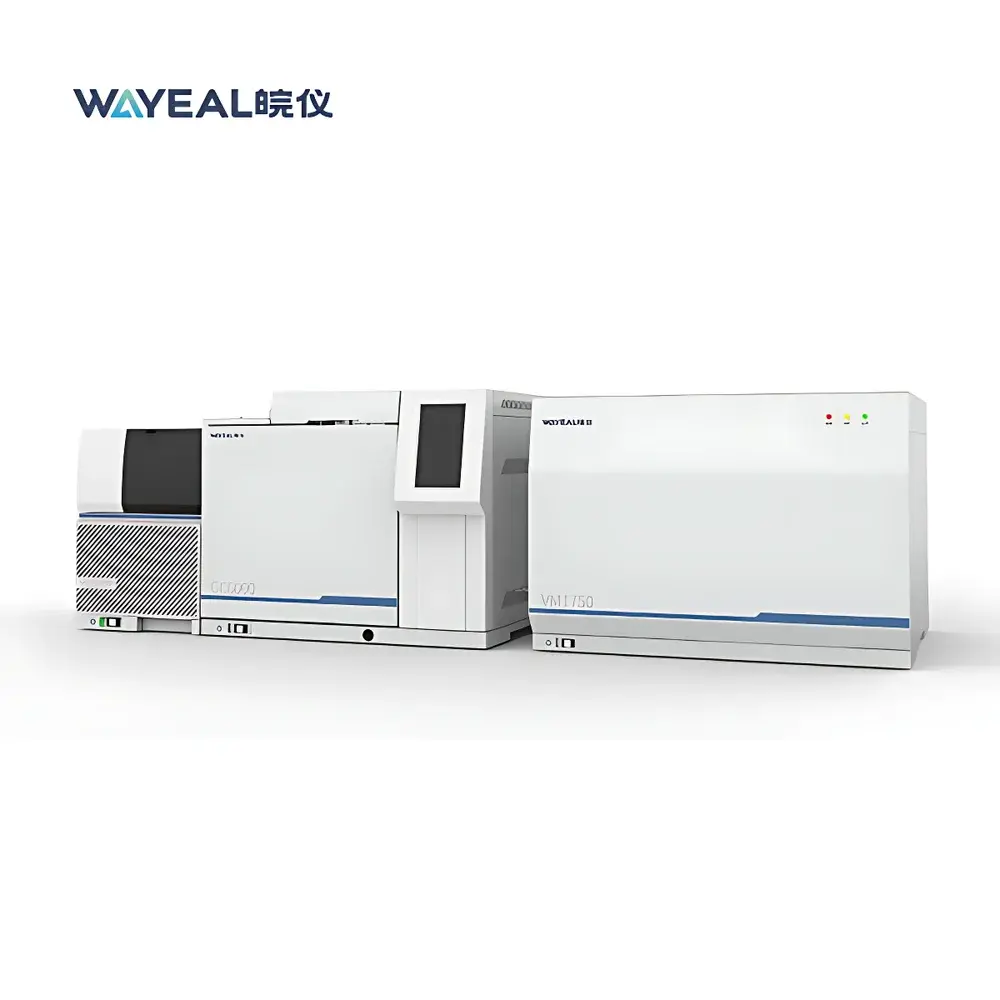
WAYEAL VM1750 Online Ambient Air Volatile Organic Compounds Monitoring System
| Brand | WAYEAL |
|---|---|
| Origin | Anhui, China |
| Manufacturer Type | Direct Manufacturer |
| Country of Origin | China |
| Model | VM1750 |
| Instrument Principle | Cryogenic Preconcentration Coupled with Gas Chromatography–Mass Spectrometry (GC-MS) |
| Configuration | Online Continuous Monitoring System |
| Response Time | ≤5 s (T90) |
| Target Analytes | 116 VOCs including PAMS, TO-14/TO-15 compounds, and C1–C10 aldehydes & ketones |
| Detection Capability | Sub-ppt (pg/m³) level quantification |
| Detector Configuration | Dual-channel detection via Flame Ionization Detector (FID) and Quadrupole Mass Spectrometer (MS) |
| Sample Introduction | Automated, unattended, real-time ambient air sampling |
| Surface Treatment | Fully passivated gas pathways (SilcoNert® or equivalent inert coating) |
| Compliance Readiness | Designed to support EPA Method TO-14A, TO-15, ASTM D5504, and ISO 16017-1 workflows |
Overview
The WAYEAL VM1750 Online Ambient Air Volatile Organic Compounds Monitoring System is an integrated, laboratory-grade continuous emissions monitoring solution engineered for unattended, real-time quantification of trace-level volatile organic compounds (VOCs) in ambient air. It operates on a validated two-stage analytical architecture: cryogenic electronic refrigeration-based preconcentration followed by high-resolution separation via capillary gas chromatography and selective detection using dual parallel detectors—flame ionization (FID) and electron ionization quadrupole mass spectrometry (EI-QMS). This hybrid detection strategy ensures simultaneous sensitivity across both non-specific hydrocarbon mass response (FID) and compound-specific identification/quantitation (MS), enabling robust speciation and compliance-grade reporting for regulatory and research applications. The system is designed for 24/7 operation in fixed-site environmental monitoring stations, fenceline monitoring networks, and industrial source characterization deployments.
Key Features
- Cryogenic preconcentrator with multi-stage cold trap design utilizing thermoelectric cooling (no liquid nitrogen or mechanical compressors), achieving >95% trapping efficiency for C2–C12 VOCs including reactive aldehydes and polar ketones.
- Dual-detector GC configuration: FID provides linear dynamic range up to 10⁷ and excellent repeatability for total hydrocarbon equivalence; QMS delivers unit-mass resolution, NIST library matching, and isotopic ratio capability for unambiguous compound identification.
- Ultra-low carryover gas pathway: All sample-contact surfaces—including valves, transfer lines, and trap housings—are chemically passivated using silanized metal or fused-silica coatings compliant with ASTM D6196 inert surface specifications.
- Rapid thermal desorption: Programmable flash-heating (≥300 °C/s ramp rate) enables sharp analyte band focusing and minimizes degradation of thermally labile species such as formaldehyde and acetaldehyde.
- Automated calibration integration: Supports external standard addition, internal standard spiking, and multi-point dynamic dilution calibration per EPA Compendium Method TO-15 Appendix B requirements.
- Embedded industrial PC with real-time data acquisition engine, capable of handling ≥128 concurrent channels and maintaining audit-trail logs compliant with 21 CFR Part 11 Annex 11 principles.
Sample Compatibility & Compliance
The VM1750 is validated for direct analysis of ambient air (0.1–10 L/min flow), stack effluent (diluted or conditioned), and indoor air matrices. It quantitatively measures all 57 PAMS compounds, the full 65-species TO-15 target list, and additional oxygenated VOCs including formaldehyde, acetaldehyde, acetone, and methyl ethyl ketone. Method performance meets or exceeds EPA Method TO-14A (purge-and-trap alternative), TO-15 (canister-based reference), and ASTM D5504 (natural gas VOCs) precision and recovery criteria. System design supports GLP/GMP-aligned operational documentation, including electronic signature-enabled method validation records, instrument qualification (IQ/OQ/PQ) templates, and raw data archiving in vendor-neutral formats (e.g., netCDF, mzML).
Software & Data Management
The proprietary VM-Suite software provides browser-accessible control, real-time chromatogram visualization, automated peak integration using retention time locking (RTL), and customizable reporting modules aligned with national air quality reporting frameworks (e.g., China’s HJ 1010–2018, US EPA AIRS, EU E-PRTR). All raw spectral and chromatographic data are stored with immutable timestamps, user-action metadata, and version-controlled processing methods. Audit trail functionality logs every parameter change, calibration event, and report generation—fully traceable for regulatory inspection. Data export supports CSV, XML, and direct API integration with third-party environmental information systems (EIS) and SCADA platforms.
Applications
- Fenceline monitoring at petrochemical refineries, chemical manufacturing plants, and bulk terminal facilities per EPA OTM-40 and EU IED Annex IV requirements.
- Urban and regional air quality networks measuring photochemical precursor VOCs to support ozone modeling and source apportionment studies (e.g., PMF, CMB).
- Indoor air quality assessment in laboratories, cleanrooms, and occupational health settings where low-level solvent exposure must be verified.
- Method development and validation support for emerging standards targeting halogenated VOCs, biogenic emissions (isoprene, monoterpenes), and emerging contaminants (e.g., fluorinated ethers).
- Research applications in atmospheric chemistry, emission factor derivation, and VOC reactivity ranking (MIR, POCP).
FAQ
Does the VM1750 require liquid nitrogen or compressed air for operation?
No—the system uses solid-state thermoelectric coolers for preconcentration and does not rely on consumable cryogens or auxiliary gas supplies beyond standard helium or hydrogen carrier gas.
Can the system be configured for unattended operation over extended periods (e.g., 30 days)?
Yes—field-deployed units routinely operate continuously for ≥30 days with scheduled automatic calibration, trap regeneration, and remote health monitoring via integrated SNMP and Modbus TCP interfaces.
Is the software compatible with existing environmental data management platforms?
Yes—VM-Suite supports standardized data exchange protocols including OGC SensorThings API, MQTT, and FTP/SFTP push to central databases; custom middleware integration is available under NDA.
What maintenance intervals are recommended for routine field operation?
Preventive maintenance is scheduled every 90 days, including trap conditioning, detector tuning verification, leak integrity testing, and firmware update validation—all documented in the built-in maintenance log module.
How is method traceability ensured during regulatory audits?
Each analysis run stores full acquisition parameters, calibration history, raw spectra, and processed results in a tamper-evident archive; all user actions are logged with digital signatures and UTC timestamps meeting FDA 21 CFR Part 11 and ISO/IEC 17025 requirements.
Related Products







