
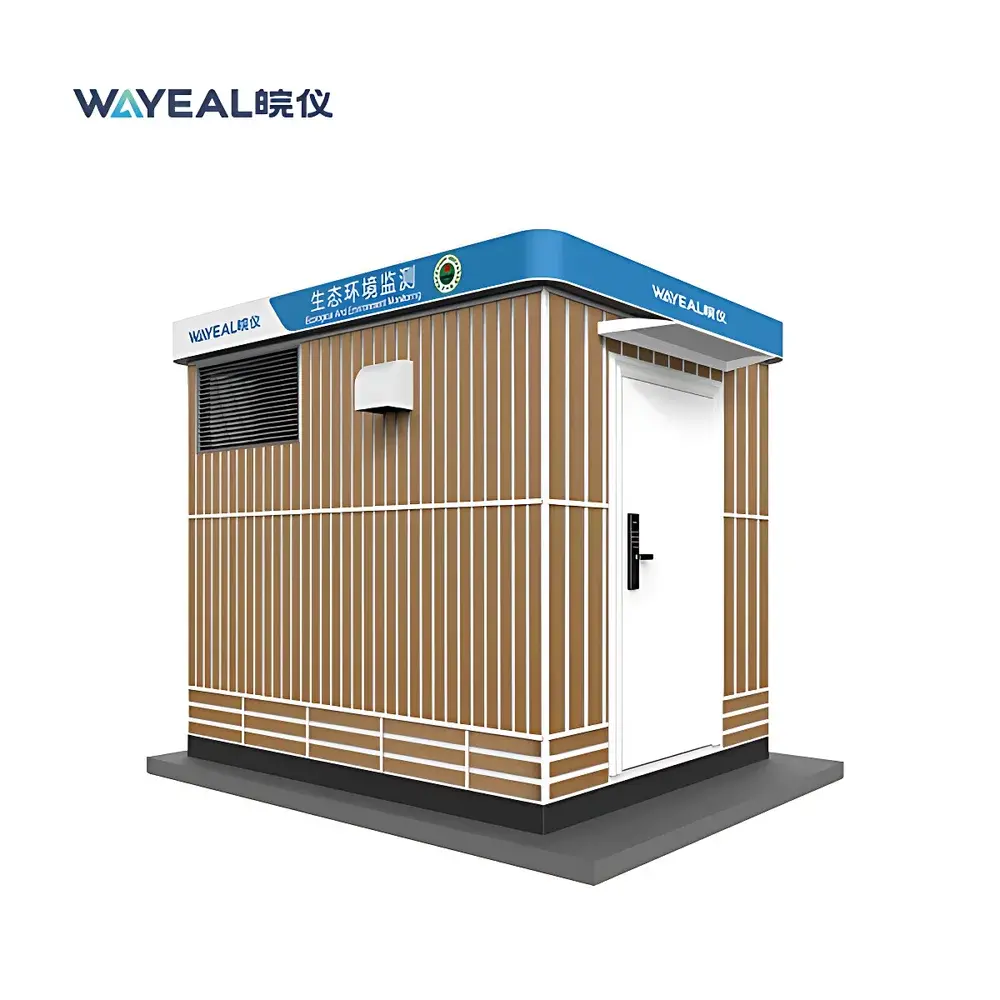
WAYEAL WMS1800x Outdoor Compact Online Water Quality Monitoring System
| Brand | WAYEAL |
|---|---|
| Origin | Anhui, China |
| Manufacturer Type | Original Equipment Manufacturer (OEM) |
| Country of Origin | China |
| Model | WMS1800x |
| Pricing | Available upon Request |
Overview
The WAYEAL WMS1800x Outdoor Compact Online Water Quality Monitoring System is an integrated, self-contained environmental monitoring platform engineered for continuous, unattended operation in exposed outdoor environments. Designed around standardized analytical methodologies compliant with Chinese National Standards (e.g., GB 3838–2002, HJ/T 96–2003), the system employs multi-sensor fusion architecture to perform real-time measurement of core water quality parameters—including pH, conductivity, dissolved oxygen (DO), turbidity, chemical oxygen demand (CODmn or CODcr via on-board digestion), ammonia nitrogen (NH3-N), total phosphorus (TP), total nitrogen (TN), and temperature—within a footprint of only 6–10 m². Its modular architecture supports field-deployable expansion for supplementary optical sensors (e.g., chlorophyll-a fluorescence, phycocyanin for cyanobacteria quantification) and electrochemical probes. The system operates on the principle of sequential automated wet-chemistry analysis combined with optical absorption, potentiometric, and amperometric detection, ensuring traceable metrology aligned with regulatory data quality objectives for environmental surveillance.
Key Features
- Compact all-in-one enclosure with weatherproof IP65-rated housing, corrosion-resistant stainless-steel frame, and climate-adaptive thermal management
- Dual-layer surge protection (Type I+II+III) and integrated uninterruptible power supply (UPS) supporting ≥4-hour backup during grid failure
- Dedicated reagent refrigeration unit maintaining 4–8 °C stability for long-term reagent integrity and reaction reproducibility
- Automated maintenance routines: ultrasonic probe cleaning cycles and compressed-air backflushing for flow cells and optical windows
- Comprehensive internal quality control: zero-sample verification, standard solution calibration checks, automatic span verification, and programmable spike recovery tests per EPA Method 1600 series principles
- Embedded environmental condition monitoring: ambient temperature/humidity, door status, water ingress detection, smoke sensing, and tamper alerts with SNMP/Modbus TCP event logging
- Pre-certified compatibility with national water monitoring data platforms (e.g., China’s National Surface Water Monitoring Information System)
Sample Compatibility & Compliance
The WMS1800x accepts raw surface water, effluent discharge samples, and drinking water source influents without pre-filtration (with optional 100 µm inline sieve). It complies with GB/T 32205–2015 (Technical Specifications for Online Monitoring Equipment of Surface Water Quality) and meets functional requirements outlined in HJ 353–2019 (Specifications for Installation and Acceptance of Online Monitoring Systems for Pollutant Sources). While not certified to ISO/IEC 17025 for accredited testing, its measurement protocols align with ISO 5667-3 (water sampling) and ISO 7027 (turbidity), and its data structure supports export in formats compatible with ISO 13843-compliant LIMS integration. All wet-chemistry modules utilize reagents traceable to national reference materials (CRM) issued by the National Institute of Metrology (NIM), China.
Software & Data Management
The embedded Linux-based controller runs WAYEAL’s proprietary WQ-OS v3.2 firmware, supporting dual-mode communication: 4G LTE Cat.4 (with fallback to NB-IoT) and Ethernet (10/100BASE-TX). Data acquisition intervals are configurable from 15 minutes to 24 hours; all measurements include timestamp, sensor ID, QC flag, and diagnostic metadata. Raw and processed data are stored locally (≥6 months at 15-min resolution) and transmitted via HTTPS/FTP/SFTP to central servers. Audit trails record all configuration changes, calibration events, and maintenance logs with immutable timestamps—supporting GLP-aligned operational transparency. Remote firmware updates and parameter reconfiguration are authenticated via TLS 1.2 with certificate pinning.
Applications
- Real-time surveillance of riverine and lacustrine ecosystems under China’s “River Chief System” and “Lake Chief System” policy frameworks
- Early-warning monitoring at industrial park discharge outlets, municipal wastewater treatment plant effluents, and stormwater outfalls
- Grid-based water quality mapping for urban water networks and distributed source tracking in watershed management
- Drinking water source protection zones (e.g., reservoir intakes, groundwater wells) requiring compliance with GB 5749–2022
- Estuarine and coastal zone monitoring where salinity-tolerant sensor configurations and anti-fouling protocols are critical
- Temporary deployment for construction site runoff monitoring or post-disaster water safety assessment
FAQ
Does the WMS1800x support remote diagnostics and over-the-air firmware updates?
Yes—diagnostic reports, sensor health metrics, and system logs are accessible via secure web interface or API; firmware updates are delivered encrypted and validated with SHA-256 signature verification.
Can the system operate reliably in sub-zero winter conditions?
The enclosure includes heated sample lines and insulated reagent compartment; operational range is specified from −20 °C to +50 °C with optional antifreeze-compatible fluid handling kits.
Is data from the WMS1800x accepted by provincial environmental monitoring centers in China?
Yes—its data format, transmission protocol (HJ 212–2017), and QA/QC reporting structure conform to the technical specifications mandated by the Ministry of Ecology and Environment (MEE) for provincial-level data ingestion.
How frequently does the system require manual maintenance?
Under typical deployment conditions, scheduled maintenance (reagent replacement, filter cleaning, electrode polishing) is recommended every 30 days; automated self-diagnostics reduce unscheduled service visits by >70% compared to legacy systems.
What cybersecurity measures are implemented to protect data integrity?
The system enforces role-based access control (RBAC), TLS 1.2+ encryption for all communications, disabled default credentials, and periodic security patching aligned with NIST SP 800-53 Rev. 5 controls for industrial IoT devices.
Related Products







