
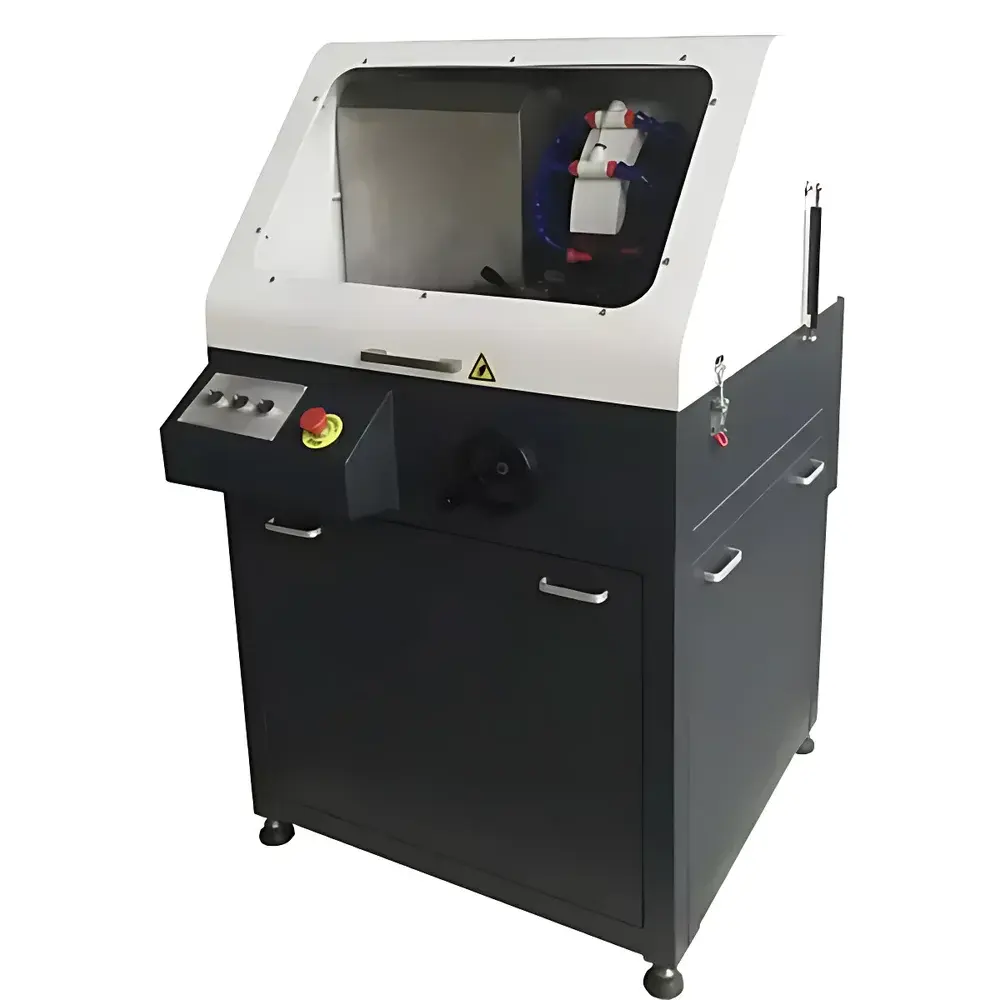
WEIYEE Q-100ZL Automatic Metallographic Cutting Machine
| Brand | WEIYEE |
|---|---|
| Origin | Guangdong, China |
| Model | Q-100ZL |
| Cutting Wheel Dimensions | Φ350 × 32 × 2.5 mm |
| Maximum Specimen Diameter | Φ100 mm |
| X-Axis Travel | 50 mm |
| Z-Axis Travel | 100 mm |
| Control Interface | Color Touchscreen |
| Cooling System | 60 L Closed-Circuit Recirculating Water Tank |
| Power Supply | 380 V AC, 3 kW |
| Operation Modes | Manual and Automatic |
| Equipment Type | Metallographic Cutting Machine |
Overview
The WEIYEE Q-100ZL Automatic Metallographic Cutting Machine is a vertically oriented, floor-standing precision sample preparation system engineered for reproducible cross-sectional sectioning of metallic, ceramic, and composite specimens prior to metallographic analysis. It operates on the principle of controlled abrasive cutting under continuous coolant delivery, utilizing high-rigidity linear motion axes (X and Z) to ensure consistent feed rate, blade engagement depth, and positional repeatability. Designed for integration into accredited metallurgical laboratories, quality control facilities, and R&D centers, the Q-100ZL supports standardized specimen preparation workflows aligned with ASTM E3, ISO 14487, and EN 10365 requirements for microstructural evaluation. Its closed-loop water recirculation system minimizes environmental exposure and operator risk while maintaining thermal stability during prolonged cutting cycles.
Key Features
- Vertical floor-standing architecture with reinforced cast-iron base and vibration-dampening feet for enhanced mechanical stability during high-torque cutting operations.
- Dual-mode operation—manual mode for rapid positioning and setup; automatic mode with programmable feed parameters (approach speed, cutting speed, dwell time, and retract sequence) for unattended batch processing.
- Precision linear motion system: 50 mm X-axis travel enables lateral specimen adjustment for optimal blade alignment; 100 mm Z-axis stroke accommodates tall or multi-layered samples and ensures full immersion of the cutting interface in coolant flow.
- Integrated 60 L closed-circuit cooling system with temperature monitoring, filtration, and anti-corrosion treatment—designed to sustain coolant integrity over extended use and comply with OSHA-compliant fluid management practices.
- Industrial-grade color touchscreen HMI with intuitive icon-driven navigation, real-time status feedback (motor load, coolant level, cycle progress), and password-protected parameter storage for up to 20 user-defined protocols.
- Standardized Φ350 × 32 × 2.5 mm cutting wheel mounting (ISO 4017 thread) compatible with common resin-bonded aluminum oxide and silicon carbide blades used in metallography.
Sample Compatibility & Compliance
The Q-100ZL accommodates a broad range of conductive and non-conductive materials, including ferrous and non-ferrous alloys, sintered powders, weld joints, coated substrates, and brittle ceramics. Specimens up to Φ100 mm in diameter and ≤100 mm in height can be secured using the adjustable vise with T-slot base and auxiliary clamping fixtures (optional). The machine conforms to IEC 61000-6-2 (immunity) and IEC 61000-6-4 (emission) electromagnetic compatibility standards. Its fully enclosed cutting chamber meets EN 60204-1 safety requirements for mechanical equipment, incorporating interlocked access doors, emergency stop circuitry, and splash-resistant IP54-rated electrical enclosures. Routine maintenance logs and calibration records support GLP/GMP documentation frameworks.
Software & Data Management
While the Q-100ZL operates via embedded firmware without external PC dependency, its touchscreen interface supports audit-trail-capable protocol logging—including date/time stamp, operator ID (via numeric login), selected program number, actual cutting duration, and coolant temperature deviation alerts. All operational data are stored internally for ≥12 months and exportable via USB flash drive in CSV format. The system architecture allows for future firmware updates to expand protocol libraries and integrate with laboratory information management systems (LIMS) through optional RS-232 or Ethernet modules—facilitating alignment with FDA 21 CFR Part 11 requirements where electronic record integrity is mandated.
Applications
- Preparation of transverse and longitudinal sections from rolled, forged, or cast components for grain structure assessment per ASTM E112.
- Cutting of heat-affected zones (HAZ) in welded assemblies to evaluate fusion line integrity and microcrack propagation.
- Sectioning of additive-manufactured parts to expose layer boundaries and porosity distribution for SEM/EDS analysis.
- Routine QC sampling in foundries and forging plants where dimensional consistency and internal defect screening are critical.
- Academic research involving multi-material interfaces, thermal barrier coatings, and metal-matrix composites requiring minimal deformation-induced artifacts.
FAQ
What types of cutting wheels are compatible with the Q-100ZL?
The machine accepts standard Φ350 mm abrasive wheels with 32 mm arbor hole and 2.5 mm thickness, conforming to ISO 6344 and EN 12413 specifications for bonded abrasives.
Is the coolant system compatible with water-soluble metalworking fluids?
Yes—the 60 L tank and pump assembly are constructed from corrosion-resistant polypropylene and stainless steel, supporting pH-stable semi-synthetic and synthetic coolants approved for metallographic use.
Can the Q-100ZL be integrated into an automated lab workflow?
It supports sequential operation via external dry-contact triggers and offers optional digital I/O expansion for synchronization with downstream grinding/polishing stations or robotic sample handlers.
Does the unit include safety certification documentation?
CE Declaration of Conformity, RoHS compliance statement, and full electrical safety test reports are provided with each shipment.
What is the recommended maintenance interval for the recirculating pump and filter?
Pump oil inspection every 500 operating hours; filter replacement every 1,000 hours or quarterly—whichever occurs first—under typical laboratory usage conditions.



