
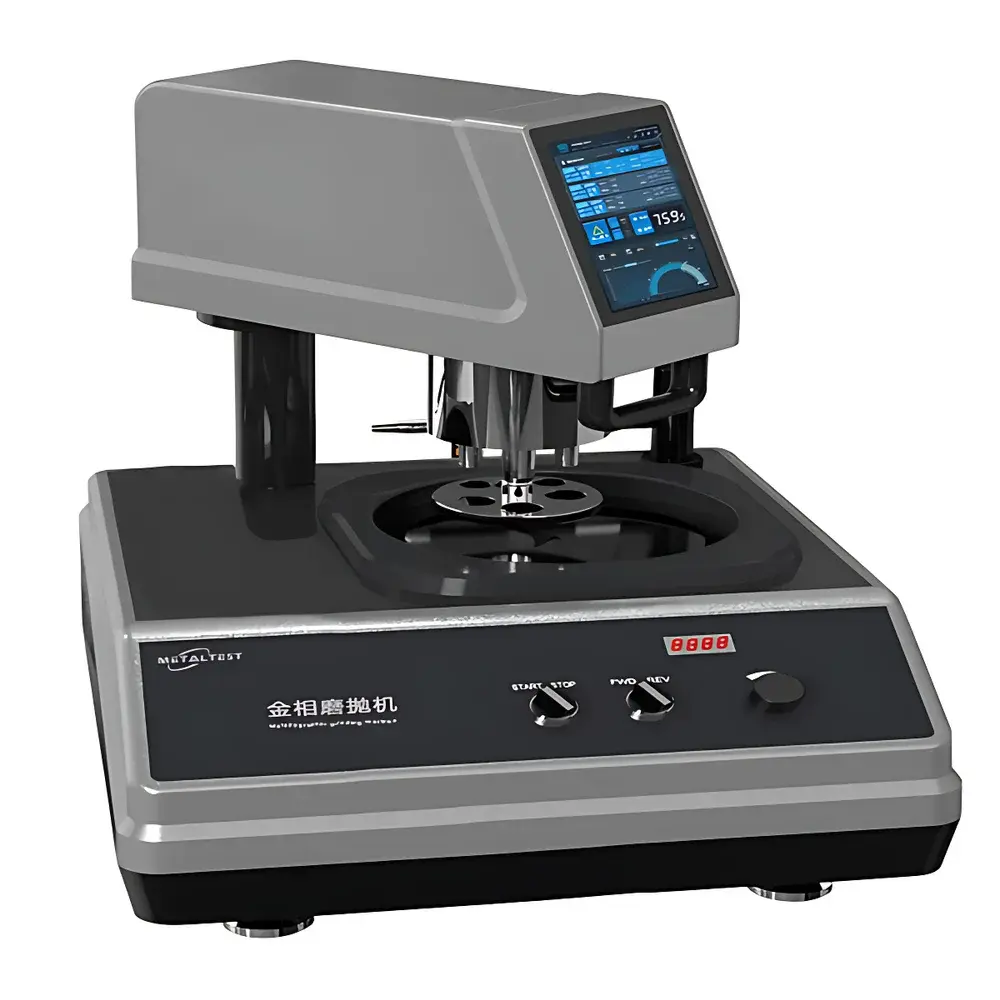
WEIYEE MP-1DA Single-Plate Intelligent Automatic Grinding and Polishing System
| Brand | WEIYEE |
|---|---|
| Origin | Guangdong, China |
| Model | MP-1DA |
| Platen Diameter | 200 mm (8") |
| Number of Platens | 1 |
| Speed Range (Platen) | 50–1500 rpm (infinitely variable) + 6 preset speeds (250/500/750/1000/1250/1500 rpm) |
| Platen Rotation | Forward/reverse selectable |
| Pressure Control | Pneumatic single-point loading with adjustable pressure |
| Head Rotation Speed | 20–120 rpm (infinitely variable) |
| Sample Capacity | Up to 8 specimens simultaneously |
| Control Interface | 7-inch high-resolution touchscreen |
| Drive System | Servo motor-driven vertical head lift |
| Startup Profile | Programmable soft-start curve |
| Liquid Dispensing | Dual-channel integrated reagent dispensing bottles |
| Power Supply | 220 V AC |
Overview
The WEIYEE MP-1DA Single-Plate Intelligent Grinding and Polishing System is an engineered solution for precision metallographic and materials sample preparation in research laboratories, quality control facilities, and industrial R&D environments. Designed around a robust single-platen architecture, the system employs Couette-flow-based abrasive action between rotating specimen holders and a motor-driven 200 mm (8″) grinding/polishing disc to achieve consistent surface planarity, edge retention, and subsurface damage minimization. Its core functionality integrates servo-controlled vertical head actuation, programmable rotational profiles, and pneumatic load regulation—enabling reproducible material removal rates across diverse sample geometries and hardness ranges (e.g., ferrous alloys, non-ferrous metals, ceramics, and composites). Unlike legacy mechanical systems, the MP-1DA implements closed-loop speed regulation on both platen and specimen head axes, ensuring stable shear stress application during coarse grinding, fine grinding, and final polishing stages. This architecture supports standardized workflows compliant with ASTM E3, ISO 14489, and GB/T 13298—making it suitable for accredited metallurgical labs requiring traceable, auditable preparation protocols.
Key Features
- Triple-mode operation: fully automatic, semi-automatic, and manual modes for maximum procedural flexibility and operator intervention control.
- 7-inch capacitive touchscreen HMI with intuitive icon-based navigation, real-time parameter visualization, and multi-language support (English, Chinese, Spanish).
- Servo-motor-driven vertical head lift mechanism enabling precise, repeatable specimen-to-platen contact force application with sub-millimeter positioning resolution.
- Pneumatic single-point loading system with digital pressure calibration; adjustable range from 5 N to 200 N (typical), supporting ISO-compliant load distribution per specimen.
- Dual independent liquid dispensing channels with programmable flow timing and volume control—compatible with water, lubricants, diamond suspensions, and colloidal silica slurries.
- Programmable soft-start curve function to minimize specimen slippage and abrasive particle displacement during initial engagement.
- Integrated safety interlocks including lid position sensing, emergency stop circuitry, and overload torque monitoring on both drive axes.
Sample Compatibility & Compliance
The MP-1DA accommodates up to eight standard 25–30 mm diameter mounted specimens or unmounted samples up to 50 mm × 50 mm in planar dimension. Its modular specimen holder design supports common thermosetting resins (epoxy, phenolic) and cold-mounting media. The system meets CE electromagnetic compatibility (EMC) Directive 2014/30/EU and Low Voltage Directive 2014/35/EU requirements. All operational parameters—including speed, pressure, time, and dispensing sequence—are timestamped and stored locally with optional export to CSV or PDF for GLP/GMP documentation. Audit trail functionality satisfies FDA 21 CFR Part 11 requirements when paired with validated networked data management software.
Software & Data Management
The embedded firmware supports user-defined method storage (up to 99 protocols), each containing up to six sequential steps with independent settings for platen speed, head speed, pressure, duration, and dispensing activation. Methods may be duplicated, edited, or password-protected. Data logging includes real-time RPM feedback, actual applied load (N), elapsed time per step, and dispensing event timestamps. Export options include USB flash drive transfer and Ethernet-connected remote retrieval via HTTP or FTP. Optional PC-based WEIYEE LabManager™ software enables centralized fleet monitoring, electronic signature capture, and integration with LIMS platforms through HL7 or RESTful API interfaces.
Applications
- Preparation of cross-sectional specimens for optical microscopy (OM) and scanning electron microscopy (SEM) analysis.
- Routine QC testing of weld integrity, heat-affected zone (HAZ) characterization, and coating thickness evaluation.
- Standardized grinding/polishing for hardness testing (Vickers, Rockwell) per ASTM E384 and ISO 6507.
- Research-scale development of novel alloy microstructures, additive manufacturing build plate analysis, and ceramic matrix composite interface studies.
- Failure analysis laboratories requiring strict adherence to ASTM E1558 and ISO 17873 preparation guidelines.
FAQ
What is the maximum specimen height accommodated by the MP-1DA?
The vertical travel range of the servo lift permits specimen heights up to 45 mm when using standard holders; custom fixtures extend this to 60 mm.
Can the MP-1DA be integrated into an automated sample prep line?
Yes—RS-232 and Modbus TCP interfaces enable external PLC coordination for upstream mounting stations and downstream cleaning/drying modules.
Is calibration documentation provided with the instrument?
A factory calibration certificate covering platen speed accuracy (±0.5% of setpoint), pressure transducer linearity (±1.0% FS), and timer stability (±0.1 s/hour) is included with shipment.
Does the system support ASTM E3-compliant timed grinding sequences?
Yes—method programming allows discrete time-limited steps with automatic transition, replicating standardized grinding durations specified in ASTM E3 Annex A1.
What maintenance intervals are recommended for pneumatic components?
Air filter elements should be inspected every 200 operating hours; pressure regulator diaphragms and solenoid valves are rated for 500,000 cycles and require replacement only upon functional verification failure.
Related Products



