
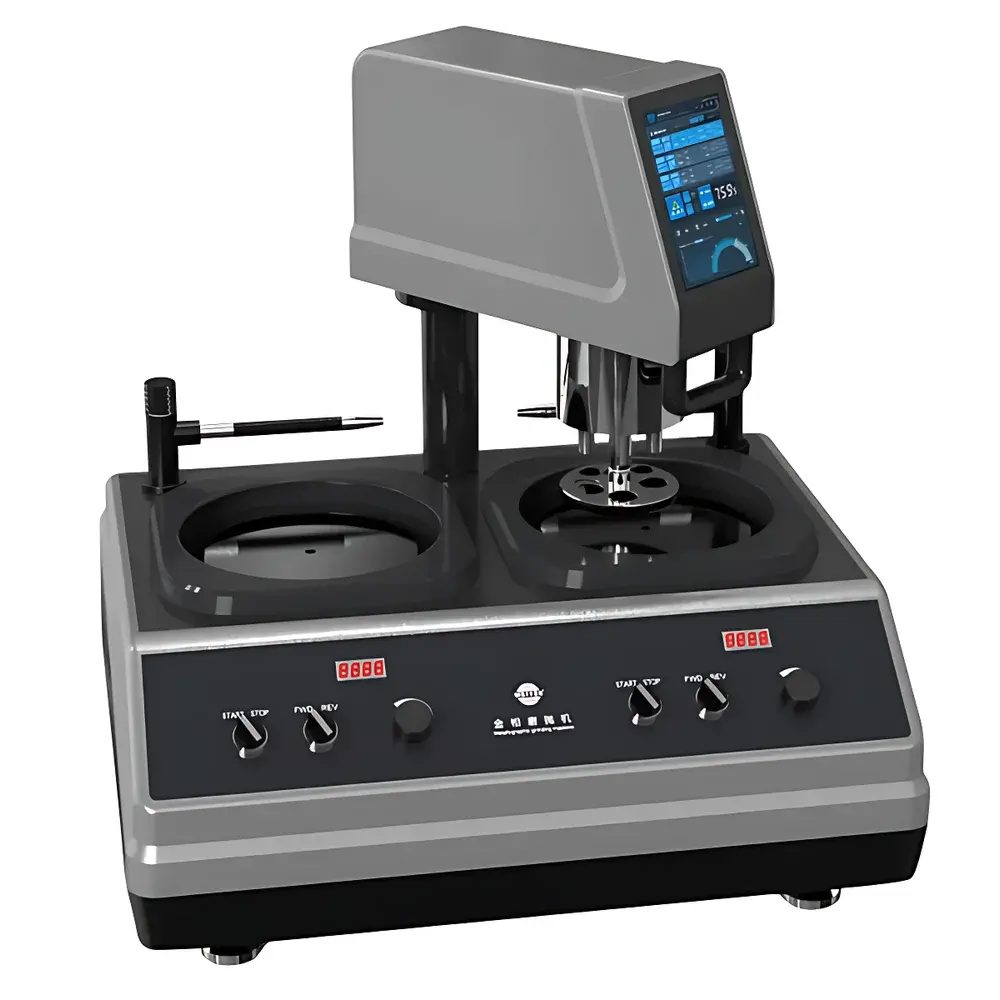
WEIYEE MP-2DA Dual-Plate Intelligent Automatic Grinding and Polishing System
| Brand | WEIYEE |
|---|---|
| Origin | Guangdong, China |
| Model | MP-2DA |
| Disc Diameter | 200 mm (8") |
| Number of Grinding/Polishing Plates | 2 |
| Rotational Speed Range (Plates) | 50–1500 rpm (infinitely variable + 6 preset speeds: 250/500/750/1000/1250/1500 rpm) |
| Plate Rotation Direction | Reversible (CW/CCW) |
| Pressure Control | Pneumatic single-point loading with adjustable pressure |
| Grinding/Polishing Head Speed | 20–120 rpm (infinitely variable) |
| Control Interface | 7-inch high-resolution capacitive touchscreen |
| Sample Capacity | Up to 6 specimens simultaneously |
| Liquid Delivery | Dual-channel intermittent dispensing system |
| Power Supply | 220 V AC, 50/60 Hz |
| Enclosure Material | Reinforced plastic-steel composite housing |
| Operating Modes | Fully automatic, semi-automatic, and manual |
Overview
The WEIYEE MP-2DA Dual-Plate Intelligent Automatic Grinding and Polishing System is an engineered solution for precision metallographic and materials science sample preparation. Designed around a dual-plate coaxial architecture, it enables simultaneous, independent operation of two 200 mm (8″) grinding/polishing stations—each with fully programmable rotational control, pneumatic load regulation, and synchronized head motion. The system employs classical abrasive material removal mechanics: controlled mechanical abrasion via rotating discs embedded with bonded or loose abrasives (e.g., SiC papers, diamond suspensions, alumina slurries), where material removal rate and surface finish are governed by applied load, rotational velocity, dwell time, and slurry delivery kinetics. Its PLC-based control core ensures repeatable process execution across batched specimen sets, supporting standardized workflows aligned with ASTM E3, ISO 14487, and EN 10365 requirements for microstructural analysis readiness.
Key Features
- Dual independent 200 mm grinding/polishing plates with full-speed decoupling—enabling concurrent coarse grinding on one station and fine polishing on the other
- Infinitely variable plate speed (50–1500 rpm) plus six factory-calibrated fixed speeds (250/500/750/1000/1250/1500 rpm) for method reproducibility
- Pneumatic single-point loading system with digital pressure adjustment (0–200 N range typical; calibrated per ISO 20489) ensuring uniform force distribution across specimen surface
- Motorized grinding/polishing head with 20–120 rpm infinitely variable rotation—optimized for orbital motion synchronization and edge-effect minimization
- 7-inch industrial-grade capacitive touchscreen interface with multi-language support (English, German, French, Chinese), real-time parameter monitoring, and touch-gesture navigation
- Integrated dual-channel intermittent liquid dispensing system—programmable by volume, interval, and duration per channel, compatible with water, ethanol, oil-based, and aqueous suspensions
- Reinforced plastic-steel enclosure compliant with IP54 ingress protection and CE/EMC Directive 2014/30/EU for laboratory electromagnetic environment stability
Sample Compatibility & Compliance
The MP-2DA accommodates standard metallographic mounts (30 mm, 40 mm, and 50 mm diameter hot-pressed resin mounts) as well as unmounted bulk samples up to 200 × 200 mm planar footprint. It supports both planar and cross-sectional preparation of ferrous/non-ferrous metals, ceramics, composites, geological specimens, and electronic packaging materials. All operational parameters—including speed, pressure, time, and dispensing cycles—are logged with timestamp and user ID in non-volatile memory, satisfying audit trail requirements under GLP and GMP frameworks. The system’s firmware architecture permits configuration lock-down and user role assignment (Operator, Technician, Administrator), aligning with FDA 21 CFR Part 11 principles for electronic records integrity.
Software & Data Management
The embedded PLC controller executes deterministic real-time motion sequencing with <10 ms cycle resolution. Process recipes—including multi-step protocols with conditional branching (e.g., “if surface roughness > 0.8 µm, extend Stage 2 by 60 s”)—are stored locally (≥500 recipes) and exportable via USB 2.0. No external PC dependency is required for routine operation; however, optional Ethernet connectivity (RJ45, TCP/IP) enables remote monitoring, centralized log aggregation, and integration into LIMS environments via Modbus TCP or OPC UA profiles. Audit logs include parameter changes, start/stop events, error codes, and calibration timestamps—retained for ≥12 months with auto-rollover.
Applications
- Routine metallographic specimen preparation for optical microscopy (OM) and scanning electron microscopy (SEM) analysis
- Quality control of weld joints, heat-affected zones (HAZ), and coating adhesion interfaces in aerospace and power generation components
- Failure analysis labs requiring rapid turnaround of fracture surfaces and fatigue crack propagation specimens
- Academic research in metallurgy, additive manufacturing post-processing, and ceramic sintering optimization
- ISO/IEC 17025-accredited testing laboratories performing accredited hardness, grain size, and inclusion rating assessments
FAQ
Is the MP-2DA compatible with third-party consumables (e.g., Struers, Buehler, or Allied High Tech polishing cloths and abrasives)?
Yes—the 200 mm plate geometry and standard M6 threaded mounting interface conform to ISO 8289-1:2016 dimensional specifications, enabling full interoperability with industry-standard consumables.
Can the system be validated for ISO 17025 compliance?
Yes—built-in parameter logging, user-access controls, and traceable calibration points support IQ/OQ/PQ documentation. A validation support package (including URS template, test scripts, and traceability matrix) is available upon request.
What maintenance intervals are recommended for pneumatic and drive components?
Pneumatic filter-lubricator units require quarterly inspection; main drive belts and bearing assemblies are rated for 10,000 operational hours with annual lubrication per manufacturer service bulletin SB-MP2DA-2023-04.
Does the system support automated endpoint detection (e.g., in-situ surface roughness sensing)?
No—endpoint determination remains operator- or protocol-defined. However, programmable dwell time, multi-stage logic, and consistent mechanical repeatability enable high inter-laboratory correlation per ASTM E112 and E1268.
Related Products



