
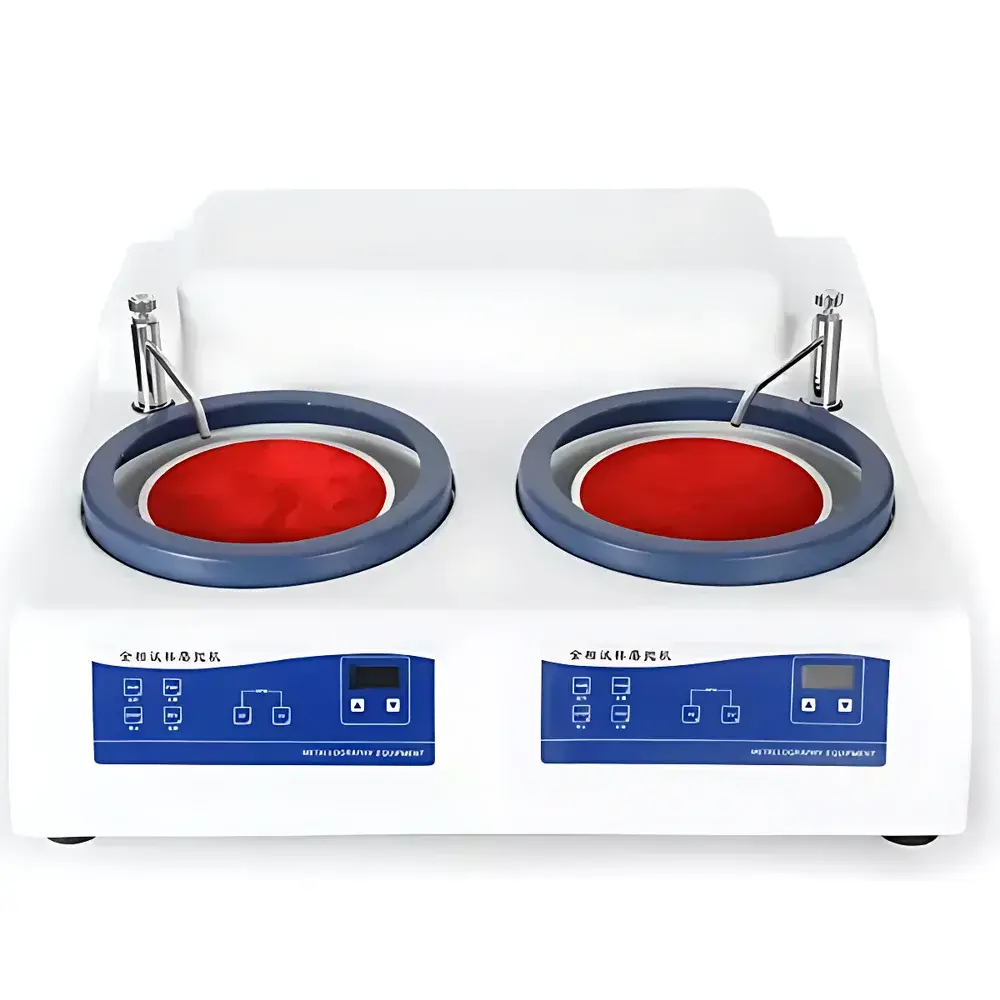
WEIYEE MP-2S Dual-Station Dual-Control Grinding and Polishing Machine
| Brand | WEIYEE |
|---|---|
| Origin | Guangdong, China |
| Model | MP-2S |
| Grinding Plate Diameter | 203 mm (8") |
| Number of Grinding/Polishing Plates | 2 |
| Speed Range | 50–1000 rpm (infinitely variable) + preset speeds at 250 / 500 / 750 / 1000 rpm |
| Rotation Direction | reversible (clockwise & counterclockwise) |
| Power Supply | 220 V AC |
Overview
The WEIYEE MP-2S Dual-Station Dual-Control Grinding and Polishing Machine is an engineered solution for precision sample preparation in metallurgical, geological, ceramic, and advanced materials laboratories. Designed around the principles of controlled mechanical abrasion and surface planarization, the MP-2S employs two independently operated grinding/polishing stations—each with fully decoupled speed control, direction reversal, and load-responsive torque delivery—to enable simultaneous yet distinct preparation protocols on two specimens. This architecture eliminates cross-contamination risk between samples and supports comparative analysis workflows, such as serial sectioning studies or multi-condition material response evaluation. The machine operates under standardized ASTM E3 and ISO 15510 methodologies for metallographic specimen preparation, ensuring reproducible surface finish quality from coarse grinding through final polishing stages.
Key Features
- Dual independent control system: Separate digital speed regulators and motor drivers for each 203 mm plate allow concurrent operation at different rotational speeds, directions, and dwell times.
- Infinitely variable speed range (50–1000 rpm) with four fixed-speed presets (250 / 500 / 750 / 1000 rpm) for rapid protocol recall and GLP-compliant repeatability.
- Reversible rotation capability per station enables optimized abrasive action—e.g., clockwise for diamond disc grinding and counterclockwise for soft cloth polishing—to minimize edge rounding and subsurface deformation.
- Robust cast-iron base and precision-machined aluminum housing ensure vibration damping and long-term dimensional stability during high-load grinding cycles.
- Integrated safety interlocks prevent operation when protective guards are disengaged; overload protection circuits automatically halt motors under excessive current draw.
Sample Compatibility & Compliance
The MP-2S accommodates standard metallographic mounts (up to 30 mm diameter), rock thin sections (26 × 46 mm and 27 × 46 mm), ceramic substrates, and composite wafers requiring flatness tolerances ≤ 0.5 µm over 10 mm. Its dual-plate configuration supports paired preparation of reference and test specimens under identical environmental conditions—critical for ASTM E407-compliant microstructural quantification. The unit complies with IEC 61000-6-2 (immunity) and IEC 61000-6-4 (emissions) electromagnetic compatibility standards, and its electrical design conforms to GB/T 13306-2011 (Chinese national standard for lab equipment labeling and safety). While not certified to UL or CE for export markets, its mechanical architecture and control logic align with ISO/IEC 17025 requirements for equipment qualification in accredited testing laboratories.
Software & Data Management
The MP-2S operates via embedded hardware controls without proprietary software dependency—ensuring operational continuity in regulated environments where software validation is impractical. All speed settings, direction states, and runtime durations are retained in non-volatile memory across power cycles, supporting audit-ready parameter traceability. For labs implementing electronic lab notebooks (ELN) or LIMS integration, optional RS-232 or USB-to-serial adapters permit timestamped logging of operational parameters (speed, direction, elapsed time) into validated data acquisition systems. No cloud connectivity or remote access functionality is included, preserving data sovereignty and simplifying 21 CFR Part 11 compliance pathways for GMP/QSR-regulated users.
Applications
- Preparation of cross-sectional specimens for SEM-EDS, EBSD, and TEM lamella extraction where parallelism and minimal deformation are essential.
- Routine metallography in QC labs processing ferrous/non-ferrous alloys, weld joints, and heat-treated components per ASTM E384 (microhardness) and ASTM E112 (grain size) standards.
- Geological thin-section production requiring consistent thickness control (±2 µm) across quartz, feldspar, and mica-rich samples.
- Research-scale polishing of battery electrode coatings, thermal barrier ceramics, and additively manufactured Ti-6Al-4V specimens prior to residual stress mapping.
- Calibration verification of automated polishing systems using MP-2S-prepared reference blocks with NIST-traceable surface roughness values (Ra < 0.02 µm).
FAQ
Can the MP-2S be used for both grinding and polishing in a single workflow?
Yes—the dual independent stations allow one plate to run coarse SiC grinding while the other performs fine alumina polishing, enabling seamless transition without manual reconfiguration.
Is the 203 mm plate compatible with standard consumables from global suppliers?
Yes—203 mm (8-inch) is an industry-standard diameter; all major abrasive disc, polishing cloth, and pad manufacturers offer products sized for this platform.
Does the machine support timed operation with automatic shutdown?
No—the MP-2S lacks programmable timers; timing must be managed externally via laboratory timers or integrated LIMS triggers.
What maintenance intervals are recommended for sustained performance?
Motor brushes should be inspected every 1,200 operating hours; grinding plate mounting flanges require torque verification quarterly; and bearing lubrication is specified at 2,000-hour intervals per the service manual.
Can the MP-2S be validated for ISO 17025 accreditation?
Yes—its mechanical repeatability, speed accuracy (±2% full scale), and directional consistency meet the equipment verification criteria outlined in ISO/IEC 17025:2017 Clause 6.4.6, provided documented calibration records and uncertainty budgets are maintained.



