
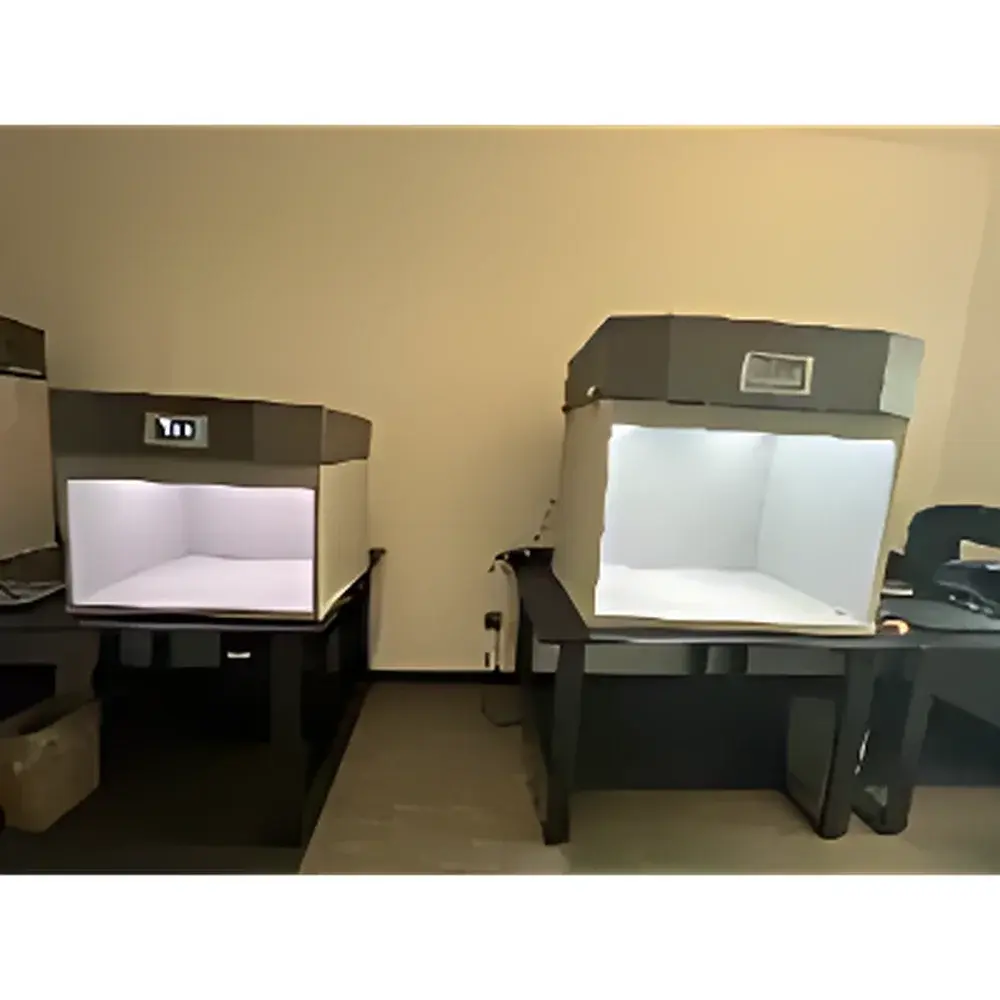
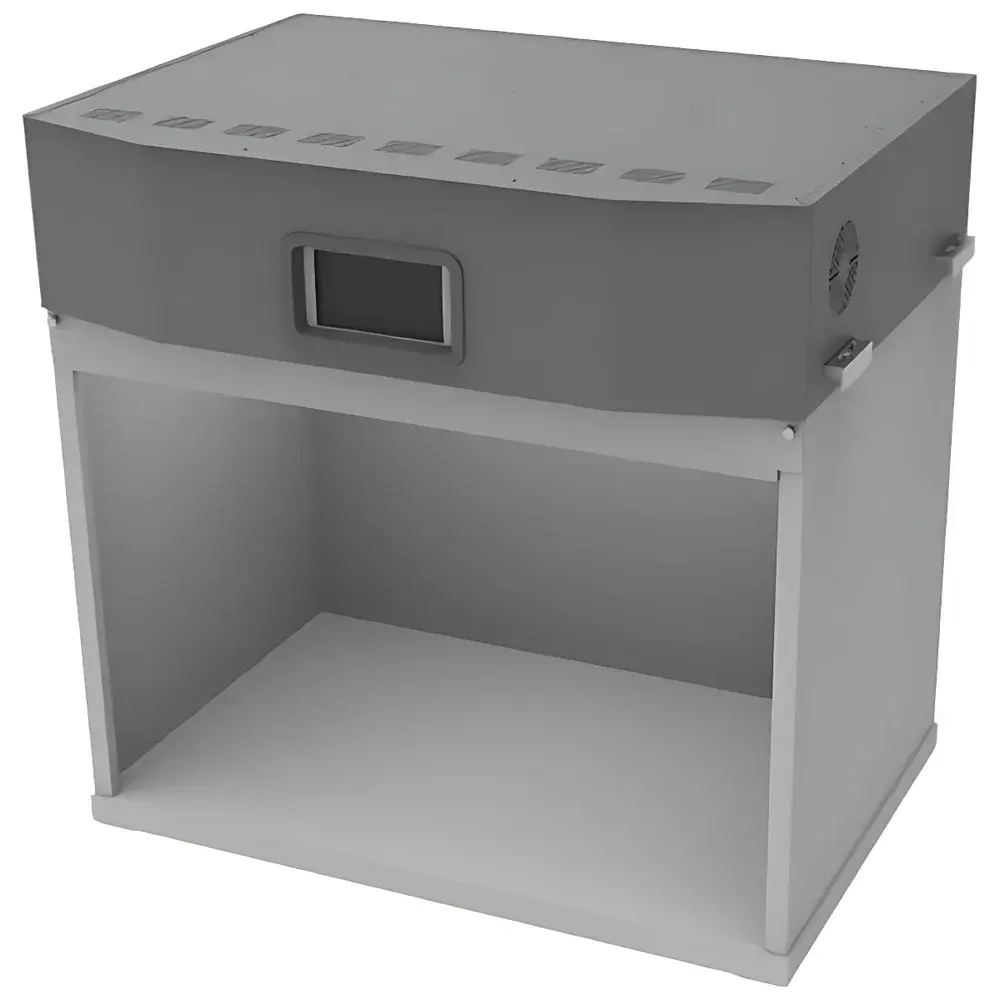
WeSpectra SpectraLED Multi-Channel LED Standard Light Source Cabinet
| Brand | WeSpectra |
|---|---|
| Origin | Shanghai, China |
| Model | SpectraLED |
| LED Channels | 14 |
| Spectral Range | 360–700 nm |
| CCT Tuning Range | 2000–20000 K (±1% accuracy) |
| CIE Ra | ~95 |
| SPD Reproducibility | CIE S 026 / IEC TR 62778 compliant |
| Flicker Frequency | 1–1000 Hz (1 Hz step) |
| Dimming Resolution | 12-bit per channel (4000 levels) |
| Illuminance Range | 0.1–2000 lx (D-series), Uniformity ≥80% |
| Preheat Time | 0 s |
| LED Lifetime | ≥8000 h |
| Storage | 7 hardware-stored presets |
| Dimensions (L×H×W) | 710×585×585 mm |
| Observation Chamber (L×H×W) | 660×430×530 mm |
| Color of Interior | Munsell N7 |
| Weight | ~20 kg |
| Power Input | 110–240 V AC, max. 180 W |
| Operating Temperature | 0–40 °C |
| Control Interface | Integrated capacitive touch panel |
| Software Compatibility | Konica Minolta CL-500A, JETI Specbos 2501 & 2501uv |
| Compliance | ISO 3664:2009, ISO 23603:2022, ASTM D1729-21 |
Overview
The WeSpectra SpectraLED Multi-Channel LED Standard Light Source Cabinet is an engineered optical reference platform designed for metrologically rigorous colorimetric and photobiological evaluation. Unlike conventional fluorescent or halogen-based light booths, the SpectraLED leverages independently addressable, spectrally optimized LED emitters—14 discrete channels spanning 360–700 nm—to synthesize user-defined spectral power distributions (SPDs) with high fidelity. Its operation is grounded in CIE-recommended principles for spectral irradiance control, enabling precise emulation of standardized illuminants (e.g., D50, D65, A, UV-A) as well as non-standardized spectra—including custom SPDs imported from measurement data or theoretical models. This capability supports applications requiring traceable, repeatable, and spectrally stable illumination across lighting R&D, display quality assurance, sensor calibration, and human visual performance studies. The system delivers immediate thermal and radiometric stability (<0.1% drift over 30 min), eliminating warm-up delays inherent to gas-discharge sources, and maintains long-term output consistency via closed-loop feedback integration with calibrated spectroradiometers.
Key Features
- Full-spectrum tunability: CCT adjustment from 2000 K to 20000 K with ±1% accuracy; correlated color rendering index (CIE Ra) up to ~95 under D65-equivalent synthesis.
- 12-bit per-channel amplitude modulation driving ensures flicker-free output (0% residual modulation at all intensities) and enables fine-grained luminance control across a 0.1–2000 lx range.
- Integrated directional lighting option supports gloss, sparkle, and granularity assessment per ISO 2813 and ASTM D523, without mechanical repositioning.
- Onboard touch interface stores and recalls up to 7 factory-preset or user-defined illuminants; optional software extends storage to unlimited SPD configurations.
- No lamp replacement required: Solid-state architecture delivers ≥8000 h L70 lifetime with minimal lumen depreciation; recalibration—not component swap—restores absolute photometric accuracy.
- Real-time feedback loop compatible with Konica Minolta CL-500A and JETI Specbos 2501/2501uv enables automated maintenance of target SPDs during extended operation.
- Comprehensive API (C/C++, Python, LabVIEW) allows seamless integration into automated test benches, vision inspection systems, or GLP-compliant validation workflows.
Sample Compatibility & Compliance
The SpectraLED cabinet accommodates standard-sized samples (up to 660×430 mm viewing area) within a Munsell N7 matte-black interior, minimizing stray reflections and ensuring uniform illumination geometry per ISO 3664:2009 requirements for graphic technology viewing conditions. Its spectral synthesis engine complies with CIE S 026/E:2018 for photobiological safety assessment and aligns with IEC TR 62778 for blue-light hazard evaluation. For color-critical industries—including textile, paint, automotive OEM, and medical device packaging—the system satisfies ISO 23603:2022 (color assessment in retail environments) and ASTM D1729-21 (visual evaluation of color differences). All preset illuminants are validated against NIST-traceable reference standards, and spectral deviation metrics (e.g., CIE Metamerism Index MI-B, GAI v2.0) are reportable via exported SPD files.
Software & Data Management
The bundled SpectraControl software provides intuitive GUI-based SPD configuration, real-time spectral visualization, and batch export of CIE XYZ, CIELAB, and spectral irradiance (µW/cm²/nm) datasets. It supports import of measured SPDs from third-party instruments (CSV, .spf, .jdx formats) and enables parametric sweeps—e.g., CCT ramping at fixed Duv or chromaticity trajectory tracking. Audit trails, user access logs, and electronic signatures comply with FDA 21 CFR Part 11 when deployed with optional software dongle authentication. Firmware updates and calibration certificates are managed through version-controlled repositories, supporting ISO/IEC 17025 laboratory accreditation requirements. The open SDK permits direct control from MATLAB, Python scripts, or MES-level automation platforms—enabling synchronized stimulus delivery in psychophysical experiments or production-line sensor characterization.
Applications
- Color rendition validation of displays, cameras, and machine vision sensors under multiple illuminants (D50, D65, TL84, UV).
- Photobiological testing: circadian stimulation (melanopic EDI), scotopic/photopic ratio analysis, and non-visual photoreceptor activation modeling.
- Agricultural lighting R&D: spectral optimization for plant morphogenesis, chlorophyll absorption profiling, and PAR/PUR mapping.
- Medical lighting verification: spectral purity assessment for surgical lamps, dermatological devices, and diagnostic imaging environments.
- Material appearance analysis: metamerism detection, whiteness index (CIE WI, ASTM E313), and texture-dependent gloss evaluation using directional mode.
- Standards development support: generation of reference SPDs for inter-laboratory comparison studies aligned with CIE TC 1-83 and ISO TC 42/WG 18.
FAQ
Does the SpectraLED require periodic lamp replacement?
No. All LEDs are solid-state emitters rated for ≥8000 h at L70. Output drift is compensated via software recalibration using an external spectroradiometer—no hardware service intervention is needed.
Can I import and reproduce a custom SPD measured on my own instrument?
Yes. The software accepts CSV and industry-standard spectral file formats. Once imported, the system computes optimal channel weights to minimize root-mean-square spectral error against the target SPD.
Is the system suitable for ISO/IEC 17025-accredited laboratories?
Yes. Full traceability is maintained through NIST-traceable calibration reports, versioned firmware, audit-ready software logs, and configurable electronic signatures per 21 CFR Part 11.
What mounting options are available beyond benchtop use?
Custom ceiling suspension kits, wall-mount brackets, and modular gantry interfaces are available upon request—engineered to preserve optical uniformity and thermal management integrity.
How is spectral stability verified over time?
Built-in self-check routines compare real-time photodiode readings against stored reference values. Deviations exceeding ±0.5% trigger a notification prompting user-initiated recalibration with an external reference meter.



