
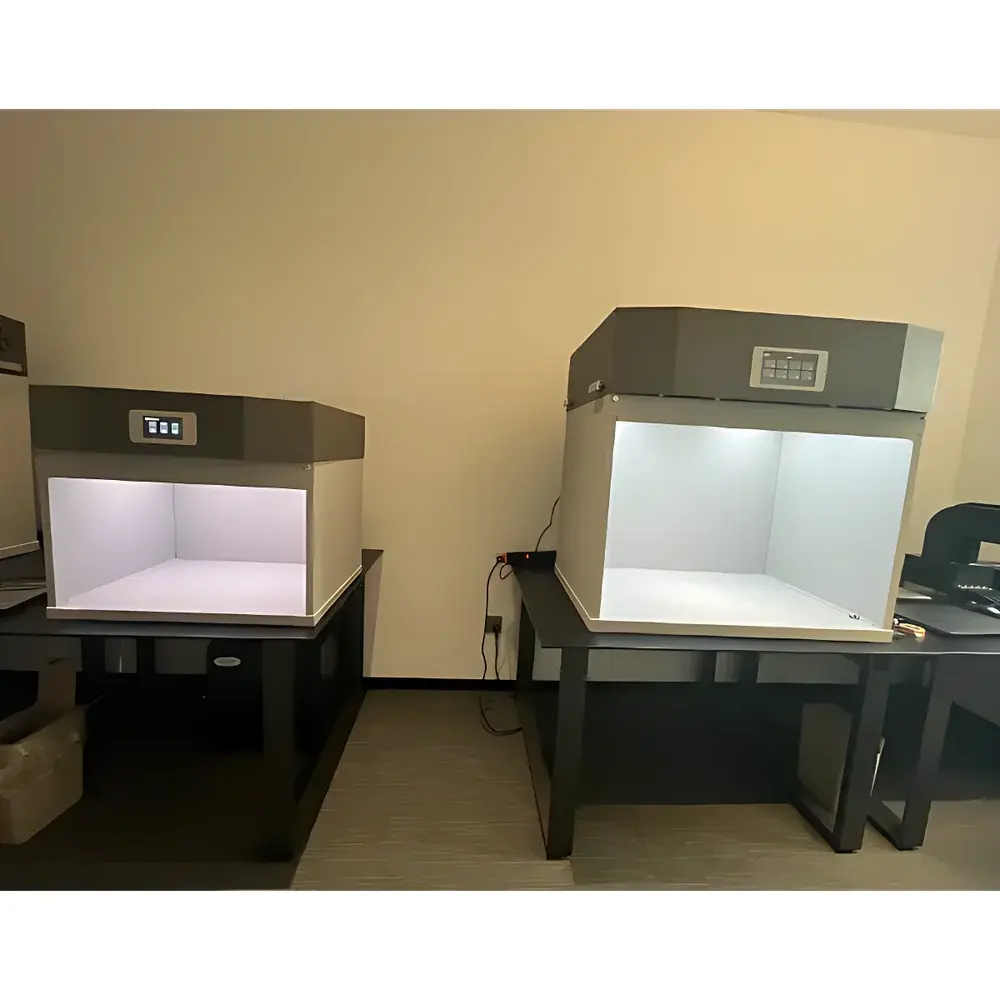
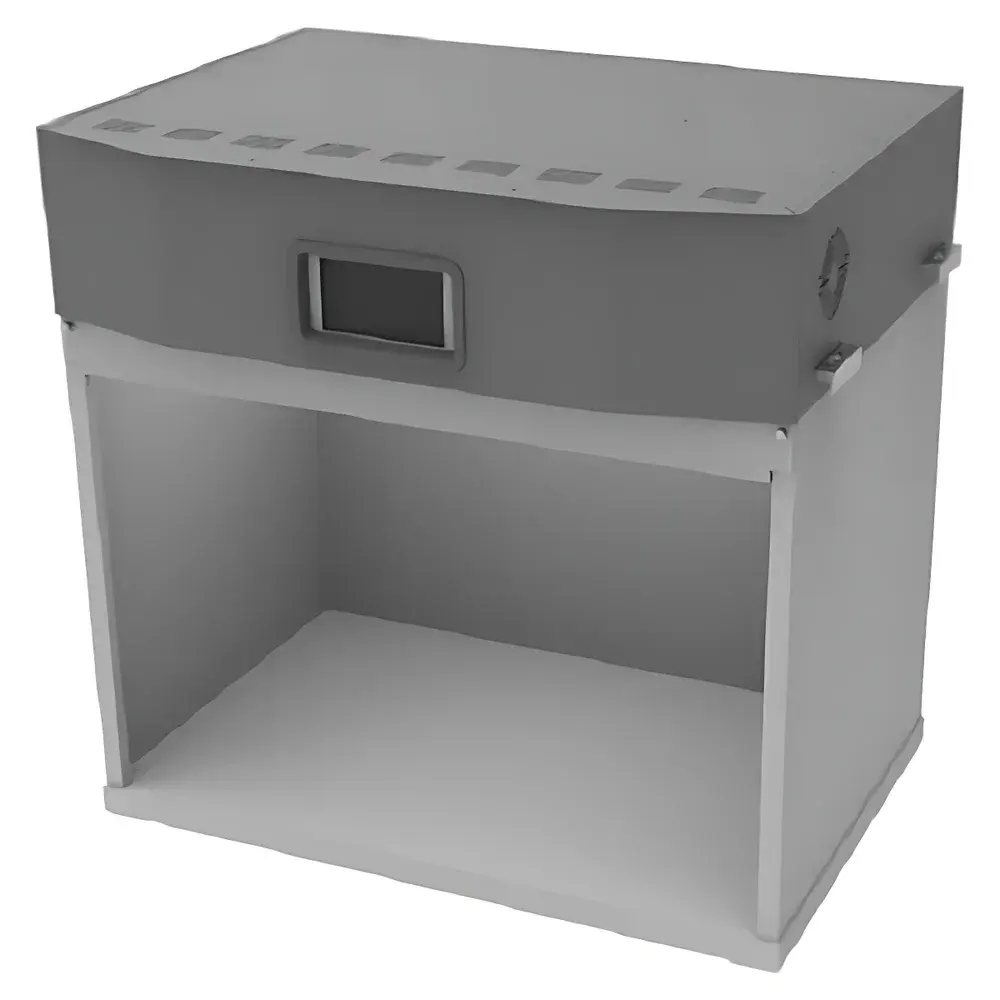
WeSpectra SpectraLED-PRO Multi-Channel Tunable LED Standard Light Source Cabinet
| Brand | WeSpectra |
|---|---|
| Origin | Shanghai, China |
| Model | SpectraLED-PRO |
| LED Channels | 21 |
| Spectral Range | 360–780 nm |
| CCT Tuning Range | 2000–20000 K (±1% accuracy) |
| Flicker Frequency | 1–1000 Hz (1 Hz step) |
| Illuminance Range | 0.1–2000 lx (fully adjustable per channel) |
| Uniformity | ≥80% (Munsell N7 interior) |
| Preheat Time | 0 s |
| LED Lifetime | ≥10,000 h |
| Control Interface | Integrated touchscreen + USB + SDK API |
| Compliance | ISO 23603, ISO 3664, ASTM D1729 |
| Dimensions (L×H×W) | 990×930×685 mm |
| Observation Chamber (L×H×W) | 890×585×620 mm |
| Weight | ~40 kg |
| Power Input | 110–240 V AC, max. 500 W |
Overview
The WeSpectra SpectraLED-PRO is a high-precision, multi-channel tunable LED standard light source cabinet engineered for metrological-grade color evaluation, spectral simulation, and photobiological research. Unlike conventional fluorescent or halogen-based color-matching booths, the SpectraLED-PRO employs 21 independently controlled, narrowband LED emitters spanning 360–780 nm — covering UV-A, visible, and near-infrared regions — to synthesize user-defined spectral power distributions (SPDs) with sub-percent chromatic fidelity. Its core architecture implements amplitude-modulated 12-bit digital driving (4000 intensity levels per channel), eliminating temporal modulation artifacts and ensuring truly flicker-free illumination across all operating modes. The system is fundamentally designed around CIE-recommended principles for illuminant characterization, enabling traceable reproduction of daylight standards (e.g., D50, D65), blackbody radiators, health-oriented lighting spectra (e.g., melanopic, scotopic, photopic weighted), and custom SPDs imported from spectroradiometric measurements. With zero warm-up time and long-term photometric stability (<0.5% drift over 1000 h), it serves as a primary reference in accredited laboratories conducting visual assessment, camera sensor calibration, display validation, and non-visual photobiological studies.
Key Features
- 21-channel spectral synthesis with full 360–780 nm coverage, including tunable UV-A (360–400 nm) and directional lighting options for gloss and texture evaluation
- CCT tuning from 2000 K to 20000 K with ±1% accuracy, validated against NIST-traceable spectroradiometers
- CIE Ra ≥99 under D65 simulation; MI Class A metamerism index per ISO 23603 Annex B
- Flicker-free operation via pure amplitude modulation — no PWM artifacts — supporting high-speed imaging and flicker-sensitive applications
- Dynamic lighting sequencing: programmable on/off timing, ramp profiles, and inter-source transitions for simulating real-world lighting transients
- Integrated 7-inch industrial touchscreen with local storage for up to 80 editable preset illuminants; software extends storage to unlimited configurations
- Real-time feedback loop compatibility: supports closed-loop stabilization using external spectroradiometers (e.g., Konica Minolta CL-500A, JETI Specbos 2501/2501uv)
- Low-illuminance mode (0.1–50 lx) calibrated for mesopic and scotopic vision studies per CIE 191:2010
- Modular mechanical design: ceiling-suspended, floor-standing, or custom-engineered mounting solutions available
Sample Compatibility & Compliance
The SpectraLED-PRO accommodates a broad range of physical samples — from textile swatches and printed media to electronic displays, dental composites, and horticultural specimens — within its Munsell N7 matte-finished observation chamber (890 × 585 × 620 mm). Its uniform irradiance distribution (≥80% spatial uniformity per ISO 3664:2009 Section 6.3) ensures consistent viewing geometry and eliminates edge bias during visual assessment. The system complies fully with ISO 23603:2022 (Standard illuminants for colorimetry), ISO 3664:2009 (Graphic technology and photography), and ASTM D1729-21 (Standard practice for visual appraisal of colors). It satisfies critical requirements for GLP/GMP-regulated environments, including audit-trail-capable calibration logs, user-access-level controls, and firmware-signed update integrity — supporting FDA 21 CFR Part 11 readiness when deployed with validated software workflows.
Software & Data Management
The included WeSpectra Control Suite provides intuitive GUI-based SPD editing, spectral import/export (ASCII, CSV, .spdx), and batch calibration management. All instrument parameters — including channel gain maps, temperature compensation coefficients, and user-defined illuminant metadata — are stored in encrypted binary format with SHA-256 checksum validation. An open Software Development Kit (SDK) delivers documented C/C++ and Python APIs for integration into automated test benches, LMS platforms, or custom QA pipelines. Remote control via USB CDC virtual COM port enables scripting of dynamic lighting protocols (e.g., circadian rhythm simulations, flicker stress testing). Calibration data remains bound to hardware serial number and firmware revision, ensuring reproducibility across distributed lab networks.
Applications
- Color-critical quality control in printing, packaging, automotive paint, and textile manufacturing
- Validation of display color gamut, white point stability, and HDR tone mapping under variable illuminants
- Photobiological safety testing per IEC 62471 and CIE S 026/E:2019 (melanopic EDI, circadian stimulus)
- Calibration and verification of spectral imaging systems, multispectral cameras, and consumer-grade colorimeters
- Research in intermediate vision, color constancy modeling, and metamerism prediction algorithms
- Agricultural lighting R&D: photosynthetic photon flux density (PPFD) profiling and phytochrome action spectrum emulation
- Medical device evaluation: endoscope white balance, surgical lighting spectral fidelity, and diagnostic display luminance linearity
FAQ
Does the SpectraLED-PRO support automatic recalibration using external spectroradiometers?
Yes — via its SDK and USB interface, the system accepts real-time SPD feedback from compatible instruments (e.g., JETI Specbos 2501uv) to dynamically adjust channel outputs and maintain photometric accuracy over time.
Can I import a measured SPD from my own spectroradiometer and reproduce it in the cabinet?
Absolutely. The Control Suite accepts ASCII-formatted SPD data (wavelength/intensity pairs) and performs constrained spectral inversion to optimize channel weights while preserving photometric constraints (CCT, Duv, Ra, R9).
Is the UV channel intensity independently controllable?
Yes — all 21 channels, including the 365 nm UV-A emitter, feature independent 12-bit digital control and thermal derating compensation.
What is the recommended recalibration interval under continuous use?
We recommend annual verification using a NIST-traceable spectroradiometer; however, built-in stability monitoring allows extension to 18 months if drift remains below ±0.3% in CIE x,y coordinates over 1000 h.
Is the cabinet suitable for ISO/IEC 17025-accredited testing laboratories?
Yes — when operated with documented procedures, version-controlled firmware, and certified calibration reports, the SpectraLED-PRO meets technical requirements for uncertainty budgeting and traceability in accredited color measurement workflows.




