
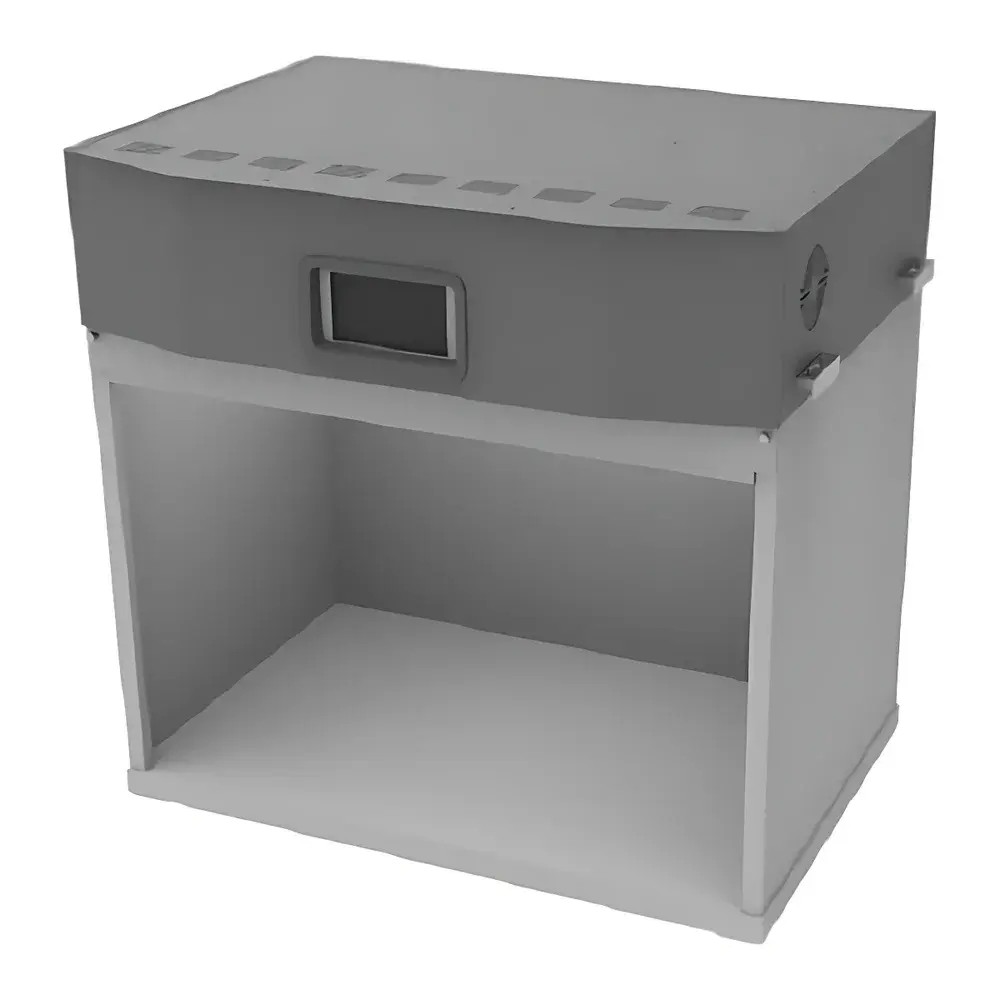
WeSpectra SpectraLED Pro Multi-Channel Tunable LED Standard Light Source Cabinet
| Brand | WeSpectra |
|---|---|
| Origin | Shanghai, China |
| Model | SpectraLED Pro |
| LED Channels | 21 |
| Spectral Range | 360–780 nm |
| CCT Tuning Range | 2000–20000 K (±1% accuracy) |
| SPD Reproducibility | Full user-defined or measured SPD import/export |
| Drive Resolution | 12-bit per channel (4000 intensity levels) |
| Flicker Frequency | 1–1000 Hz (1 Hz step) |
| Warm-up Time | 0 s |
| Uniformity | ≥80% (Munsell N7 interior) |
| Max Illuminance | ≥2000 lx (D-series) |
| Low-Light Mode | 0.1–50 lx |
| Storage | 80 editable presets onboard |
| Dimensions (L×H×W) | 990×930×685 mm |
| Observation Chamber (L×H×W) | 890×585×620 mm |
| Weight | ~40 kg |
| Power Supply | 110–240 V AC, ≤500 W |
| Operating Temperature | 0–40 °C |
| Compliance | ISO 23603, ISO 3664, ASTM D1729, CIE S 026/E:2018, IEC TR 62778 |
| Software Interface | USB + SDK (API for automated calibration & integration) |
| Supported Radiometers | Konica Minolta CL-500A, JETI Specbos 2501 & 2501uv |
Overview
The WeSpectra SpectraLED Pro is a high-fidelity, multi-channel tunable LED standard light source cabinet engineered for metrologically rigorous optical evaluation and spectral simulation in research, industrial quality control, and regulatory-compliant color science laboratories. Unlike conventional fluorescent or halogen-based light booths, the SpectraLED Pro employs 21 independently controlled, narrow-band LED emitters spanning 360–780 nm—including UV, visible, and near-visible spectral regions—to synthesize arbitrary spectral power distributions (SPDs) with high photometric fidelity. Its core architecture leverages proprietary spectral modeling algorithms and precision 12-bit amplitude modulation per channel to achieve continuous, flicker-free illumination without warm-up delay. The system enables accurate reproduction of CIE standard illuminants (e.g., D50, D65, A, F-series), as well as non-standard sources such as health-oriented circadian lighting, horticultural PAR spectra, medical-grade surgical lighting, and intermediate-vision (mesopic) conditions. Designed for traceable, repeatable photometric performance, it serves as both a primary reference for visual assessment and a programmable stimulus generator for radiometric sensor characterization, camera spectral response mapping, and display perceptual evaluation.
Key Features
- 21 individually addressable LED channels with full spectral coverage from 360 nm (UV-A) to 780 nm (deep red), supporting custom SPD synthesis and CIE-compliant standard illuminant emulation.
- Continuous correlated color temperature (CCT) tuning from 2000 K to 20000 K with ±1% absolute accuracy—validated against NIST-traceable spectroradiometric measurement protocols.
- CIE Ra ≥ 99 and Metamerism Index (MI) Class A performance for D-series illuminants, exceeding ISO 3664:2022 requirements for graphic technology viewing conditions.
- Flicker-free 12-bit per-channel intensity control (4000 discrete levels), enabling stable, low-noise illumination across all brightness ranges—from 0.1 lx (scotopic simulation) to ≥2000 lx (high-intensity daylight simulation).
- Programmable dynamic lighting sequences: users define temporal order, dwell time, and transition profiles between up to 80 onboard presets—critical for evaluating temporal color consistency and visual adaptation effects.
- Integrated directional light module for gloss, sparkle, and graininess assessment—compatible with ISO 2813 and ASTM D523 geometries.
- No warm-up period; output stabilizes within <10 ms of command execution, ensuring immediate repeatability in high-throughput test environments.
- Onboard storage for 80 user-editable presets; unlimited additional SPDs managed via PC software with full metadata tagging and version history.
Sample Compatibility & Compliance
The SpectraLED Pro accommodates diverse sample types—including reflective prints, transmissive films, textured surfaces, OLED/LCD displays, biomedical specimens, and agricultural substrates—within its Munsell N7 matte-finished observation chamber (890 × 585 × 620 mm). Its uniform irradiance distribution (≥80% spatial uniformity per ISO 3664 Annex B) minimizes edge artifacts during visual or instrumental evaluation. The system meets and exceeds international standards governing color-critical viewing environments: ISO 23603 (graphic arts), ISO 3664:2022 (viewing conditions for color matching), ASTM D1729 (color matching under controlled illumination), and CIE S 026/E:2018 (photobiological safety and spectral weighting functions). It supports GLP/GMP-aligned workflows through audit-trail-capable software logging, calibrated radiometer integration (e.g., JETI Specbos 2501uv), and optional 21 CFR Part 11–compliant electronic signature modules for regulated industries.
Software & Data Management
The SpectraLED Pro ships with a Windows-based control suite featuring an intuitive touch-enabled GUI, real-time SPD visualization, and bidirectional communication with supported spectroradiometers. Users may import measured SPDs (ASCII, CSV, or JETI .spc formats), apply spectral corrections, and export validated configurations for inter-laboratory transfer. The included Software Development Kit (SDK) provides documented C/C++ and Python APIs for integration into automated test benches, LMS platforms, or custom QA pipelines—enabling closed-loop feedback calibration where real-time radiometric data adjusts LED drive signals to compensate for long-term drift. All calibration records, SPD definitions, and session logs are stored with timestamps, operator IDs, and instrument serial numbers to satisfy ISO/IEC 17025 documentation requirements.
Applications
- Colorimetric validation of displays, cameras, and machine vision systems under standardized and application-specific illuminants.
- Metamerism analysis and spectral sensitivity profiling of photoreceptors, image sensors, and biological tissues.
- Development and verification of human-centric lighting (HCL), circadian-effective irradiance (Ee,opic), and non-visual photobiological metrics per CIE TN 003:2015.
- White point stability testing of LEDs and OLEDs across thermal and aging conditions.
- Standardized evaluation of whiteness, yellowness, and fluorescence in paper, textiles, and dental materials per ISO 11475 and ASTM E313.
- Controlled-environment horticultural lighting R&D, including photosynthetic photon flux density (PPFD) and phytochrome photostationary state (PSS) modeling.
FAQ
Does the SpectraLED Pro support third-party spectroradiometer integration for automatic recalibration?
Yes—via USB-connected Konica Minolta CL-500A or JETI Specbos 2501/2501uv units, the system performs real-time feedback correction using the provided SDK, maintaining photometric stability over the LED lifetime.
Can I import and reproduce a custom SPD measured in my lab?
Absolutely. The software accepts ASCII/CSV-formatted SPD data with wavelength-intensity pairs at 1 nm or 5 nm intervals and reconstructs it with hardware-level fidelity.
Is the system compliant with FDA or EU regulatory requirements for medical device testing?
While not a medical device itself, the SpectraLED Pro meets photometric and spectral traceability criteria referenced in IEC 62471 (photobiological safety) and supports 21 CFR Part 11–compliant audit trails when configured with optional secure authentication modules.
What maintenance is required over its 10,000-hour rated LED lifetime?
None beyond periodic radiometric verification. LED degradation is compensated algorithmically via software recalibration—no lamp replacement or optical realignment is necessary.
Is remote operation possible over Ethernet or LAN?
The base configuration uses USB 2.0; Ethernet or TCP/IP remote control is available via optional gateway firmware and API extension modules.





