
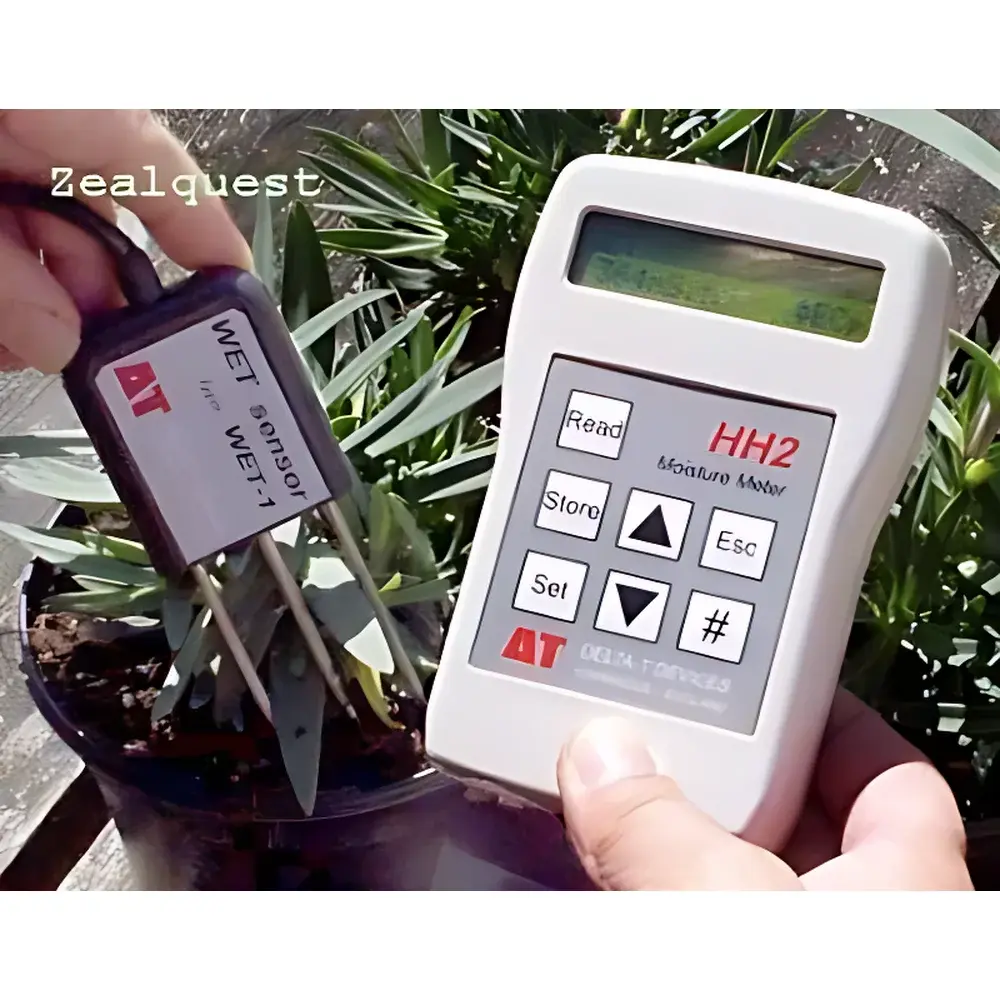
WET-2 Soil Tri-Parameter Sensor (FDR-Based)
| Origin | UK |
|---|---|
| Manufacturer Type | Authorized Distributor |
| Origin Category | Imported |
| Model | WET-2 |
| Pricing | Available Upon Request |
Overview
The WET-2 Soil Tri-Parameter Sensor is a field-deployable, high-stability FDR (Frequency Domain Reflectometry) instrument engineered for simultaneous, in-situ measurement of three fundamental soil physical properties: volumetric water content (θv), bulk electrical conductivity (ECb), and soil temperature. Unlike time-domain reflectometry (TDR) systems requiring complex signal interpretation, the WET-2 operates at a fixed 20 MHz excitation frequency to induce stable dielectric polarization within the soil matrix. Dielectric permittivity (εr) — measured in the range of 1–80 — serves as the primary raw parameter; θv is derived via empirical calibration against soil-specific texture and density relationships. ECb is extracted from low-frequency impedance components of the same FDR signal, while temperature is measured using an integrated Pt1000-grade thermistor embedded within the sensor body. This co-located, single-probe architecture eliminates inter-sensor spatial mismatch and ensures temporal synchrony across all three parameters—critical for irrigation scheduling, salinity stress assessment, and biogeochemical flux modeling.
Key Features
- Integrated tri-parameter sensing in a single, compact probe (55 × 45 × 10 mm housing; 3 mm Ø × 66 mm stainless-steel electrodes)
- FDR-based measurement principle with 20 MHz carrier frequency, delivering robust performance across variable soil textures and moisture regimes
- High-resolution digital output: dielectric permittivity resolution 0.1, ECb resolution 1 mS/m, temperature resolution 0.1 °C, θv resolution 0.1 %vol
- IP65-rated enclosure ensures reliable operation under outdoor environmental exposure, including rain, dust, and transient immersion
- Fast response time of ≤5 seconds per full measurement cycle, enabling high-frequency monitoring in dynamic field conditions
- Low mass (75 g) and minimal insertion footprint reduce soil disturbance during installation and long-term burial
- Standard 2 m shielded, UV-resistant cable with industrial-grade connector (M12 or equivalent) for compatibility with most data loggers and telemetry systems
Sample Compatibility & Compliance
The WET-2 is validated for direct insertion into mineral soils ranging from sandy loam to clay loam, with demonstrated stability in organic-rich topsoil (up to 20% OM) and moderately saline substrates (ECb ≤ 200 mS/m). It is not recommended for saturated peat or highly conductive brine-saturated sediments (>300 mS/m), where electrode polarization effects may compromise ECb accuracy. The sensor conforms to IEC 60529 (IP65 ingress protection), meets CE marking requirements for electromagnetic compatibility (EMC Directive 2014/30/EU), and complies with RoHS 2011/65/EU restrictions on hazardous substances. While not certified to ISO 11277 or ASTM D5116 for laboratory-standardized soil characterization, its field measurement protocol aligns with FAO-recommended practices for agronomic soil water monitoring and supports data traceability in GLP-aligned environmental monitoring programs.
Software & Data Management
The WET-2 outputs calibrated analog (0–5 V or 4–20 mA) or digital (RS-485 Modbus RTU) signals compatible with Campbell Scientific CR-series, Decagon EM50G, Onset HOBO, and other industry-standard data acquisition platforms. Raw dielectric, ECb, and temperature values are transmitted independently, permitting post-acquisition recalibration using site-specific pedotransfer functions. When integrated into networked environmental monitoring systems, the sensor supports audit-trail-capable data logging—including timestamped metadata, measurement status flags (e.g., “probe contact error”, “temperature out-of-range”), and firmware version reporting—to satisfy basic requirements for data integrity under ISO/IEC 17025 and FDA 21 CFR Part 11 Annex 11 contexts where electronic records are subject to review.
Applications
- Agricultural water management: Real-time feedback for deficit irrigation, drip system optimization, and root-zone water balance modeling
- Soil salinity mapping and temporal tracking in irrigated croplands, coastal zones, and reclaimed mining sites
- Ecological research: Quantifying soil thermal buffering capacity, freeze-thaw dynamics, and moisture-driven microbial activity thresholds
- Environmental impact assessment: Monitoring leachate plume migration, landfill cap performance, and remediation efficacy
- Climate observatories: Long-term validation of satellite-derived soil moisture products (e.g., SMAP, Sentinel-1) at in situ reference stations
FAQ
How does the WET-2 differentiate between bulk EC (ECb) and pore-water EC (ECp)?
It measures ECb directly via low-frequency impedance. ECp is calculated post-hoc using the Rhoades or Hilhorst mixing model, which requires concurrent θv and assumes uniform solute distribution. Accuracy of ECp is strongly dependent on θv precision and soil-specific calibration.
Can the WET-2 be buried permanently?
Yes—its IP65 rating, corrosion-resistant electrodes, and stable FDR electronics support multi-season deployment. However, mechanical protection (e.g., PVC conduit or gravel backfill) is recommended in high-traffic or tillage-prone areas.
What is the operational temperature limit during measurement?
The sensor performs measurements within –5 °C to +50 °C. For extended storage outside this range, consult the manufacturer’s thermal derating guidelines to preserve long-term calibration stability.
Is factory recalibration required annually?
No scheduled recalibration is mandated. Field verification against gravimetric θv and standard KCl solutions for ECb is recommended every 12–24 months depending on deployment severity and data-criticality requirements.
Related Products







