
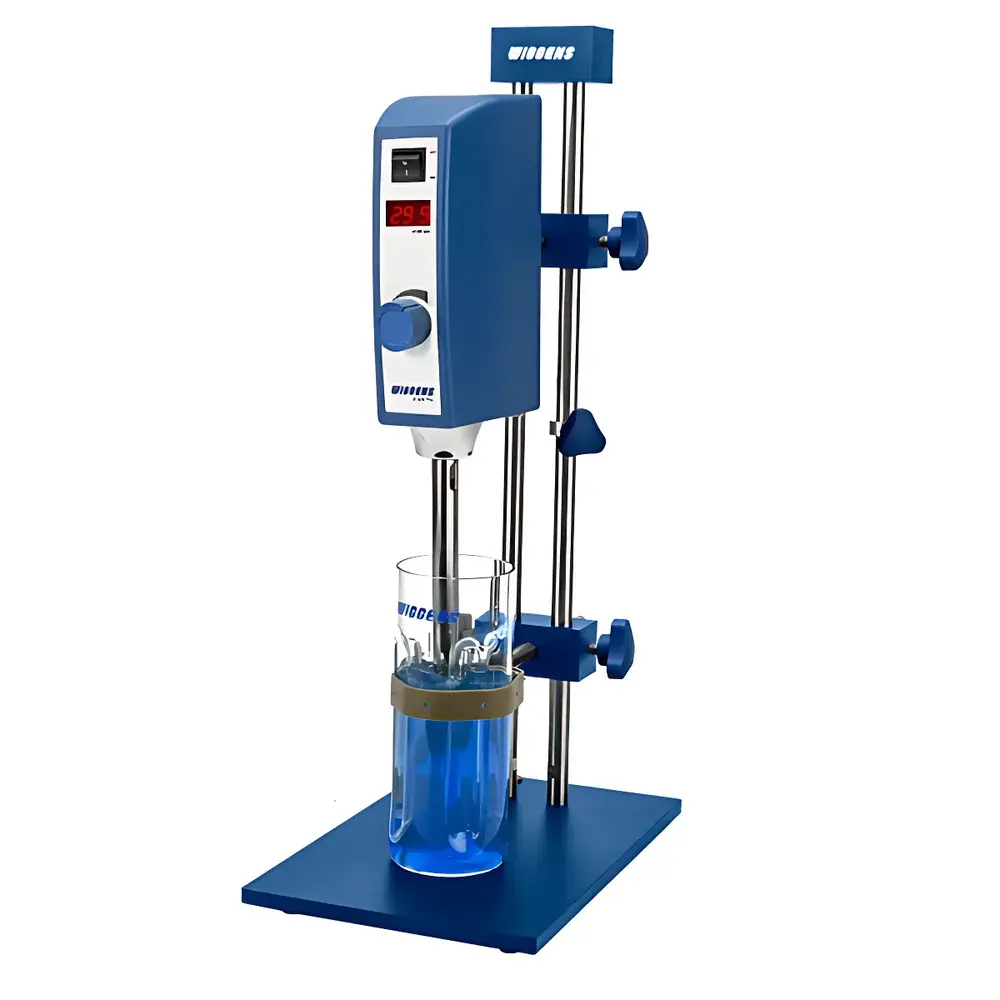
WIGGENS D-500 Pro Digital High-Shear Homogenizer
| Brand | WIGGENS |
|---|---|
| Origin | Germany |
| Model | D-500 Pro |
| Output Power | 500 W |
| Sample Volume Range | 10–40,000 mL |
| Speed Range | 500–30,000 rpm |
| Rotor Diameter | Ø4–Ø23 mm |
| Max. Viscosity | 10,000 cP |
| Tip Speed | ≤34.9 m/s |
| Noise Level | 66 dB (2,500 rpm), 72 dB (30,000 rpm) |
| Motor Type | Brushless DC |
| Voltage | 220 V / 50 Hz |
| Operating Temperature | 0–40 °C |
| Relative Humidity | ≤80 % RH |
| IP Rating | IP20 |
| Dimensions (W×D×H) | 76×157×236 mm |
| Net Weight | 1.8 kg |
Overview
The WIGGENS D-500 Pro Digital High-Shear Homogenizer is a precision-engineered benchtop homogenization system designed for reproducible, scalable dispersion, emulsification, and cell disruption across research, quality control, and process development laboratories. Based on rotor-stator high-shear hydrodynamic principle, it generates intense localized shear forces through the controlled interaction between a rapidly rotating rotor and a fixed stator—enabling efficient particle size reduction, phase stabilization, and uniform suspension formation in liquid or semi-liquid matrices. Its modular architecture supports interchangeable rotors (Ø4–Ø23 mm), facilitating method transfer from micro-scale (10 mL) to pilot-batch volumes (up to 40 L), while maintaining consistent energy input per unit volume. The device complies with fundamental electrical safety requirements per IEC 61010-1 and is constructed to meet ISO 9001-certified manufacturing standards.
Key Features
- Brushless DC motor delivering stable speed control across full 500–30,000 rpm range with ±1% speed accuracy at setpoint
- LED digital display with rotary encoder interface for intuitive, tactile speed adjustment and real-time rpm readout
- Corrosion-resistant 316L stainless steel rotor-stator assemblies, autoclavable and compatible with aggressive solvents and biological buffers
- Three-layer safety architecture: electronic overload protection, soft-start ramping (0–3 s acceleration), and integrated emergency stop switch
- Optimized thermal management enabling continuous operation at rated power without duty-cycle limitation under ambient conditions (0–40 °C, ≤80% RH)
- Low-profile ergonomic housing (76 × 157 × 236 mm) with non-slip base, suitable for fume hood integration or mobile lab deployment
- Tip speed up to 34.9 m/s ensures effective mechanical lysis of mammalian cells, yeast, and bacterial cultures without chemical additives
Sample Compatibility & Compliance
The D-500 Pro accommodates a broad spectrum of sample types—including aqueous suspensions, oil-in-water emulsions, polymer solutions, tissue homogenates, and nanoparticle dispersions—within viscosity limits up to 10,000 cP. Its rotor geometry supports both low-volume precision processing (e.g., 10–100 mL lysates) and high-throughput batch preparation (e.g., 5–40 L formulations). When paired with optional GS-series dispersion vessels (borosilicate glass or 316L stainless steel; 35 mL–2 L capacity), vortex suppression and radial flow optimization significantly improve mixing efficiency and reduce processing time by ≥35% compared to standard cylindrical beakers. The instrument meets general laboratory safety directives (IEC 61010-1), carries CE marking, and supports GLP-compliant workflows via audit-trail-ready software integration (see Software section). It is not intended for use in explosion-hazardous environments (ATEX) or intrinsically safe applications.
Software & Data Management
While the D-500 Pro operates as a standalone unit with local digital control, it features an RS-232 serial port (optional USB-to-serial adapter available) for external command and data logging. Compatible with WIGGENS’ LabControl Suite v3.2+, the interface enables remote parameter setting, real-time rpm monitoring, session timestamping, and export of CSV-formatted operation logs—including start/stop times, average speed, and total runtime. These records satisfy basic FDA 21 CFR Part 11 requirements for electronic record integrity when deployed with validated IT infrastructure and user access controls. For fully auditable GMP environments, integration with LIMS or ELN platforms is supported via Modbus RTU protocol upon configuration request.
Applications
- Preparation of homogeneous pharmaceutical suspensions and nanoemulsions for dissolution testing (USP )
- Routine homogenization of tumor, liver, or brain tissues prior to RNA/DNA extraction or proteomic analysis
- Dispersion of carbon nanotubes, graphene oxide, or ceramic nanoparticles into polymer matrices
- Stabilization of food-grade emulsions (e.g., mayonnaise analogs, functional beverage bases)
- Cell lysis for microbial strain banking and bioprocess intermediate sampling
- Accelerated dissolution of coated tablets and excipient blends in QC release testing
- Viscosity-controlled dispersion of pigments, catalysts, or conductive fillers in R&D prototyping
FAQ
Is the D-500 Pro suitable for sterile processing?
Yes—rotor-stator assemblies are fully autoclavable (121 °C, 20 min, saturated steam). Glass and stainless steel GS vessels are also sterilizable; however, the main unit housing must remain outside the autoclave.
Can it handle abrasive slurries containing silica or alumina particles?
With appropriate rotor material selection (e.g., hardened 316L or optional tungsten-carbide-coated variants), the system demonstrates robust performance in low-abrasion slurries (<5 wt% solids); extended use with highly abrasive media requires scheduled wear inspection per maintenance manual.
What is the minimum recommended sample volume for reliable homogenization?
For optimal shear transfer and cavitation control, the minimum working volume is 10 mL using a Ø4 mm rotor; lower volumes risk air entrainment and inconsistent energy delivery.
Does the device support variable-speed ramping profiles?
No—the D-500 Pro provides fixed-speed operation only. Programmable multi-step ramping is available on the higher-tier D-500 Pro+ model with Ethernet connectivity and embedded controller.
Are spare rotors and GS vessels supplied with traceable calibration certificates?
Standard rotors ship with material certification (EN 10204 3.1). Traceable speed calibration certificates (ISO/IEC 17025 accredited) are available as optional add-ons at time of order.



