
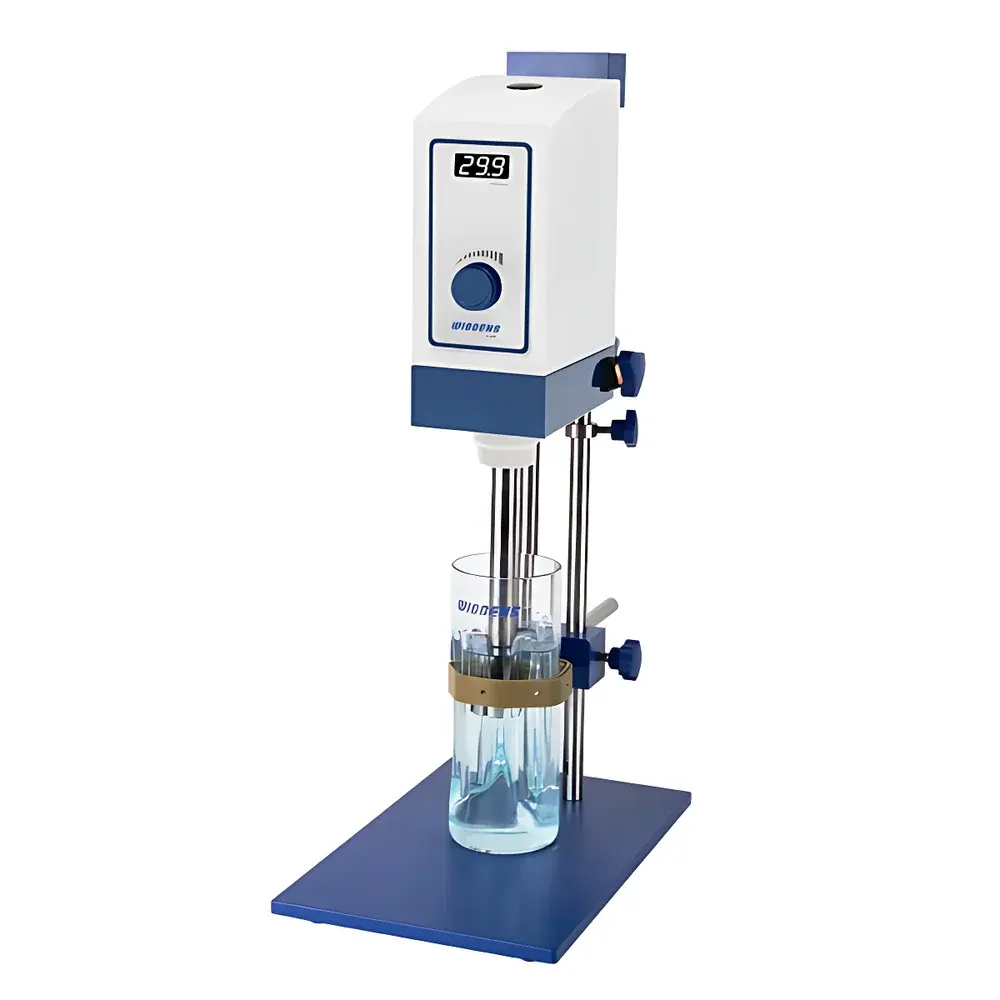
WIGGENS D-600 High-Shear Rotor-Stator Homogenizer
| Brand | WIGGENS |
|---|---|
| Origin | Germany |
| Model | D-600 |
| Instrument Type | Rotor-Stator Probe Homogenizer |
| Dimensions (W×D×H) | 95 × 163 × 236 mm (host unit only) |
| Processing Volume | 0.05–2,000 mL |
| No-Load Speed Range | 500–30,000 rpm |
| Power Rating | 500 W |
| Noise Level | 66 dB(A) at 25,000 rpm |
| Rotor Diameter Options | Ø3–Ø25 mm |
| Protection Class | IP20 |
| Operating Voltage | 220 V / 50 Hz |
| Ambient Temperature | 0–40 °C |
| Relative Humidity | ≤80 % RH |
| Construction Material | 316L stainless steel with electrophoretic coating |
| Bearing Material | PTFE (Teflon)-lined precision bearings |
| Sterilization Compatibility | Autoclavable (121 °C, 20 min, steam) |
Overview
The WIGGENS D-600 High-Shear Rotor-Stator Homogenizer is an engineered solution for laboratory-scale cell disruption, emulsification, dispersion, and particle size reduction in demanding R&D and quality control environments. Based on the Couette–Taylor flow principle, it generates intense mechanical shear forces through precise relative motion between a high-speed rotating rotor and a stationary concentric stator—creating controlled cavitation, turbulent mixing, and hydrodynamic stress sufficient to homogenize viscous suspensions, lyse microbial cells, prepare nanoemulsions, and disintegrate tissue samples. Designed for reproducibility and operational safety, the D-600 delivers consistent energy input across variable sample viscosities without manual recalibration, making it suitable for method development under GLP-compliant workflows.
Key Features
- 500 W brushless motor with soft-start electronics ensures stable torque delivery and eliminates abrupt acceleration—critical for preserving heat-sensitive biomolecules and preventing sample splashing.
- Digital LED speed display and precision flywheel encoder control enable repeatable setpoint selection from 500 to 30,000 rpm in 100-rpm increments, with real-time feedback and ±1% speed accuracy under load.
- Intelligent adaptive power modulation dynamically adjusts output torque in response to changing sample viscosity, maintaining constant rotational speed throughout processing—eliminating drift during extended homogenization cycles.
- Acoustically damped housing constructed from vibration-dissipating composite materials reduces operational noise to 66 dB(A) at 25,000 rpm and 72 dB(A) at maximum speed—meeting ISO 7779 requirements for laboratory ambient noise limits.
- One-handed quick-connect probe interface allows full rotor-stator assembly insertion or removal in <3 seconds; three-step disassembly enables complete cleaning of all wetted parts without tools.
- Serrated rotor geometry optimizes radial fluid ejection and localized shear gradient generation, enhancing micro-droplet formation in emulsions and improving sub-micron particle distribution in colloidal dispersions.
- All wetted components—including rotor, stator, and shaft—are fabricated from medical-grade 316L stainless steel with electrophoretic epoxy coating for corrosion resistance and biocompatibility; PTFE-lined bearings ensure chemical inertness and thermal stability up to 121 °C.
Sample Compatibility & Compliance
The D-600 accommodates volumes from 50 µL to 2 L using interchangeable rotor-stator sets (Ø3 mm to Ø25 mm), supporting applications ranging from microscale nucleic acid extraction to benchtop formulation trials. It complies with IEC 61000-6-3 (EMC emission standards) and IEC 61000-6-2 (immunity), and its IP20 rating aligns with standard indoor laboratory environmental classifications per IEC 60529. The autoclavable design meets EN 285 and ISO 17665-1 for steam sterilization validation, supporting GMP-aligned cleanroom use when paired with validated cleaning SOPs. While not inherently 21 CFR Part 11 compliant, audit trails and electronic records may be implemented via external data acquisition systems adhering to ALCOA+ principles.
Software & Data Management
The D-600 operates as a standalone analog-controlled instrument with no embedded firmware or network interface. Speed settings and runtime are manually configured and recorded externally. For traceability in regulated environments, integration with third-party Lab Information Management Systems (LIMS) or programmable logic controllers (PLCs) is supported via optional 0–10 V analog output (speed feedback signal) and digital I/O triggers. Users performing method transfer or process validation should document operating parameters—including probe type, volume, duration, temperature monitoring, and post-homogenization particle size analysis—per ISO/IEC 17025 clause 7.2.2.
Applications
- Cell lysis of bacterial, yeast, and mammalian cultures for protein extraction and subcellular fractionation
- Preparation of oil-in-water and water-in-oil emulsions for pharmaceutical dosage forms and cosmetic formulations
- Dispersion of nanoparticles (e.g., TiO₂, SiO₂, liposomes) into aqueous or organic matrices
- Homogenization of tissue homogenates for ELISA, PCR, and metabolomics workflows
- Rapid deagglomeration of pigment suspensions, polymer blends, and ceramic slurries
- Viscosity-dependent process optimization studies where constant shear rate must be maintained across formulation variants
FAQ
Is the D-600 suitable for continuous operation?
No—this instrument is rated for intermittent duty cycles only. Maximum recommended continuous run time is 3 minutes per cycle, followed by ≥2-minute cooling intervals to prevent thermal overload of the motor windings.
Can rotor-stator assemblies be sterilized in an autoclave?
Yes—wetted components are validated for 20 minutes at 121 °C and 100 kPa saturated steam pressure. Ensure complete drying before reassembly to avoid condensation-induced bearing wear.
What maintenance is required to sustain performance?
Routine inspection of rotor-stator alignment and surface finish every 50 operating hours is advised; replace PTFE bearings if axial play exceeds 0.05 mm or if rotational smoothness degrades.
Does the D-600 support speed ramping profiles?
No—speed is set manually and held constant during operation. Programmable ramping requires external controller integration via analog input.
How does the D-600 compare to ultrasonic homogenizers for cell disruption?
Rotor-stator systems deliver higher bulk energy transfer and better scalability than ultrasonics but generate more localized heat; temperature control via ice-jacketed vessels or inline chillers is recommended for thermolabile samples.
Related Products



