
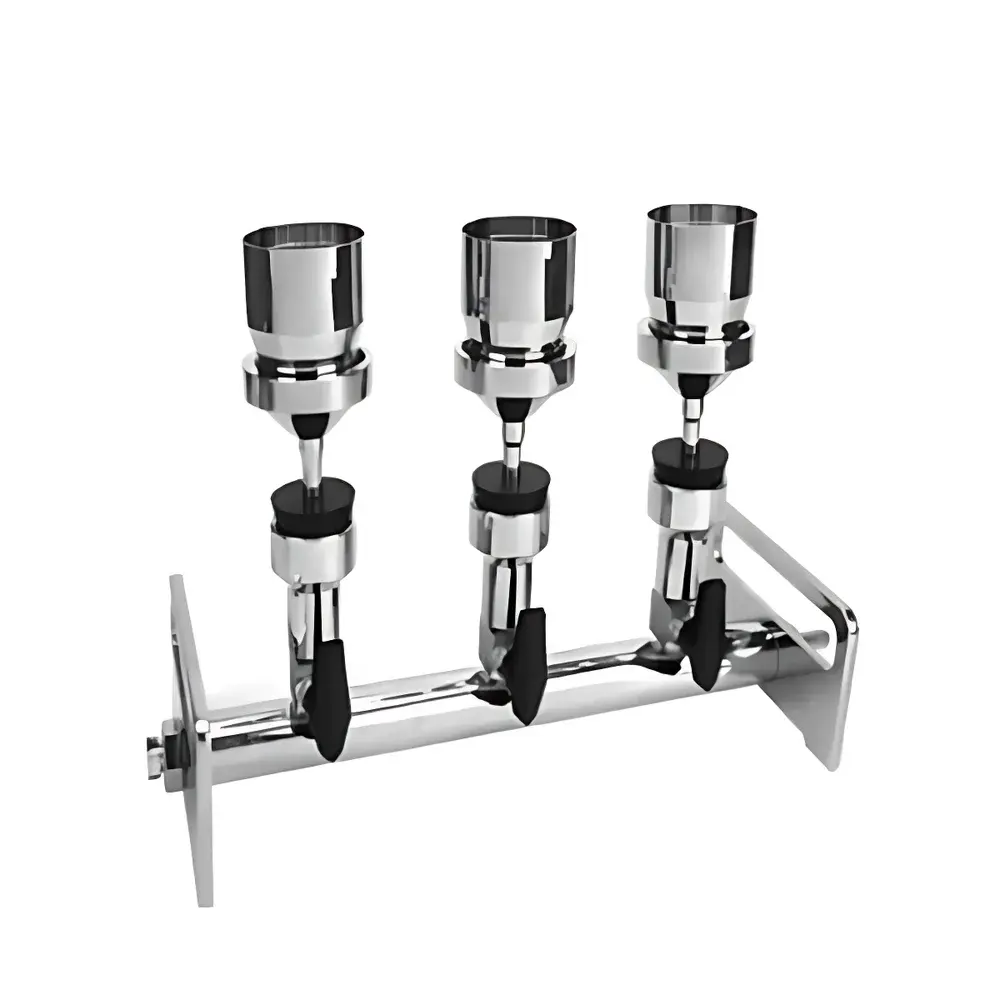
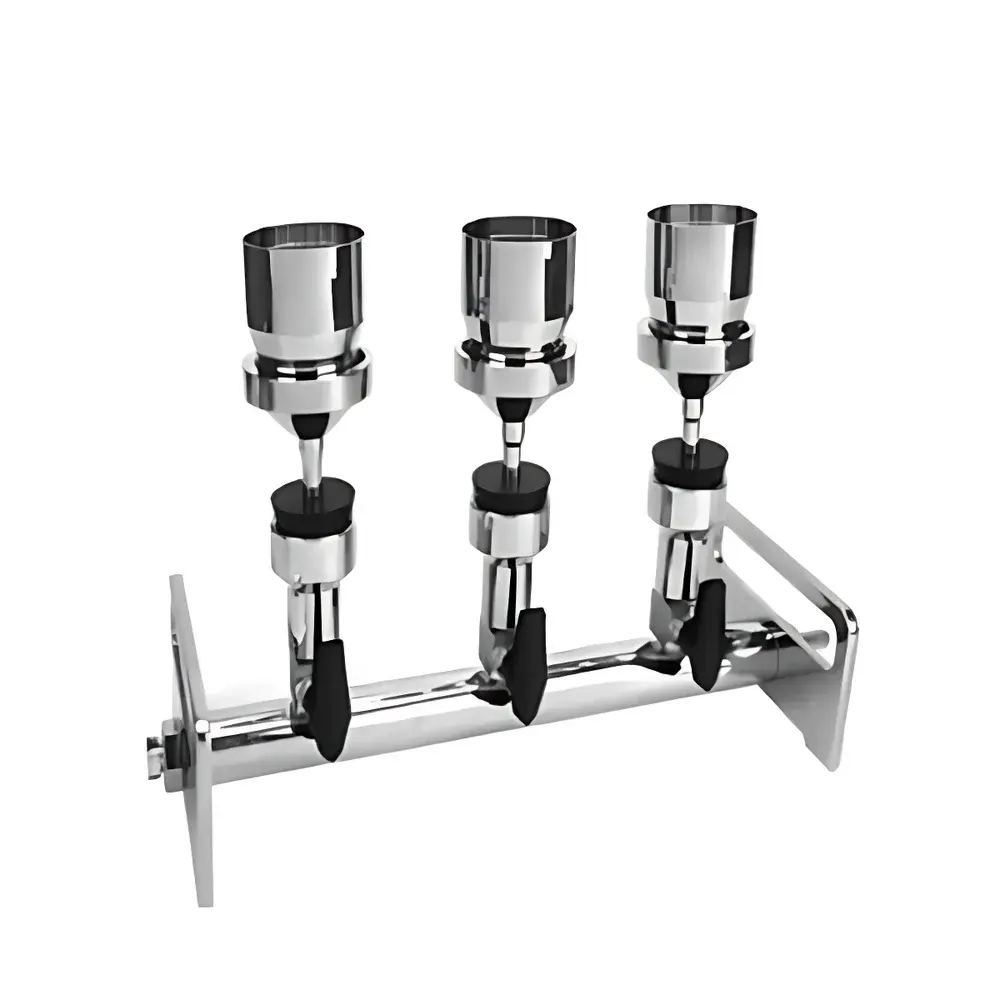
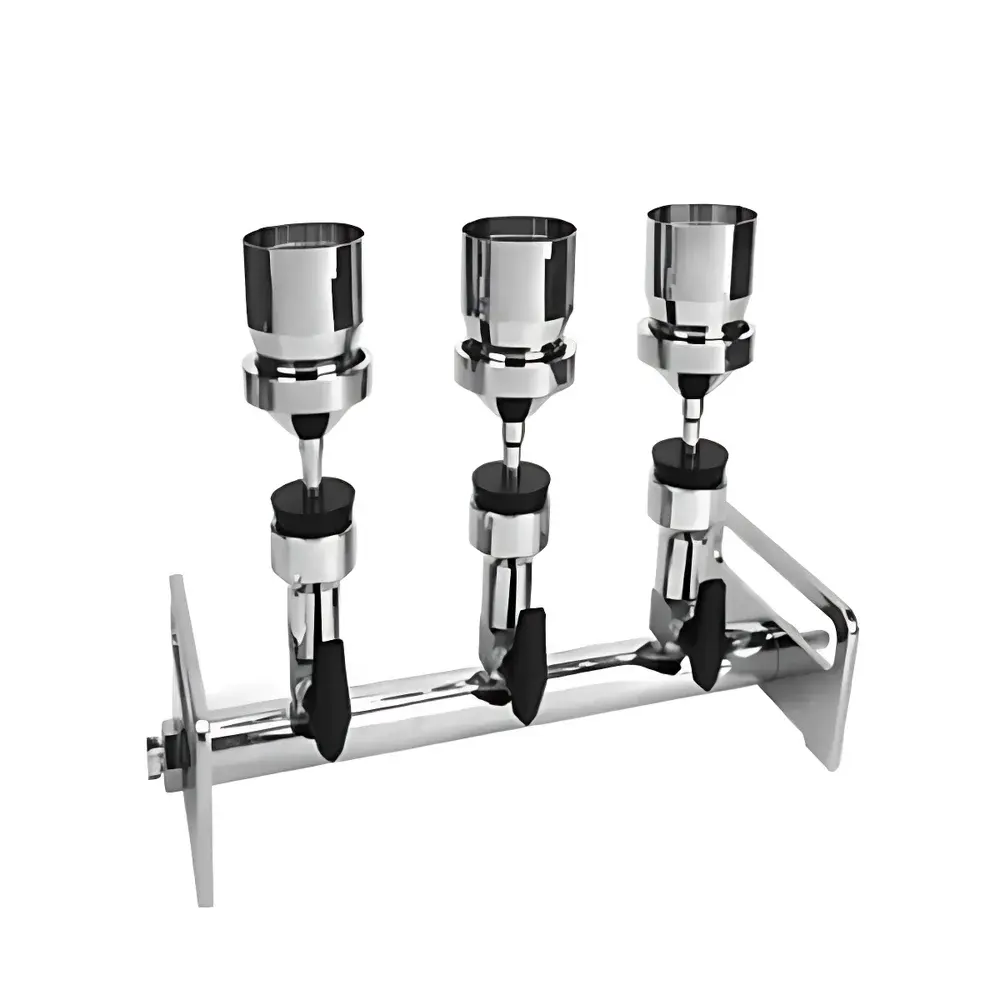
WIGGENS BioVac330 Snap-Lock Multi-Position Vacuum Filtration Manifold
| Brand | WIGGENS |
|---|---|
| Origin | Germany |
| Model | BioVac330 |
| Filtration Positions | 3 |
| Filter Diameter | 47/50 mm |
| Effective Filtration Area | 9.6 cm² |
| Hose Connection | 8 mm ID |
| Dimensions (L×W×H) | 50 × 15 × 15 cm |
| Filter Holder Material | ASTM F138-certified SS316 stainless steel |
| Sterilization Compatibility | Autoclave (121 °C, 20 min), dry heat (180 °C), and flame sterilization |
| Independent Valve Control | Yes, per position |
| Compatible Flask Volumes | 100 mL, 300 mL, 500 mL (all SS316) |
| Regulatory Compliance | Designed for GLP/GMP environments with traceable component sourcing |
Overview
The WIGGENS BioVac330 Snap-Lock Multi-Position Vacuum Filtration Manifold is an engineered solution for high-integrity, scalable vacuum-driven sample processing in regulated laboratory environments. Built on the principle of gravity-assisted vacuum filtration through standardized membrane supports, the BioVac330 enables parallel processing of up to three samples under independently controlled vacuum conditions. Its core architecture centers on a precision-machined SS316 stainless steel manifold body conforming to ASTM F138 (surgical-grade corrosion-resistant alloy), ensuring long-term dimensional stability and chemical inertness across aggressive solvents, acids, bases, and biological decontamination agents. Unlike polymer-based manifolds susceptible to creep or thermal deformation, the BioVac330 maintains mechanical integrity during repeated sterilization cycles—including saturated steam autoclaving (121 °C, 20 min per cycle), dry-heat treatment (180 °C), and localized flame passivation—making it suitable for aseptic processing, bioburden reduction, and sterility testing workflows compliant with ISO 11140, USP , and EU Annex 1 requirements.
Key Features
- Three independent, manually operated stainless steel valves—each actuated via tactile rotary knob—allow selective vacuum application without cross-contamination or pressure equalization between ports.
- Snap-lock coupling mechanism eliminates reliance on external clamps or threaded adapters; secure mechanical engagement is achieved with a single 30° rotation per filter holder, verified by audible click and visual alignment indicator.
- Uniform 47/50 mm filter support diameter ensures compatibility with standard GN-6, HA, MF-Millipore, and other certified 47 mm disc membranes; effective filtration area per position is precisely 9.6 cm², enabling reproducible flux calculations per ISO 4022.
- Integrated 8 mm inner-diameter hose barbs accept reinforced silicone or Viton® vacuum tubing; all fluid-path surfaces are electropolished to Ra ≤ 0.4 µm per ASTM B912, minimizing particle retention and biofilm nucleation.
- Modular flask interface accepts interchangeable SS316 filtration flasks (100 mL, 300 mL, 500 mL) with conical ground-glass joints (ISO K29/32) and reinforced neck geometry to withstand cyclic vacuum stress without deformation.
Sample Compatibility & Compliance
The BioVac330 supports aqueous, organic, and mixed-phase samples across life science, environmental, and pharmaceutical applications—including microbial recovery (e.g., membrane filtration per ISO 7218), particulate analysis (ASTM D2986), and sterile filtration validation (PDA TR26). All wetted components comply with FDA 21 CFR 177.1520 (food-contact plastics not applicable; metal-only construction avoids polymer leachables) and EU Regulation (EC) No. 1935/2004. Batch-specific material certifications (EN 10204 3.1) and mill test reports are available upon order. The system’s design facilitates full auditability: valve positions are mechanically indexed, flask seating is tactilely verifiable, and no adhesive or elastomeric seals are used—eliminating potential sources of extractables in GMP-compliant filtration documentation.
Software & Data Management
As a purely mechanical, non-electronic filtration manifold, the BioVac330 requires no firmware, drivers, or software integration. This analog architecture ensures zero electromagnetic interference, deterministic operational behavior, and full compatibility with ISO/IEC 17025-accredited calibration records. For digital workflow integration, users may pair the BioVac330 with validated vacuum source controllers (e.g., WIGGENS WV 200 series) that support RS-232/Modbus RTU output and 21 CFR Part 11–compliant electronic log generation. All physical documentation—including installation qualification (IQ), operational qualification (OQ), and preventive maintenance logs—is structured to align with Annex 15 and WHO TRS 986 validation templates.
Applications
- Microbiological membrane filtration for water, pharmaceuticals, and cosmetics per USP , EP 2.6.27, and JP 4.06.
- Particulate matter collection from air or liquid streams for gravimetric analysis (ISO 12103-1, ISO 4406).
- Cell harvesting and clarification in upstream bioprocessing where stainless steel contact surfaces prevent protein adsorption artifacts.
- Pre-filtration of HPLC mobile phases and ICP-MS standards to eliminate sub-5 µm contaminants.
- Environmental sampling of wastewater, soil extracts, and aerosol condensates under EPA Method 1603 and ISO 9308-1 protocols.
FAQ
Can the BioVac330 be used with non-stainless steel filter flasks?
No. Only SS316 stainless steel flasks supplied by WIGGENS are certified for use with the BioVac330 manifold; alternative materials risk gasket failure, vacuum collapse, or surface corrosion compromising sterility assurance.
Is the snap-lock mechanism compatible with glovebox or laminar flow hood operation?
Yes—the low-torque, one-handed engagement requires no tools and generates no particulates; the absence of springs or plastic clips prevents static charge accumulation in controlled environments.
What vacuum pressure range is recommended for optimal performance?
A stable vacuum of –80 to –95 kPa (–24 to –28 inHg) is advised; higher differentials may cause membrane blistering, while lower values extend filtration time beyond ISO-defined limits for microbial recovery.
How often should the manifold undergo preventive maintenance?
Visual inspection before each use; full disassembly, electropolish verification, and valve seat torque validation every 500 operating cycles or quarterly—whichever occurs first—as documented in the included WIGGENS Maintenance Log Template.



