
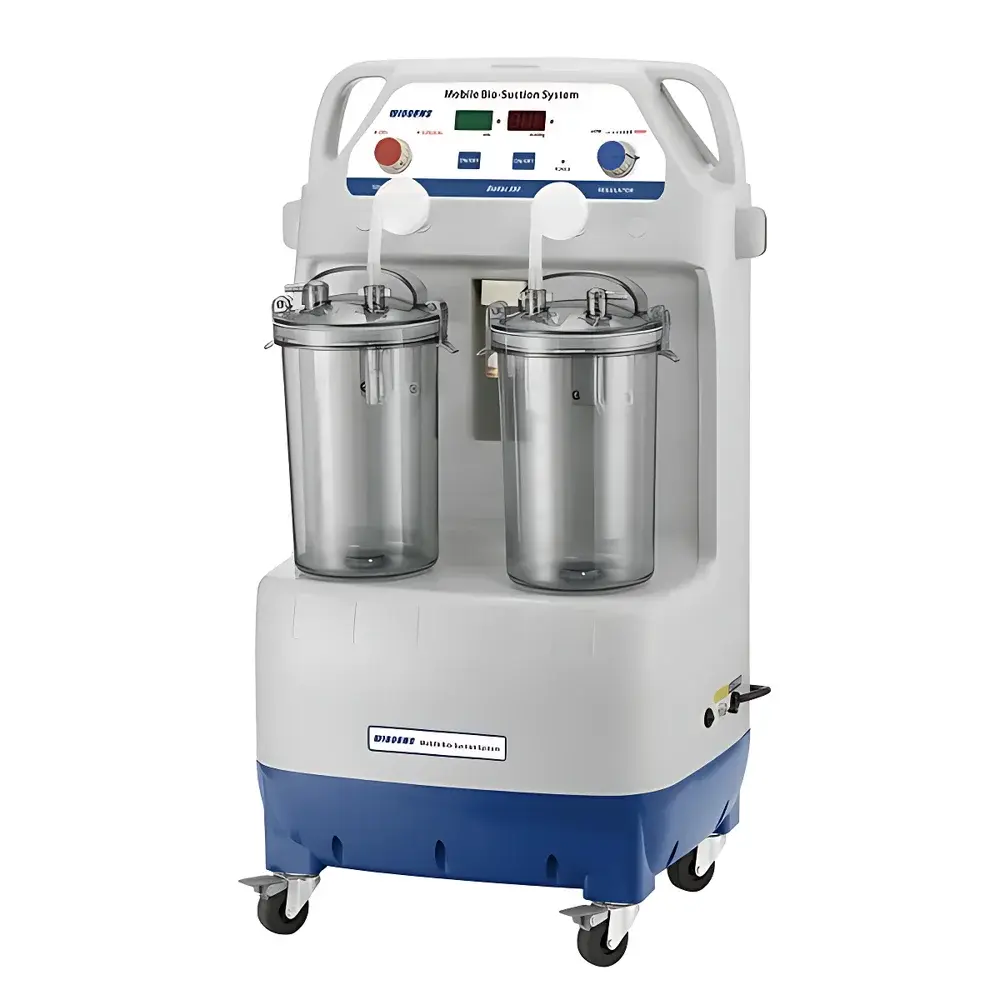
WIGGENS Biovac350A Mobile Bio-Suction Vacuum Pump
| Brand | WIGGENS |
|---|---|
| Origin | Germany |
| Model | Biovac350A |
| Pump Type | Oil-Free Diaphragm Vacuum Pump |
| Ultimate Vacuum | 60 mbar |
| Maximum Flow Rate | 80 L/min |
| Dimensions (W×D×H) | 45 × 35 × 84 cm |
| Weight | 19.5 kg |
| Motor Power | 250 W |
| Standard Waste Bottle | 2 × 3000 mL PC Bottles |
| Filtration | Integrated 0.2 µm PTFE Disc Filter |
| Sterilization Compatibility | Autoclavable (Bottles & Filter) |
| Mobility | Equipped with Locking Casters |
| Control Interface | Analog Vacuum Gauge |
| Operation Mode | Foot-Switch Activated |
Overview
The WIGGENS Biovac350A is a mobile, oil-free diaphragm vacuum pump engineered specifically for sterile liquid aspiration in life science laboratories. Designed to support post-culture separation of biological specimens—including cell suspensions, tissue homogenates, and supernatants—the system operates on a robust, maintenance-free principle that eliminates lubricant contamination risks inherent in oil-lubricated pumps. Its core architecture integrates a corrosion-resistant diaphragm mechanism capable of sustaining stable vacuum levels down to 60 mbar while delivering a continuous flow rate of up to 80 L/min—sufficient for rapid, controlled aspiration across multiple workstations or biosafety cabinets. The unit’s mobility, coupled with its low-noise operation (<55 dB(A) at 1 m), ensures seamless integration into laminar flow hoods, cleanrooms, and GMP-compliant environments where spatial flexibility and acoustic performance are critical.
Key Features
- Oil-free diaphragm technology: Eliminates need for lubrication, reduces maintenance frequency, and prevents hydrocarbon contamination of sensitive biological samples.
- Dual-channel suction capability: Supports simultaneous aspiration from two independent sources via separate 3000 mL polycarbonate waste bottles—enhancing workflow efficiency during high-throughput cell culture harvesting or media exchange procedures.
- Integrated dual-stage protection: Each suction line incorporates a 0.2 µm hydrophobic PTFE disc filter positioned between the waste bottle and pump head, supplemented by a float-valve mechanism inside the bottle to prevent overflow-induced pump ingress.
- Autoclavable components: Both waste bottles and PTFE filters are rated for repeated steam sterilization (121°C, 20 min, 1 bar), ensuring full compliance with GLP and ISO 13485 requirements for reusable labware in regulated bioprocessing.
- Ergonomic mobility: Four heavy-duty locking casters (two with brakes) enable stable positioning and secure relocation—even over uneven laboratory flooring—without compromising vibration isolation or vacuum stability.
- Foot-switch operation: Enables hands-free activation, preserving aseptic technique during manipulations inside biosafety cabinets or glove boxes.
- Analog vacuum gauge: Provides real-time visual feedback of system pressure, supporting reproducible aspiration protocols aligned with USP and ISO 14644-1 cleanroom operational standards.
Sample Compatibility & Compliance
The Biovac350A is validated for use with aqueous buffers, saline solutions, enzymatic digestates, and low-viscosity culture media (e.g., DMEM, RPMI-1640). It is not intended for organic solvents, strong acids/bases, or viscous suspensions (>100 cP). All wetted surfaces—including tubing ports, bottle threads, and filter housings—are constructed from chemically inert polymers (PC, PTFE, EPDM) to resist degradation and leaching. The system conforms to IEC 61000-6-3 (EMC emission limits) and IEC 61000-6-2 (immunity), and meets CE marking requirements under the EU Machinery Directive 2006/42/EC. Its design supports audit readiness for FDA 21 CFR Part 11–aligned workflows when paired with validated electronic log systems.
Software & Data Management
As a standalone analog-controlled instrument, the Biovac350A does not feature embedded digital control firmware or data logging capabilities. However, its consistent vacuum output and mechanical repeatability make it suitable for integration into documented SOPs requiring manual parameter recording. Laboratories implementing electronic batch records may assign unique equipment IDs and associate usage logs with specific operators, dates, and procedures—facilitating traceability under ISO 17025 and GMP Annex 11 frameworks. Optional third-party pressure transducers (e.g., calibrated 4–20 mA sensors) can be installed upstream for external data acquisition if process validation mandates continuous vacuum monitoring.
Applications
- Cell culture harvest and supernatant removal in Class II biosafety cabinets
- Media aspiration during stem cell passaging and primary tissue dissociation
- Waste fluid evacuation in microbiological isolation workflows (e.g., mycoplasma testing)
- Support for vacuum-assisted filtration in nucleic acid purification kits
- Low-pressure aspiration in histology sample preparation (e.g., paraffin embedding stations)
- General-purpose liquid transfer in QA/QC labs adhering to ISO/IEC 17025 accreditation criteria
FAQ
Can the Biovac350A be used with corrosive or volatile solvents?
No. The pump is designed exclusively for aqueous and mildly buffered biological fluids. Exposure to acetone, ethanol, chloroform, or strong acids will degrade PTFE seals and polycarbonate components.
Is the vacuum level adjustable?
The Biovac350A delivers fixed vacuum performance (≤60 mbar); fine-tuning is achieved externally using inline needle valves or flow restrictors compatible with standard 8 mm ID tubing.
How often should the PTFE filter be replaced?
Under typical cell culture use (2–3 hours/day), replacement is recommended every 6 months—or immediately after visible saturation, pressure drop, or autoclave cycle fatigue.
Does the unit require annual calibration?
While no formal calibration is mandated for analog gauge readouts, laboratories operating under ISO/IEC 17025 should verify gauge accuracy annually against a NIST-traceable reference manometer.
What is the expected service life of the diaphragm?
With proper load management and avoidance of dry-running, the diaphragm assembly maintains functional integrity for ≥15,000 operating hours—equivalent to approximately 5–7 years of standard academic lab usage.



