
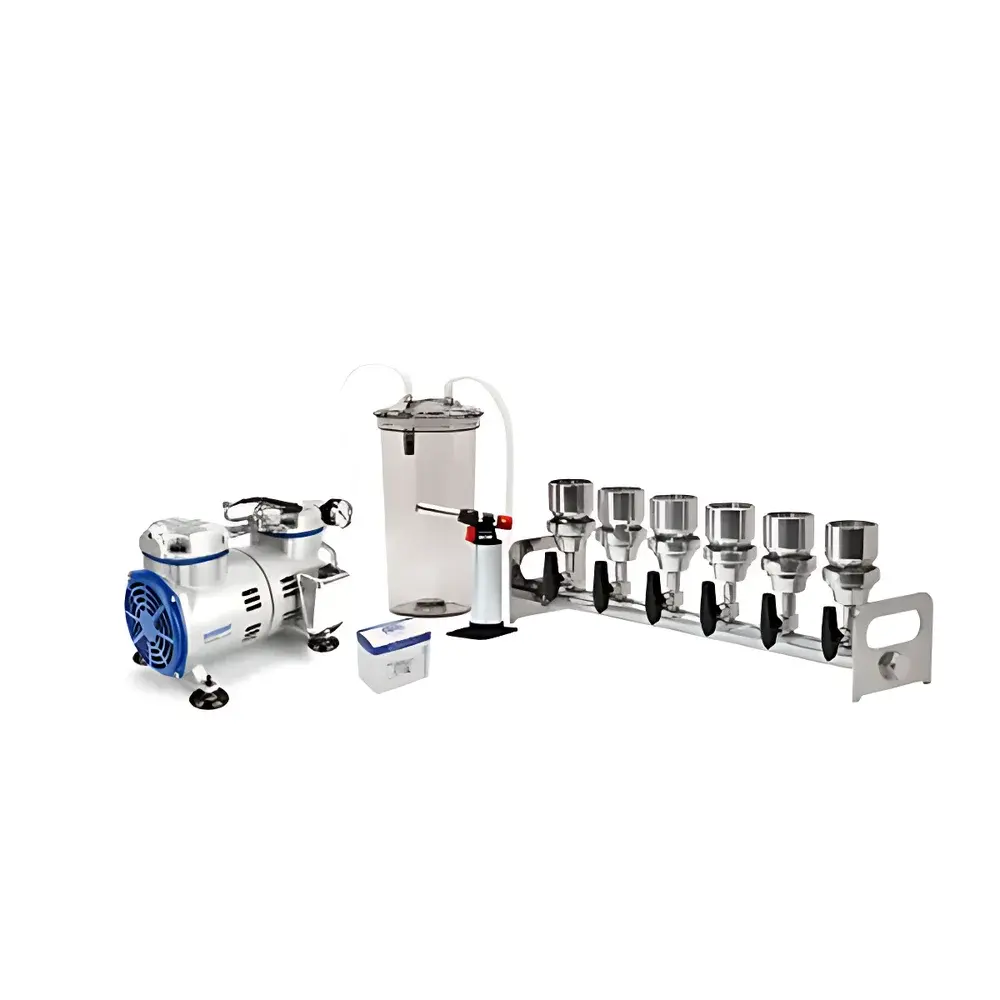
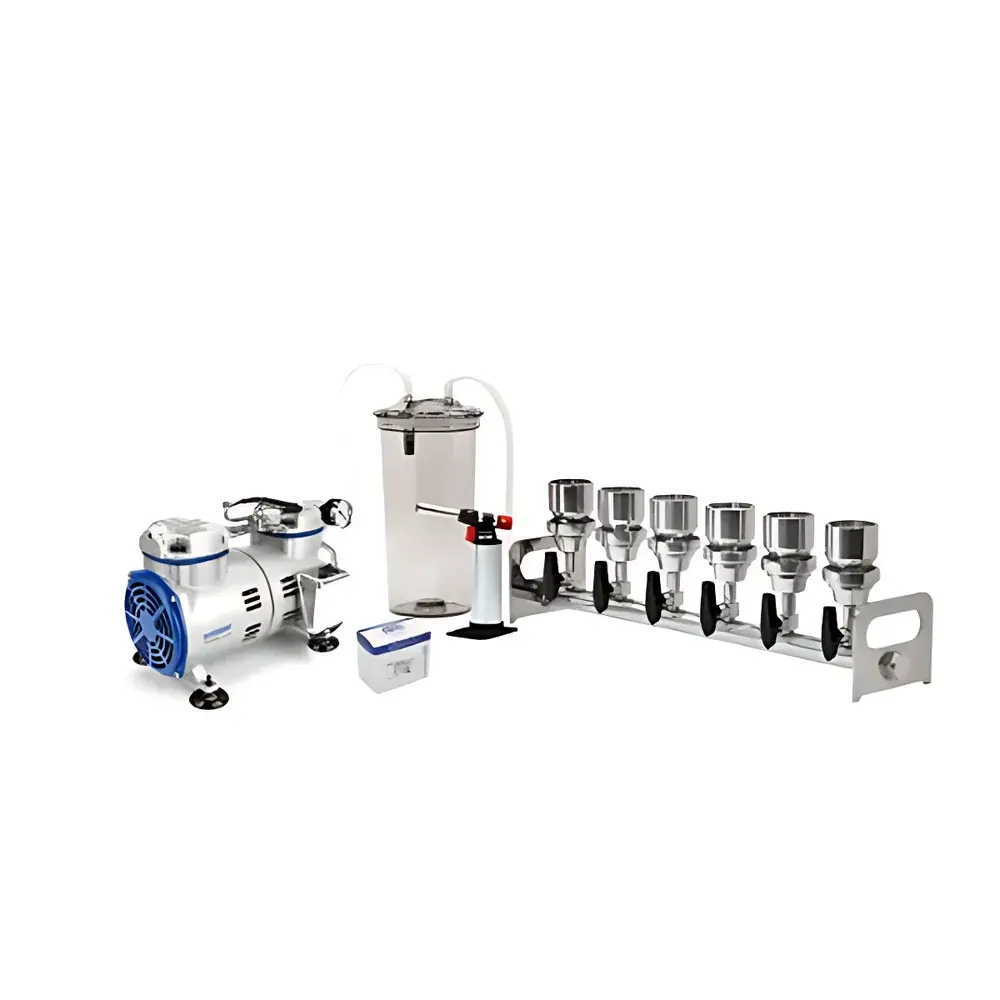
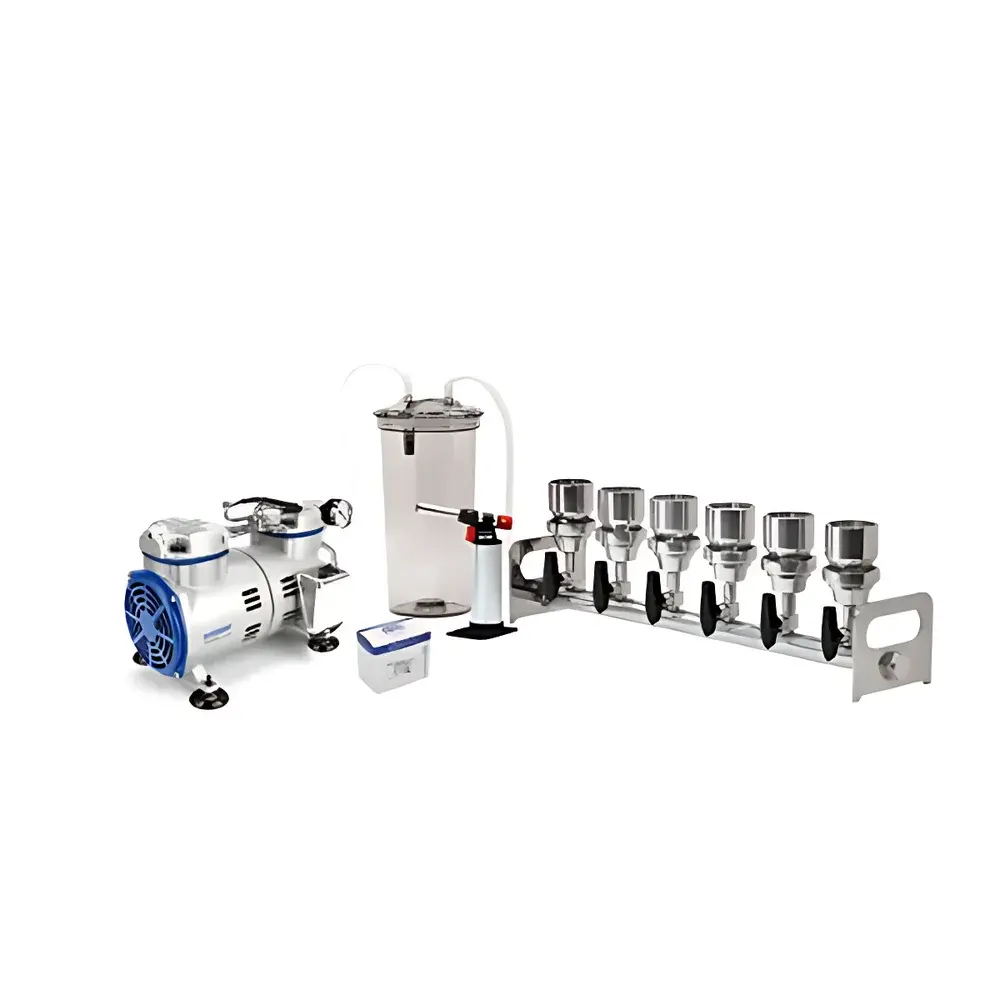
WIGGENS BioVac630B Six-Position Stainless Steel Vacuum Filtration System
| Brand | WIGGENS |
|---|---|
| Origin | Germany |
| Model | BioVac630B |
| Pump Flow Rate | 58 L/min |
| Ultimate Vacuum | ≤150 mbar |
| Waste Bottle Capacity | 3000 mL (Polycarbonate) |
| Number of Filtration Positions | 6 |
| Filtration Plate Material | SS316 Stainless Steel |
| Filter Membrane Diameter | 47 mm or 50 mm |
| Filter Flask Volumes | 100 mL, 300 mL, 500 mL (compatible) |
| Effective Filtration Area per Position | 9.6 cm² |
| Tubing Inner Diameter | 8 mm |
| Sterilization Compatibility | Autoclavable, Dry Heat (up to 250 °C), Flame-Sterilizable |
Overview
The WIGGENS BioVac630B is a six-position vacuum filtration system engineered for high-integrity, repeatable liquid and microbial sample processing in regulated laboratory environments. Designed around Couette-type vacuum-driven separation principles, the system enables simultaneous, independent filtration across six discrete channels using precisely engineered SS316 stainless steel filtration plates. Its architecture eliminates elastomeric gaskets and polymer-based sealing interfaces at critical contact points—replacing them with metal-to-metal rotary latch couplings and magnetically stabilized funnel mounts—to ensure long-term dimensional stability, chemical resistance, and full compatibility with sterilization protocols required under ISO 13485, USP , and GLP-compliant workflows. The integrated diaphragm vacuum pump delivers a stable flow rate of 58 L/min with an ultimate vacuum of ≤150 mbar, sufficient to support rapid filtration of viscous biological suspensions, aggressive solvents, and particulate-laden process streams without membrane collapse or channel clogging.
Key Features
- SS316 Filtration Plate Assembly: All wetted surfaces—including plate body, sealing rings, and funnel retention hardware—are fabricated from electropolished AISI 316 stainless steel, providing exceptional resistance to chloride-induced pitting, organic acids, and oxidizing agents commonly encountered in pharmaceutical QC and environmental testing.
- Independent Channel Control: Each of the six filtration positions features a dedicated on/off valve with tactile feedback and positive shut-off, enabling selective operation without cross-contamination or pressure imbalance between active and idle channels.
- Rotary Snap-Lock Interface: The filtration plate employs a precision-machined rotary coupling mechanism that achieves leak-tight sealing via angular torque engagement—not clamps or threaded adapters—reducing setup time by >60% versus conventional manifold systems while maintaining reproducible compression force across repeated cycles.
- Magnetic Funnel Mounting: BioVac630B-compatible funnels (including optional 47 mm and 50 mm variants) integrate rare-earth neodymium magnets into their base flanges, ensuring centric alignment and vibration-damped seating on the SS316 plate without auxiliary fixtures or alignment jigs.
- Modular Flask Compatibility: Supports interchangeability among 100 mL, 300 mL, and 500 mL borosilicate glass or polycarbonate filter flasks—each rated for ≥0.8 bar differential pressure—allowing volume scalability without revalidation of filtration parameters.
Sample Compatibility & Compliance
The BioVac630B accommodates standard 47 mm and 50 mm diameter membranes (e.g., mixed cellulose ester, PVDF, PTFE, and nylon) and maintains uniform flow distribution across all six positions within ±3.2% CV (coefficient of variation) when tested per ASTM D2873-22. Its construction complies with EU Directive 2014/30/EU (EMC), IEC 61010-1:2010 (safety), and FDA 21 CFR Part 11 requirements for audit-trail-capable instrumentation when paired with WIGGENS’ optional BioLog software suite. All components are validated for 100+ autoclave cycles at 121 °C / 15 psi, dry heat sterilization at 180 °C for 2 hours, and direct flame pass-through (per ISO 14644-1 Class 5 cleanroom maintenance protocols).
Software & Data Management
When integrated with the WIGGENS BioLog v3.2 platform (optional), the BioVac630B supports electronic batch records, user-access-controlled method storage, and time-stamped event logging—including valve actuation, vacuum pressure excursions, and runtime duration per channel. Data export conforms to ASTM E2500-21 for raw data integrity and supports CSV, PDF, and XML formats compliant with LIMS ingestion standards. Audit trails meet ALCOA+ criteria and include immutable operator ID, timestamp, action type, and pre-/post-change values for all configurable parameters.
Applications
- Membrane filtration assays for E. coli, Pseudomonas aeruginosa, and Staphylococcus aureus per ISO 7218 and AOAC 977.27
- Particulate removal from HPLC mobile phases and cell culture media prior to sterile filtration
- Residual solvent recovery and catalyst separation in fine chemical synthesis
- Airborne particulate collection using NIOSH-approved 37-mm cassettes (with adapter kit)
- Pre-concentration of low-biomass environmental water samples for qPCR-based pathogen detection
FAQ
Is the BioVac630B compatible with aggressive solvents such as chloroform or concentrated nitric acid?
Yes—the SS316 filtration plate, polycarbonate waste bottle, and fluorosilicone O-rings resist prolonged exposure to halogenated hydrocarbons, strong mineral acids, and caustic bases per ASTM G128-20 corrosion resistance guidelines.
Can the system be validated for GMP manufacturing environments?
Yes—full IQ/OQ documentation packages, including calibration certificates traceable to NIST standards, are available upon request; system design supports installation qualification per Annex 15 of the EU GMP Guide.
What is the maximum operating temperature for the filtration plate during dry-heat sterilization?
The SS316 plate retains mechanical integrity and surface passivation up to 250 °C for durations ≤4 hours, consistent with EN 285:2015 steam sterilizer validation requirements.
Does each filtration position maintain identical vacuum distribution under load?
Yes—pressure mapping conducted per ISO 5355:2019 confirms ≤±12 mbar deviation across all six ports at 58 L/min flow, ensuring equivalent filtration kinetics regardless of channel utilization pattern.



