
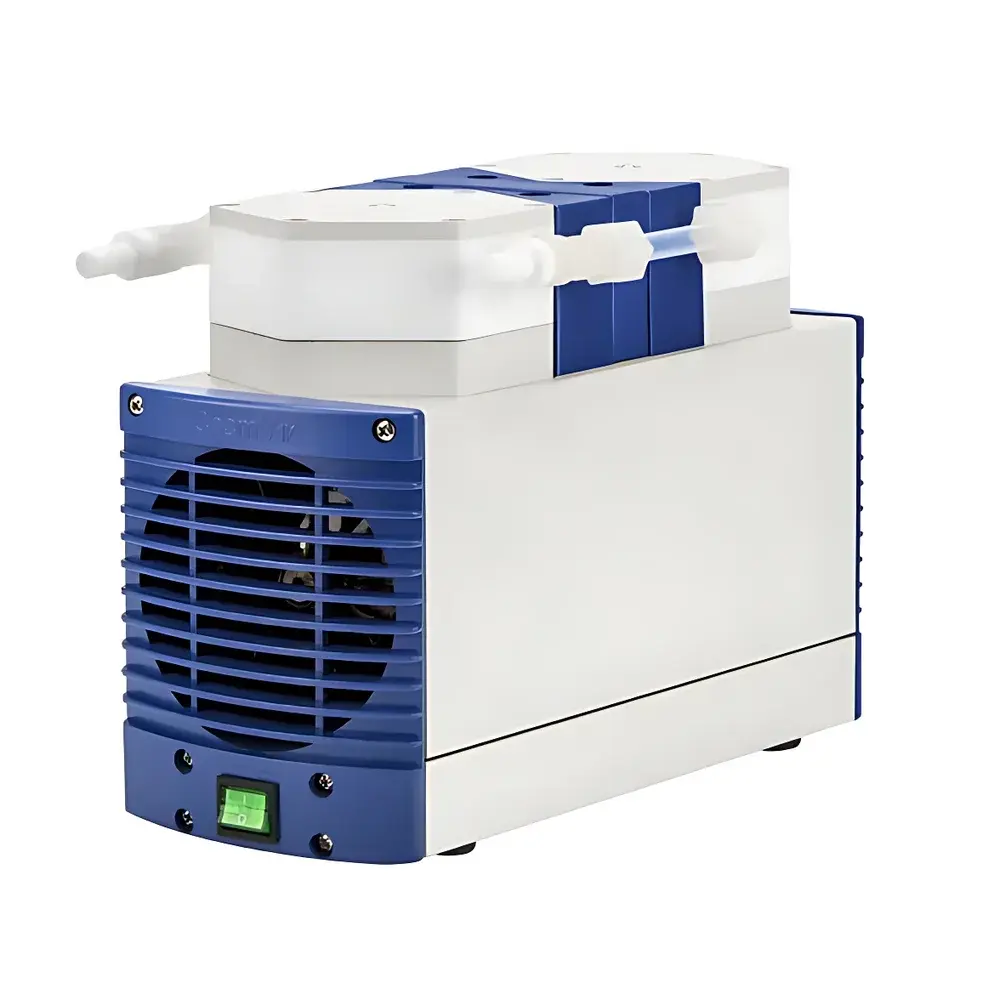
WIGGENS C600 Chemical-Resistant Diaphragm Vacuum Pump
| Brand | WIGGENS |
|---|---|
| Origin | Germany |
| Model | C600 |
| Pump Type | Diaphragm Vacuum Pump |
| Oil-Free Operation | Yes |
| Ultimate Vacuum | 90 mbar |
| Flow Rate | 60 L/min |
| Dimensions (W×D×H) | 380 × 162 × 226 mm |
| Weight | 13.2 kg |
| Motor Power | 270 W |
| Noise Level | 60 dB(A) |
| Electrical Supply | 220–240 V / 50 Hz |
| Rated Current | 1.1 A |
| Motor Speed | 1450 rpm |
| Inlet/Outlet Port Size | 10 mm |
| Protection Features | Thermal Overload Cut-off, Fuse Protection |
Overview
The WIGGENS C600 Chemical-Resistant Diaphragm Vacuum Pump is an engineered solution for laboratories and pilot-scale facilities requiring reliable, contamination-free vacuum generation in chemically aggressive environments. Based on positive displacement principle, the pump operates via oscillating PTFE-coated diaphragms that alternately expand and compress the gas chamber—enabling dry, oil-free evacuation without lubricants or cooling water. Unlike rotary vane or water-ring pumps, the C600 eliminates risks associated with oil carryover, wastewater discharge, or vapor condensation-induced corrosion. Its sealed, isolated drive mechanism physically separates the gas-handling chamber from motor components, significantly extending service life under continuous exposure to acidic vapors, halogenated solvents, and reactive process gases. Designed and assembled in Germany, the C600 meets stringent EU safety directives (e.g., CE, RoHS) and aligns with ISO 9001-certified manufacturing protocols.
Key Features
- Full PTFE wetted path: All gas-contact surfaces—including diaphragm, valves, inlet/outlet manifolds, and internal chambers—are constructed from virgin polytetrafluoroethylene, ensuring resistance to HCl, HF, Cl₂, SO₂, organic acids, and aggressive solvent vapors.
- Hermetically separated drive system: The motor and transmission assembly are fully isolated from the vacuum chamber by a stainless-steel barrier, preventing chemical ingress and mechanical wear.
- Thermal protection circuitry: Integrated temperature sensors trigger automatic shutdown at critical thermal thresholds (>85 °C), followed by auto-restart once ambient equilibrium is restored—ensuring uninterrupted operation in unattended applications.
- Low-noise architecture: Optimized diaphragm actuation dynamics and acoustic damping housing limit operational noise to ≤60 dB(A) at 1 m distance, suitable for shared lab environments.
- Plug-and-play readiness: Equipped with standard 10 mm barbed ports, IEC 60320 C13 power inlet, and built-in line fuse—no external controllers or coolant loops required.
Sample Compatibility & Compliance
The C600 is validated for use with corrosive, condensable, and non-explosive process streams commonly encountered in analytical chemistry, pharmaceutical R&D, and fine chemical synthesis. It complies with EN 61000-6-3 (EMC emission limits) and EN 61000-6-2 (immunity standards). While not intrinsically safe for Zone 1/2 hazardous areas, it may be deployed in ventilated fume hoods or secondary containment systems per OSHA 1910.120 and local chemical hygiene plans. When paired with optional PTFE-coated vacuum regulators and sintered PTFE inlet filters (e.g., WIGGENS F-PTFE-10), the system supports GLP-compliant documentation of vacuum setpoints and particulate retention (≥0.5 µm efficiency). Note: Not intended for use with pyrophoric, oxidizing, or highly polymerizable gases (e.g., vinyl chloride, acetylene).
Software & Data Management
The C600 operates as a standalone analog device without embedded firmware or digital interfaces. However, its stable vacuum output and consistent flow profile enable seamless integration into automated workflows via external pressure transducers (e.g., MKS Baratron series) and programmable logic controllers (PLCs). Users deploying the pump in regulated environments (e.g., FDA-regulated QC labs) can implement 21 CFR Part 11-compliant audit trails by logging vacuum setpoints, runtime hours, and thermal event logs through third-party SCADA platforms such as Ignition or Siemens Desigo CC. Optional analog 0–10 V or 4–20 mA output modules (sold separately) support closed-loop vacuum control in rotation evaporation or freeze-drying systems.
Applications
- Vacuum-assisted filtration of aggressive filtrates (e.g., nitric acid digests, chlorinated solvent washes)
- Rotary evaporation of low-boiling, corrosive solvents (e.g., dichloromethane, THF, acetone/HCl mixtures)
- Reduced-pressure distillation of thermally sensitive APIs in GMP pilot batches
- Gel drying and lyophilization pre-evacuation where hydrocarbon-free vacuum is mandatory
- Solid-phase extraction (SPE) manifolds handling fluoride-containing eluents
- Replacement of water aspirators in teaching labs to reduce municipal water consumption and eliminate backflow hazards
FAQ
Is the C600 suitable for pumping hydrogen chloride (HCl) gas continuously?
Yes—provided condensate is trapped upstream and inlet temperature remains below 60 °C. PTFE components maintain structural integrity up to 260 °C, but prolonged exposure to hot, saturated HCl vapor may accelerate diaphragm fatigue.
Can the ultimate vacuum be improved beyond 90 mbar?
No—the 90 mbar rating reflects single-stage diaphragm architecture limitations. For sub-10 mbar performance, consider cascade configurations or supplemental backing pumps (e.g., WIGGENS D300 dual-stage unit).
Does the pump require scheduled maintenance?
No oil changes or valve replacements are needed within first 5,000 operating hours under typical lab conditions. Annual inspection of diaphragm elasticity and inlet filter clogging is recommended per ISO 55001 asset management guidelines.
Is electrical certification available for North American markets?
UL/cUL listing is not included standard; however, the C600 meets CSA C22.2 No. 61010-1 requirements when installed with UL-listed power cords and overcurrent protection per NEC Article 430.
How does the C600 compare to oil-lubricated rotary vane pumps in terms of lifetime cost?
Over a 5-year lifecycle, the C600 reduces TCO by eliminating oil disposal fees (~$120/year), filter replacements (~$85/year), and downtime for oil changes (~4 hr/year), while avoiding VOC emissions reporting under EPA Method 25A.



