
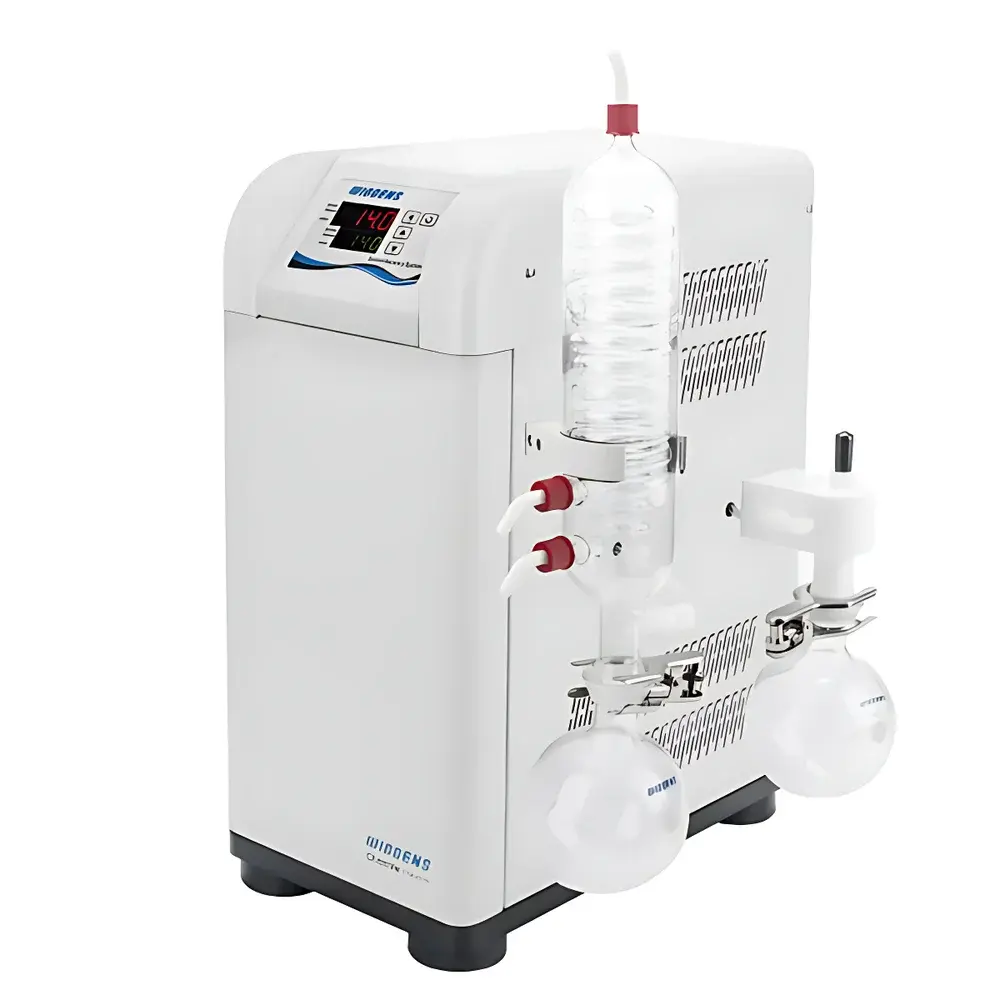
WIGGENS CSC920Z Corrosion-Resistant Solvent Recovery Diaphragm Vacuum Pump
| Brand | WIGGENS |
|---|---|
| Origin | Germany |
| Model | CSC920Z |
| Pump Type | Diaphragm Vacuum Pump |
| Ultimate Vacuum | ≤8 mbar |
| Pumping Speed | 75 L/min |
| Dimensions (W×D×H) | 220 × 400 × 495 mm |
| Weight | 25 kg |
| Motor Power | 400 W |
| Vacuum Resolution | 0.1 mbar |
| Vacuum Range | 0.1–1000 mbar |
| Noise Level | 50 dB(A) |
| Inlet Port Size | 10 mm |
| Voltage | 220–240 V / 50 Hz |
Overview
The WIGGENS CSC920Z is a corrosion-resistant, oil-free diaphragm vacuum pump engineered specifically for solvent recovery applications in demanding laboratory and pilot-scale chemical processing environments. Unlike traditional rotary vane or water-ring pumps, the CSC920Z employs a chemically inert PTFE-coated diaphragm and valve system—ensuring full compatibility with aggressive solvents, acidic vapors, alkaline condensates, and halogenated compounds commonly encountered during rotary evaporation, fractional distillation, crystallization, and vacuum drying. Its core operational principle relies on positive displacement via oscillating PTFE diaphragms driven by a brushless AC motor, eliminating oil contamination risks and enabling true maintenance-free operation over extended duty cycles. The integrated variable-frequency drive (VFD) enables precise, closed-loop vacuum regulation through AI-enhanced PID control—dynamically adjusting motor speed to maintain user-defined setpoints within ±0.3 mbar repeatability across fluctuating load conditions.
Key Features
- PTFE-wetted path throughout entire gas stream—including diaphragm, valves, inlet/outlet manifolds, and internal chamber—guaranteeing resistance to HCl, HF, HNO₃, NaOH, acetone, THF, DCM, and other corrosive media.
- Intelligent VFD-based vacuum control with auto-tuning PID algorithm; supports multi-step programmable vacuum profiles and real-time setpoint adjustment via front-panel interface or analog 0–10 V input.
- Energy-efficient adaptive operation: motor automatically reduces speed or enters standby mode when target vacuum is achieved, lowering power consumption by up to 60% versus fixed-speed equivalents.
- Integrated digital vacuum gauge with 0.1 mbar resolution and selectable units (mbar, Torr, kPa); calibrated traceably to NIST-traceable standards.
- Modular architecture allows seamless integration with cold traps, buffer flasks (10 mm standard inlet), condensers, and automated evaporation systems—compliant with ISO 8573-1 Class 0 air purity requirements for critical processes.
- Acoustically optimized housing and vibration-dampened mounting reduce operational noise to ≤50 dB(A) at 1 m distance—suitable for shared lab spaces and GLP-compliant environments.
Sample Compatibility & Compliance
The CSC920Z is validated for continuous use with volatile organic compounds (VOCs), low-boiling solvents (e.g., diethyl ether, pentane), and reactive process streams containing residual moisture or particulates—provided upstream filtration (e.g., glass fiber or sintered PTFE pre-filter) is employed. It meets IEC 61000-6-3 (EMC emissions) and IEC 61000-6-2 (immunity) standards. All electrical components comply with CE marking directives (2014/30/EU, 2014/35/EU). While not intrinsically safe per ATEX/IECEx, it is rated for use in Zone 2/22 environments when installed with appropriate ventilation and solvent vapor monitoring per OSHA 1910.120 and EU Directive 1999/92/EC. Documentation includes Factory Calibration Certificate and Material Declaration (RoHS/REACH compliant).
Software & Data Management
The built-in vacuum controller supports RS-485 Modbus RTU communication for integration into LabVantage, DeltaV, or custom SCADA systems. Optional PC software (WIGGENS VacuumLink™) provides audit-trail-enabled logging (timestamped vacuum values, runtime, fault codes), configurable alarms, and CSV export compatible with 21 CFR Part 11 requirements when deployed with validated electronic signatures and role-based access control. All parameter changes are recorded with operator ID and timestamp—supporting GLP/GMP traceability in pharmaceutical QC labs and contract research organizations.
Applications
- Vacuum-assisted solvent recovery from reaction mixtures and extraction residues in API synthesis.
- Controlled-rate rotary evaporation of heat-sensitive natural products under defined sub-atmospheric pressures (2–30 mbar range).
- Crystallization under reduced pressure to modulate supersaturation kinetics and polymorph selection.
- Drying of hygroscopic or oxidation-prone intermediates in glovebox-integrated systems.
- Membrane filtration and degassing of electrolyte solutions in battery R&D laboratories.
- High-purity vacuum transfer of etchants and photoresist developers in semiconductor cleanrooms (Class 100–1000).
FAQ
Is the CSC920Z suitable for handling hydrochloric acid vapors during distillation?
Yes—the entire gas path is constructed from PTFE and FFKM elastomers, offering full resistance to HCl vapor up to 120 °C saturation temperature under dynamic flow conditions.
Can it be operated continuously for 24/7 solvent recovery cycles?
Yes—designed for >10,000 hours MTBF; thermal overload protection and automatic duty-cycle modulation prevent overheating during extended operation.
Does it require periodic oil changes or membrane replacement?
No—this is an oil-free diaphragm pump with lifetime-lubricated bearings and field-replaceable PTFE diaphragms (typical service interval: 6,000–8,000 hours depending on solvent load).
How does the PID auto-tuning function adapt to changing ambient temperatures?
The controller performs real-time gain scheduling based on ambient sensor feedback and historical process deviation data—ensuring stable regulation across 15–35 °C operating ranges without manual recalibration.
Is remote monitoring supported via Ethernet or Wi-Fi?
Standard RS-485 Modbus enables connection to industrial gateways; optional Ethernet-to-Modbus converters (e.g., Moxa EDS-205A) provide TCP/IP access for centralized lab infrastructure management.



