
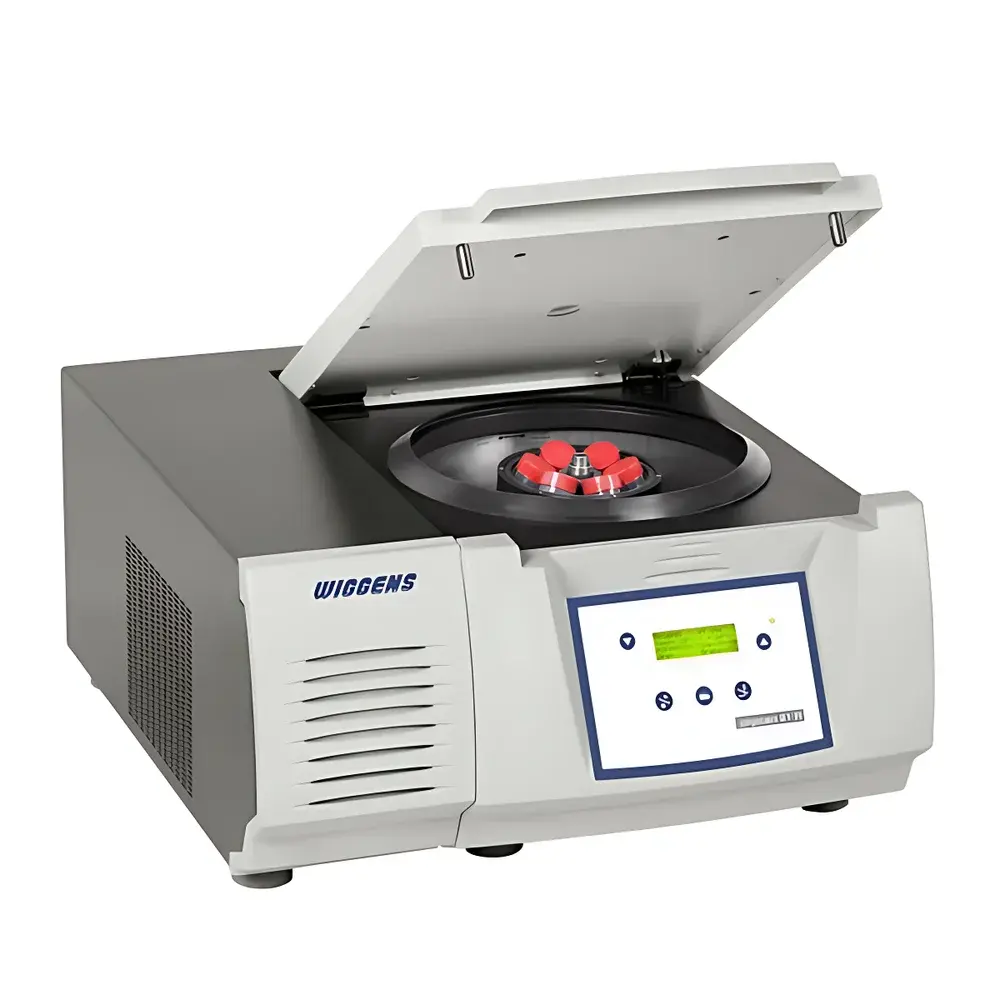
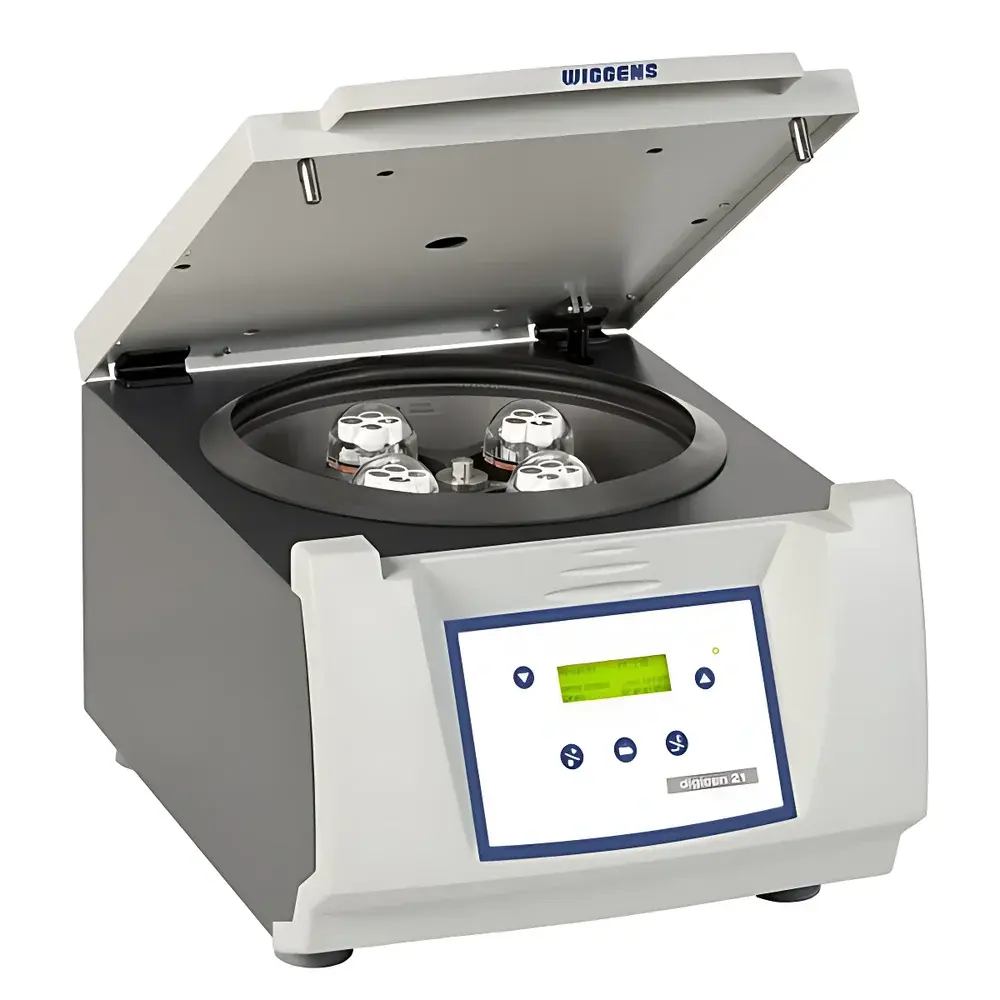
WIGGENS DIGICEN 21/21R Programmable Refrigerated Microplate Centrifuge
| Brand | WIGGENS |
|---|---|
| Origin | Germany |
| Model | DIGICEN 21/21R |
| Instrument Type | Benchtop Refrigerated Microplate Centrifuge |
| Max RCF | 26480 × g |
| Max Speed | 16500 rpm |
| Sample Capacity | 4 × 100 mL |
| Acceleration Time | ≥5 s |
| Operating Noise | ≤60 dB(A) |
| Temperature Range | −20 °C to +40 °C |
| Refrigerant | R449A |
| Compliance | EN 61010-1, EN 61010-2-020, EN 61326-1, Directive 2011/65/EU, 2012/19/EU, 98/79/EC |
Overview
The WIGGENS DIGICEN 21/21R is a high-performance, programmable refrigerated microplate centrifuge engineered for precision separation in life science laboratories. Utilizing fixed-angle and horizontal rotor configurations, it delivers controlled sedimentation forces up to 26,480 × g at speeds up to 16,500 rpm—optimized for applications requiring thermal stability during high-speed microplate processing. Its core architecture integrates a brushless DC motor, active refrigeration with R449A eco-friendly refrigerant, and real-time cavity temperature monitoring via an internal Pt100 sensor. Unlike conventional centrifuges, the DIGICEN 21/21R maintains consistent thermal conditions throughout operation—even at maximum speed—enabling reproducible pelleting of temperature-sensitive biomolecules such as RNA, enzymes, and cell lysates. Designed for GLP-compliant workflows, its mechanical safety interlocks, imbalance detection, and audit-ready operational logging support regulated environments including clinical diagnostics and pharmaceutical QC labs.
Key Features
- Programmable control with LCD interface displaying real-time rpm, RCF, elapsed time, and cavity temperature
- 16 user-defined protocols with stepwise timing (1–99 min, 5-sec increments) and dual counting modes (count-up/count-down)
- PCBS (Progressive Control Braking System): 175 selectable acceleration/deceleration ramps to minimize resuspension and preserve pellet integrity
- Refrigerated operation from −20 °C to +40 °C (1 °C resolution); pre-cooling function ensures sample thermal equilibration prior to run initiation
- Stainless-steel centrifuge chamber with integrated thermal insulation layer and forced-air cooling circuit to limit heat accumulation
- Comprehensive safety suite: automatic mechanical lid lock, emergency manual release, lid-drop prevention, optical inspection window, and automatic shutdown upon imbalance detection
- Autoclavable rotors and adapters (121 °C, 20 min), quick-release rotor mounting, and tool-free adapter installation
- Energy-saving mode with auto-power-off after idle timeout; post-run refrigeration hold maintains setpoint temperature for sample integrity
Sample Compatibility & Compliance
The DIGICEN 21/21R accommodates diverse sample formats via interchangeable rotors: horizontal RT267 (28 × 15 mL), RT143 (4 × 50 mL), RT138 (4 × 100 mL), and angular RT150 (6/4/2 microplates) or RT183 (32 × 0.2 mL tubes). It supports standard microplates (128 × 86 mm footprint), deep-well plates, cell culture plates, capillary tubes, conical-bottom tubes, cryovials, and PCR strips. All rotors are certified for steam sterilization per ISO 17665-1. The instrument complies with EN 61010-1 (safety of laboratory equipment), EN 61010-2-020 (particular requirements for centrifuges), and EN 61326-1 (EMC). Regulatory alignment includes EU In Vitro Diagnostic Medical Device Directive (98/79/EC), Low Voltage Directive (2006/95/EC), EMC Directive (2004/108/EC), RoHS (2011/65/EU), and WEEE (2012/19/EU). Refrigerant use adheres to Regulation (EC) No 1005/2009 and No 842/2006.
Software & Data Management
While the DIGICEN 21/21R operates via embedded microcontroller without external PC dependency, its firmware architecture supports full traceability per FDA 21 CFR Part 11 principles. Each run logs timestamp, rotor ID, speed, RCF, duration, temperature setpoint, actual cavity temperature, acceleration/deceleration profile, and fault events (e.g., imbalance, lid error). Log data is retained in non-volatile memory for ≥10,000 cycles and exportable via optional RS-232 or USB interface (firmware v2.4+). Password-protected parameter editing prevents unauthorized protocol modification. Audit trail functionality meets GLP/GMP documentation requirements for QC release testing and method validation studies.
Applications
- Microplate-based assays: rapid pelleting of ELISA plates, cell-based screening plates, and nucleic acid binding plates prior to aspiration or washing steps
- High-throughput sample prep: consolidation of lysates, supernatants, or precipitates from multiwell formats into uniform pellets for downstream analysis
- Cryopreservation workflows: controlled deceleration minimizes ice crystal disruption in frozen-thawed samples
- Diagnostic sample processing: separation of serum/plasma from whole blood in microtiter formats under temperature-controlled conditions
- Protein purification: low-shear pelleting of inclusion bodies or affinity beads without aggregation
- Quality control in biomanufacturing: routine verification of suspension homogeneity and particulate clearance in final drug product containers
FAQ
Does the DIGICEN 21R support GMP-compliant electronic records?
Yes—the device maintains tamper-evident run logs with timestamps, operator IDs (via optional RFID badge integration), and full parameter history, satisfying ALCOA+ data integrity criteria.
Can I run microplates and tube rotors interchangeably on the same unit?
Yes—rotor changes require no tools; the system automatically detects rotor type and enforces speed/RCF limits based on mechanical certification.
What is the lowest temperature achievable at 16,500 rpm?
With RT183 angular rotor installed, the chamber stabilizes at −6 °C at maximum speed; RT138 horizontal rotor achieves −7 °C under identical conditions.
Is remote monitoring or network connectivity available?
Standard configuration includes local display and keypad control; Ethernet or Wi-Fi modules are available as factory-installed options for Lab Information Management System (LIMS) integration.
How often does the R449A refrigerant require servicing?
Sealed-system design ensures refrigerant longevity exceeding 10 years under normal lab use; no scheduled replenishment is required unless physical damage compromises integrity.






