
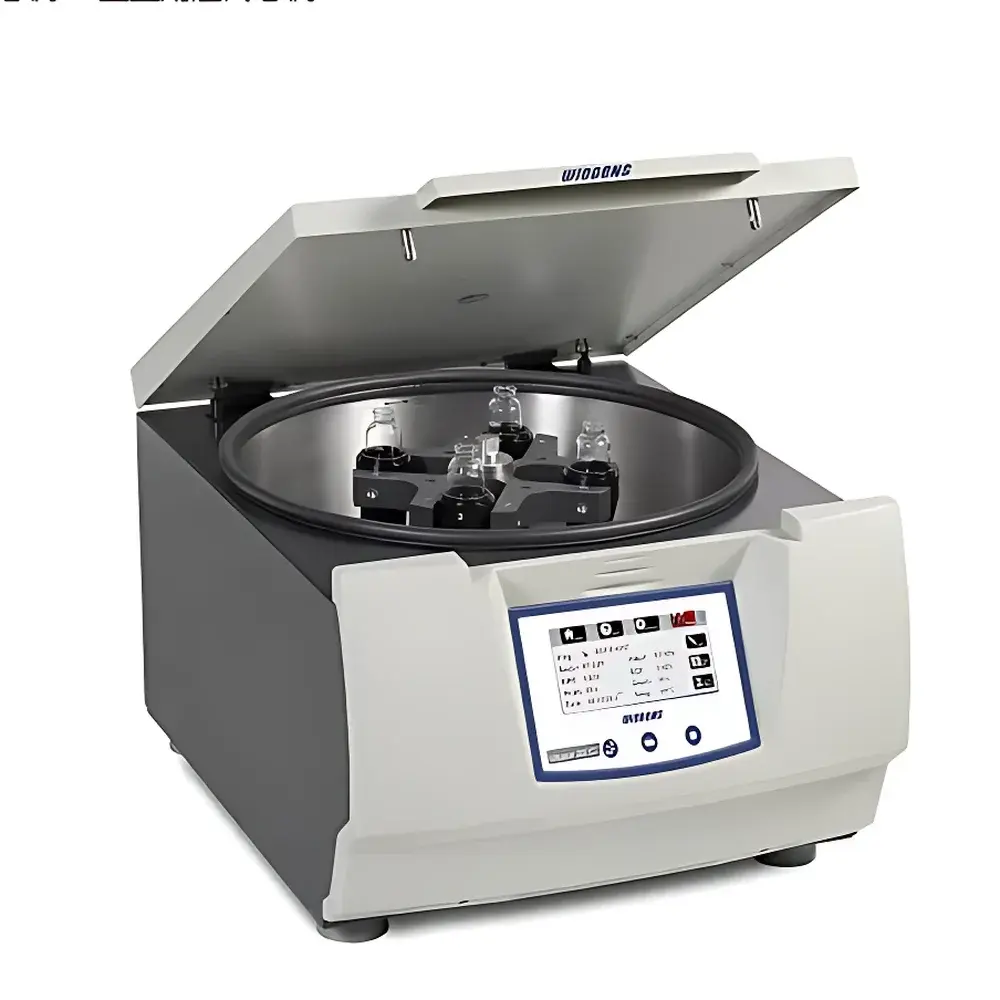
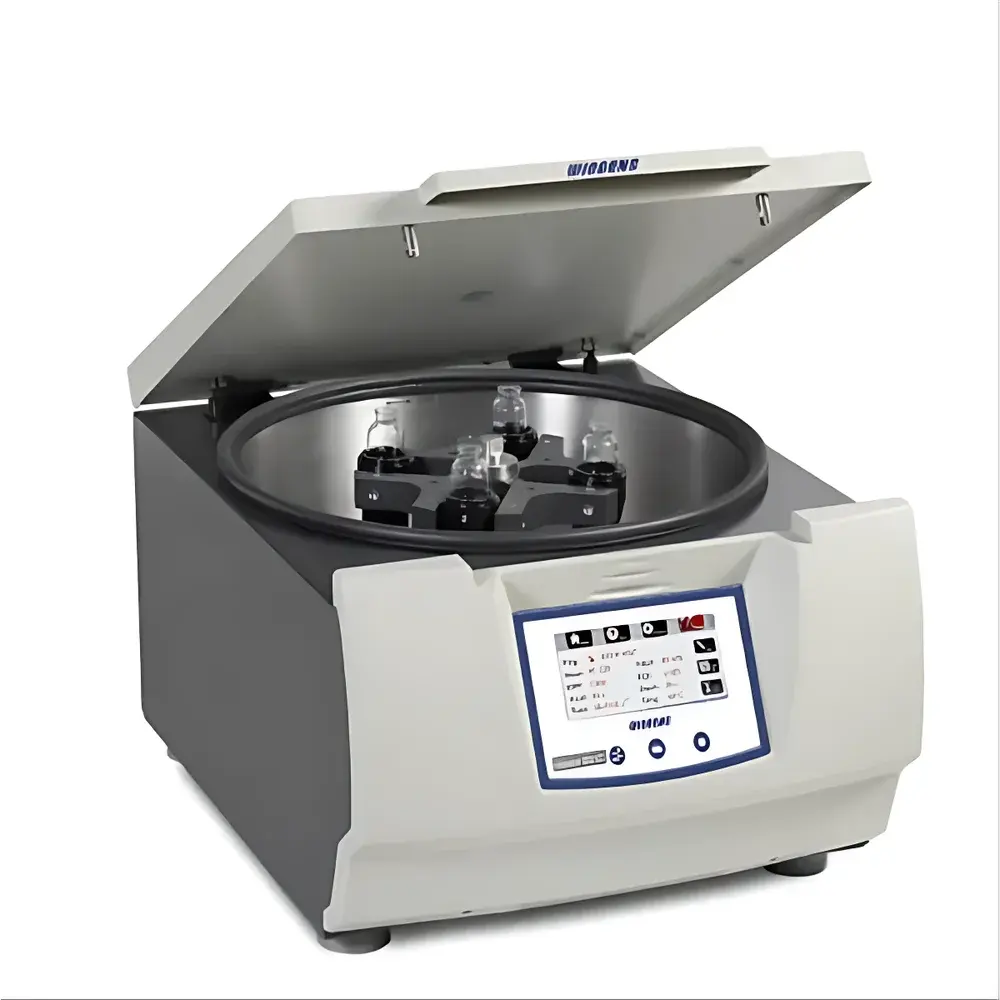
WIGGENS Digtor 22 C-8 Benchtop Refrigerated Centrifuge
| Brand | WIGGENS |
|---|---|
| Origin | Germany |
| Model | Digtor 22 C-8 |
| Instrument Type | Benchtop Refrigerated Centrifuge |
| Maximum Capacity | 8 × 100 mL (6" or 8" tubes) |
| Max RCF | 2425 × g |
| Max Speed | 3000 rpm |
| Temperature Range | RT + 5 °C to 80 °C (adjustable in 1 °C steps) |
| Noise Level | < 60 dB(A) |
| Compliance | ASTM D91, D96, D893, D1796, D2273, D2709, D2711, D4007, D5546 |
| Safety Certifications | EN 61010-1, EN 61010-2-020, EN 61010-2-010, EN 61326-1, EN 61326-2-6 |
| EU Directives | 2011/65/EU (RoHS), 2012/19/EU (WEEE), 2014/30/EU (EMC), 2014/35/EU (LVD), 98/79/EC (IVDR) |
Overview
The WIGGENS Digtor 22 C-8 is a precision-engineered benchtop refrigerated centrifuge designed for standardized sediment and water separation in petroleum-based fluids—particularly in accordance with ASTM, ISO, IP, and API test methods for lubricants, fuels, and used oils. Operating on the principle of sedimentation under controlled gravitational force (RCF), the Digtor 22 C-8 delivers reproducible, method-compliant separations at up to 2425 × g (3000 rpm), with integrated temperature control enabling thermal stabilization from ambient +5 °C to 80 °C. Its horizontal rotor configuration supports high-volume sample processing (up to 8 × 100 mL), accommodating standard 6-inch and 8-inch cylindrical tubes, pear-shaped tubes, and 12.5 mL conical tubes—making it suitable for routine QC testing in refinery labs, lubricant service centers, and third-party petroleum analysis facilities.
Key Features
- Microprocessor-controlled operation with TFT color display (visible beyond 3 m), showing real-time rpm, RCF, elapsed time, acceleration/deceleration profiles, and unbalance position (ULS)
- Programmable speed control in 10 rpm / 10 × g increments, with live RCF recalculated dynamically based on installed rotor and tube geometry
- 175-step programmable acceleration and braking profiles (PCBS) to prevent resuspension of sediments and ensure stratified layer integrity
- 40 user-programmable methods with password protection, automatic recall of last-used parameters, and rotor/adapter memory recognition
- Integrated heating system with pre-heating mode (activated post-loading), cavity-mounted temperature sensor, overtemperature cutoff, and thermal insulation to minimize energy loss
- Double mechanical + electromagnetic lid lock system with emergency manual release, anti-drop safety guard, transparent viewing window, and automatic lid opening/closing via program logic
- Unbalance detection (ULS) triggers immediate shutdown and displays exact rotor position number; full chamber isolation with stainless-steel rotor chamber and reinforced safety shielding
- Brushless maintenance-free motor, forced-air cooling for thermal management, noise level < 60 dB(A), and optional GRS vacuum exhaust system (pre-installed port)
Sample Compatibility & Compliance
The Digtor 22 C-8 is validated for use with standardized glass or polypropylene centrifuge tubes conforming to ASTM D96 (water and sediment in fuel oils), ASTM D2709 (water and sediment in aviation turbine fuels), and ISO 9030 (determination of water and sediment in crude oil). It accommodates both vertical and horizontal orientation during non-centrifugation phases—ensuring tube stability prior to acceleration. All rotors and adapters are autoclavable (121 °C, 20 min), supporting GLP-aligned cleaning protocols. The instrument complies fully with EN 61010-1 (safety requirements for electrical equipment), EN 61010-2-020 (particular requirements for centrifuges), and EN 61326-1/-2-6 (EMC for laboratory use), satisfying regulatory expectations for auditable environments under ISO/IEC 17025 and FDA 21 CFR Part 11–compatible data handling when paired with compliant software.
Software & Data Management
While the Digtor 22 C-8 operates as a standalone instrument, its digital interface supports traceable operation through timestamped parameter logging, audible and visual status alerts, and stepwise program execution with pause/resume capability. The embedded controller records run history—including start/stop times, setpoints, actual RCF achieved, temperature deviation, and unbalance events—for internal QA review. For laboratories requiring electronic records, the unit’s RS-232 or optional USB interface enables integration with LIMS or custom SCADA systems, provided external software enforces audit trail, electronic signature, and data integrity controls per ALCOA+ principles. No proprietary cloud platform is required; raw operational metadata can be exported in CSV format for archival.
Applications
- Quantitative determination of water and sediment content in diesel, gasoline, jet fuel, lubricating oils, and crude oil per ASTM D91, D96, D2709, and ISO 3734
- Sediment analysis in used engine oils (ASTM D893, D4007) and oxidation byproduct assessment (ASTM D2273)
- Emulsion stability testing in formulated fuels and bio-blends (API RP 2542)
- Particulate matter isolation for gravimetric analysis (ASTM D1796, D2711)
- Preparative separation of coalesced contaminants prior to FTIR, GC-MS, or elemental analysis
- Temperature-dependent phase separation studies in thermal stability testing (e.g., ISO 9030 at elevated temperatures)
FAQ
What standards does the Digtor 22 C-8 directly support?
It is configured and validated for ASTM D91, D96, D893, D1796, D2273, D2709, D2711, D4007, D5546; API RP 2542 and 2548; ISO 3734 and 9030; IP 75 and 359; DIN 51793; BS 4385; and NF M07-020.
Can the rotor be removed while the lid is closed?
No—the lid must be fully opened and mechanically unlocked before rotor access. However, the rotor can be installed or removed with the lid in the open position without tools.
Is the heating function usable during centrifugation?
Yes. The integrated heater operates concurrently with rotation, maintaining setpoint temperature within ±1.5 °C across the full speed range, verified per ISO 9030 thermal uniformity requirements.
Does the unit include rotor identification capability?
Yes. Automatic rotor recognition prevents overspeed conditions and ensures RCF calculations reflect actual geometry and mass distribution.
What safety certifications apply to this model?
It carries CE marking under EU directives 2014/35/EU (LVD), 2014/30/EU (EMC), 2011/65/EU (RoHS), and complies with EN 61010-1, EN 61010-2-020, EN 61326-1, and EN 61326-2-6 for laboratory instrumentation safety and electromagnetic compatibility.



