
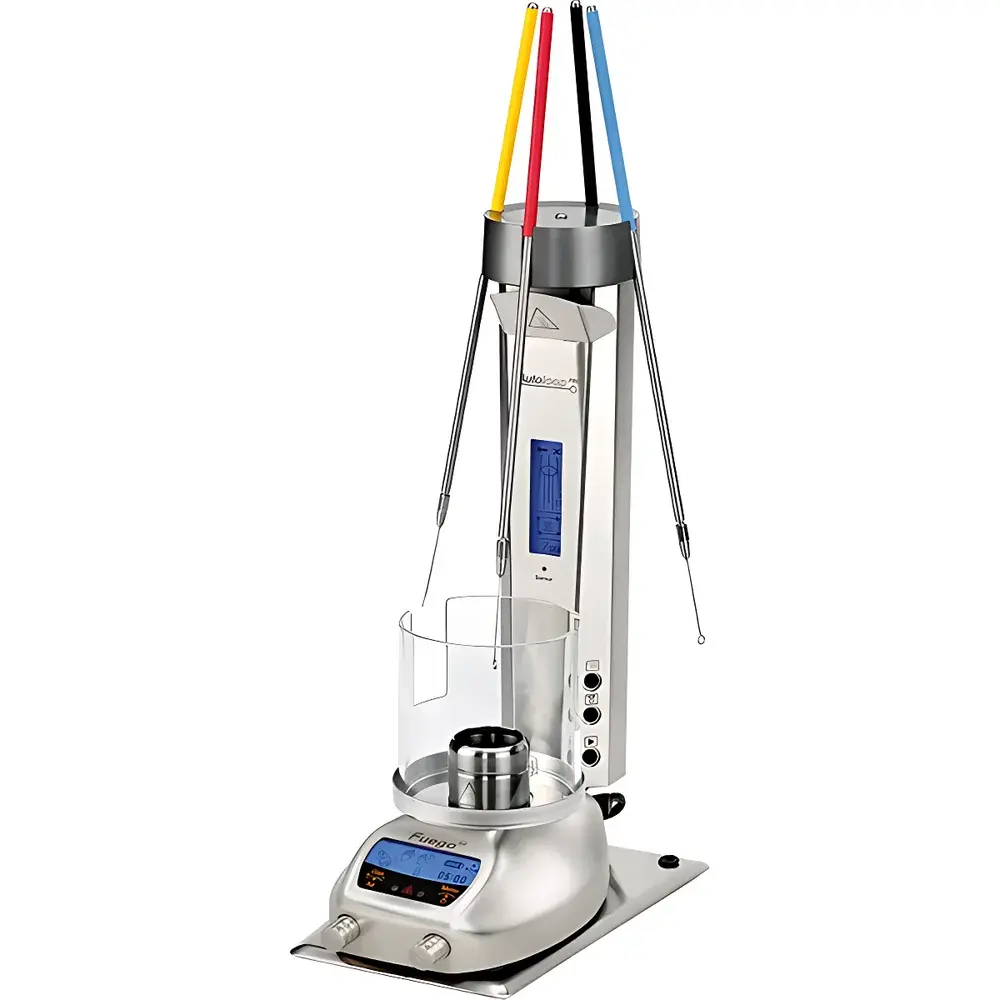
WIGGENS Ecoloop Automatic Rotating Inoculation Loop Sterilizer
| Brand | WIGGENS |
|---|---|
| Origin | Germany |
| Model | Ecoloop |
| Control Mode | Manual |
| Rotation Mechanism | Motorized, Bidirectional (Left/Right Adjustable) |
| Sterilization Method | Open-flame thermal sterilization using compatible WIGGENS-Fuego Bunsen burners |
| Detection System | Integrated optical sensor for loop presence/absence detection |
| Auto Shut-off | Yes, configurable at 15 min or 60 min |
| Flame Intensity Settings | 2 levels |
| Post-sterilization Cooling Options | 2 selectable durations |
| Status Indication | Dual-color LED (red = hot, green = cooled) |
| Construction Material | Stainless steel |
| Dimensions (W×D×H) | 120 × 150 × 395 mm |
| Weight | 1800 g |
| Compliance | Designed for ISO 13485-aligned lab environments |
Overview
The WIGGENS Ecoloop Automatic Rotating Inoculation Loop Sterilizer is an engineered solution for precise, repeatable flame-based sterilization of microbiological inoculation loops and needles in controlled laboratory settings. Unlike conventional handheld flaming or static burner stands, the Ecoloop integrates a motor-driven rotational mechanism synchronized with standard WIGGENS-Fuego Bunsen burners to ensure uniform thermal exposure across the entire wire surface. Its operation relies on open-flame pyrolysis—achieving rapid microbial inactivation (>6-log reduction of vegetative bacteria and spores) through transient exposure to temperatures exceeding 800 °C. Designed specifically for high-throughput microbiology, cell culture, and biotechnology workflows, the Ecoloop eliminates operator-dependent variability in dwell time, angle, and distance—critical parameters affecting both sterility assurance and loop integrity. The device operates independently of external power sources beyond its low-voltage control circuitry, making it compatible with laminar flow hoods, biosafety cabinets, and ISO Class 5–7 cleanroom environments where electromagnetic interference or compressed gas infrastructure is restricted.
Key Features
- Motorized bidirectional rotation (left/right adjustable) ensures complete circumferential exposure of loops and needles to the flame zone.
- Integrated optical detection system automatically confirms loop presence before initiating rotation—preventing unintended actuation and conserving fuel.
- Dual-intensity flame mode allows optimization for fine-gauge platinum loops (low setting) or heavier nickel-chromium wires (high setting), minimizing oxidation and extending tool life.
- Configurable post-sterilization cooling intervals (1–45 seconds) enable safe, immediate handling without thermal shock to sensitive media or agar surfaces.
- Visual status feedback via dual-color LED indicators: red signifies elevated surface temperature (>60 °C); green confirms safe-to-touch conditions (<40 °C).
- Compact stainless-steel chassis (120 × 150 × 395 mm) occupies minimal benchtop footprint—ideal for integration into confined biosafety cabinets or modular clean benches.
- Auto shut-off timer with dual thresholds (15 minutes or 60 minutes) complies with institutional safety protocols for unattended equipment operation.
Sample Compatibility & Compliance
The Ecoloop accommodates all standard microbiological inoculation loops and straight needles with diameters ranging from 0.5 mm to 1.2 mm, including platinum, nichrome, and stainless-steel variants. It is validated for use exclusively with WIGGENS-Fuego series Bunsen burners (models Fuego 1000–3000), ensuring consistent flame geometry and stoichiometric combustion. While not a standalone sterilizer under ISO 17664 or EN 554, the Ecoloop supports adherence to ISO 15189 and CLSI M22-A3 by enforcing standardized, auditable sterilization cycles. Its procedural repeatability contributes to GLP-compliant recordkeeping when paired with lab notebook entries or electronic log systems. No regulatory submission (e.g., FDA 510(k), CE-IVD) applies, as it functions solely as an ancillary mechanical aid to manual flame sterilization—not a medical device or sterilization processor.
Software & Data Management
The Ecoloop operates without embedded firmware or network connectivity; its microcontroller executes fixed-sequence logic with no user-updatable software. All operational parameters—including rotation initiation, flame duration, cooling delay, and auto-off timing—are set via tactile push-button interface with LED confirmation. This architecture eliminates cybersecurity risks, avoids validation overhead associated with computerized systems (per FDA 21 CFR Part 11), and ensures deterministic behavior across instrument lifetimes. For laboratories requiring traceability, cycle logs may be manually recorded or captured via external time-lapse imaging synchronized to LED status transitions. No proprietary drivers, cloud services, or subscription dependencies are involved.
Applications
- Routine sterilization of inoculation loops between streaking steps on agar plates in clinical microbiology labs.
- Aseptic transfer of bacterial or fungal cultures during strain isolation and subculturing protocols.
- Pre-sterilization conditioning of microinjection needles in developmental biology workflows.
- Flame-polishing of glass Pasteur pipettes and capillaries in tissue culture facilities.
- Quality control testing of loop sterility efficacy per USP <71> and EP 5.1.2 guidelines.
- Training modules for new technicians emphasizing standardized aseptic technique execution.
FAQ
Is the Ecoloop compatible with non-WIGGENS Bunsen burners?
No—optimal flame geometry, gas flow rate, and burner port alignment are calibrated specifically for WIGGENS-Fuego models. Use with other burners may result in incomplete sterilization or mechanical interference.
Does the Ecoloop require calibration or periodic maintenance?
No scheduled calibration is required. Routine cleaning of the optical sensor window and rotation shaft with isopropyl alcohol is recommended every 200 cycles to maintain detection reliability.
Can the Ecoloop be used inside a Class II biosafety cabinet?
Yes—its fully enclosed stainless-steel housing, absence of external fans or exhaust, and low-power electronics meet NFPA 45 and ANSI/NSF 49 requirements for internal cabinet operation.
What is the expected service life of the rotation motor?
Rated for ≥50,000 operational cycles under typical lab usage (approx. 5 years at 30 cycles/day), with brushless DC construction ensuring consistent torque and minimal wear.
How does the Ecoloop support audit readiness for ISO 15189 accreditation?
By enforcing identical dwell times, rotation angles, and cooling delays across users and shifts, it reduces inter-operator variation—a key element in method validation and ongoing quality assessment per ISO 15189:2022 clause 5.7.



