
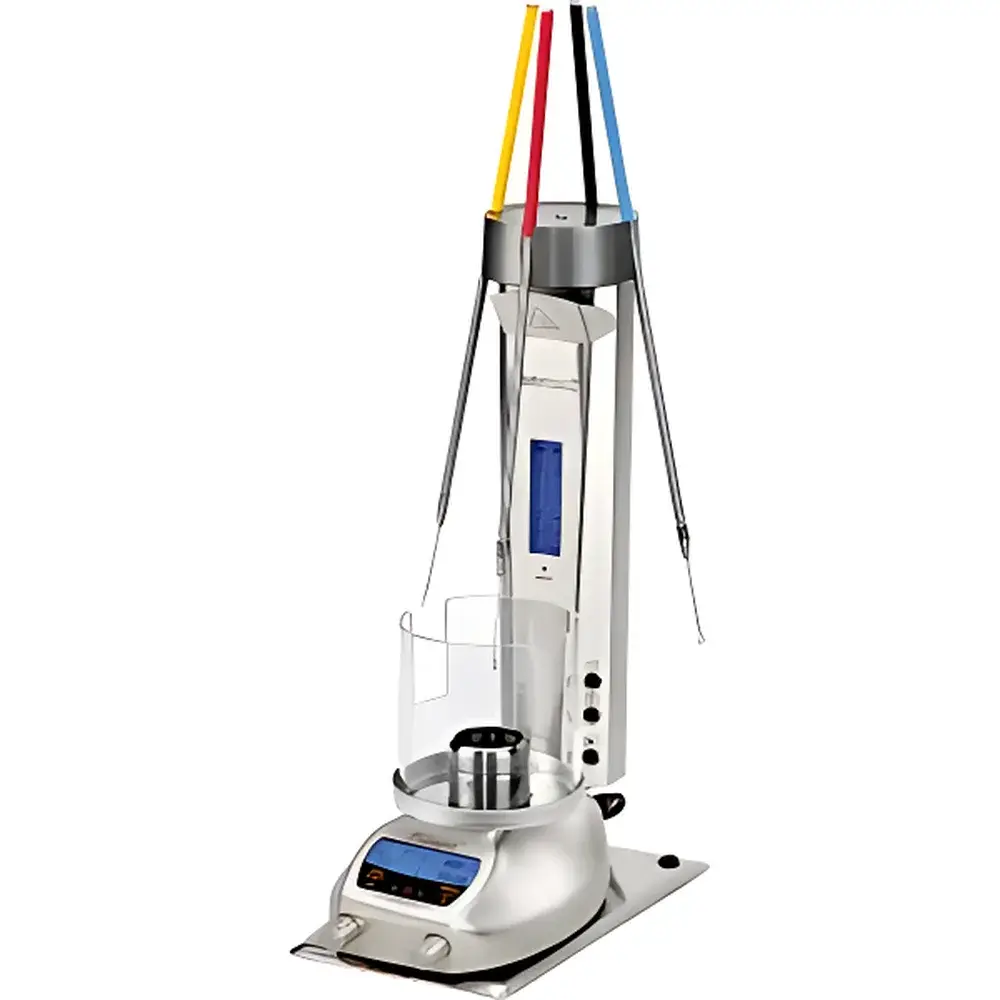
WIGGENS Ecoloop Automatic Rotating Inoculation Loop Sterilizer
| Brand | WIGGENS |
|---|---|
| Origin | Germany |
| Model | Ecoloop |
| Control Mode | Manual |
| Rotation Mechanism | Motorized, Bidirectional (Left/Right Adjustable) |
| Sterilization Time Range | 1–15 s |
| Cooling Time Range | 1–45 s |
| Auto-Shutdown | Yes (15 min / 1 h selectable) |
| Detection System | Integrated Optical Sensor for Loop Presence/Absence |
| Flame Intensity Settings | 2 Levels |
| Post-Sterilization Status Indication | Dual-Color LED (Red = Hot, Green = Cooled) |
| Construction Material | Stainless Steel |
| Dimensions (W×D×H) | 120 × 150 × 395 mm |
| Weight | 1800 g |
| Compatibility | All WIGGENS-Fuego Bunsen Burners |
| Mounting | Benchtop or Cleanbench Integrated Fixture |
Overview
The WIGGENS Ecoloop Automatic Rotating Inoculation Loop Sterilizer is an engineered solution for precise, repeatable, and fuel-efficient flame sterilization of microbiological inoculation loops and needles. Designed for integration with WIGGENS-Fuego Bunsen burners, the Ecoloop operates on the principle of controlled radiant heat exposure combined with programmable rotational kinetics—ensuring uniform thermal treatment across the entire loop surface without manual repositioning. Unlike conventional handheld flaming, which introduces operator-dependent variability and inconsistent dwell times, the Ecoloop executes standardized thermal cycles governed by microprocessor logic, minimizing human error and enhancing reproducibility in aseptic technique-critical workflows. Its compact footprint (120 × 150 × 395 mm) and modular mounting system make it especially suitable for biosafety cabinets, laminar flow hoods, and space-constrained clean benches where ergonomic access and contamination control are paramount.
Key Features
- Optical presence detection system automatically verifies loop insertion and initiates rotation only when the loop is correctly positioned—preventing incomplete sterilization or accidental activation.
- Bidirectional motorized rotation with left/right direction adjustment ensures optimal alignment with flame geometry across diverse burner configurations.
- Dual-level flame intensity selection allows users to match thermal input to loop gauge and material (e.g., platinum vs. nickel-chromium), reducing oxidation and extending loop service life.
- Configurable sterilization duration (1–15 s) and post-sterilization cooling delay (1–45 s) support protocol-specific requirements, including rapid turnover in high-throughput plating or sensitive cell line handling.
- Visual status feedback via dual-color LED indicators: red illumination during active heating or residual thermal hazard; green confirmation upon safe-to-touch temperature threshold attainment.
- Auto-shutdown functionality with dual timer options (15 minutes or 1 hour) complies with laboratory energy conservation policies and mitigates unattended operation risks.
- Stainless steel housing provides corrosion resistance, mechanical durability, and compatibility with routine decontamination protocols using ethanol or quaternary ammonium solutions.
Sample Compatibility & Compliance
The Ecoloop accommodates standard straight, wire-loop, and calibrator-style inoculation tools ranging from 1 mm to 4 mm loop diameters. It is validated for use with all WIGGENS-Fuego series Bunsen burners (models Fuego 100–500), ensuring stable flame coupling and consistent thermal transfer. While not a medical device under EU MDR or FDA 510(k), its operational repeatability supports adherence to ISO 13408-1 (Aseptic Processing of Health Care Products) and CLSI M22-A4 (Quality Assurance for Microbiological Culture Media) guidelines. The absence of consumables, closed-loop sensor feedback, and deterministic cycle timing facilitate audit-ready documentation in GLP- and GMP-aligned environments.
Software & Data Management
The Ecoloop operates via embedded firmware without external software dependency. All operational parameters—including sterilization time, cooling delay, shutdown timer, and flame intensity—are retained in non-volatile memory after power cycling. No data logging or export capability is provided; however, the deterministic nature of its control architecture enables full traceability through procedural SOPs. For laboratories requiring electronic records, integration with LIMS or ELN systems may be achieved via external footswitch-triggered event timestamps synchronized to instrument activation cycles.
Applications
- Routine sterilization of inoculation loops and needles in clinical microbiology labs performing bacterial isolation, colony purification, and antibiotic susceptibility testing.
- Aseptic transfer workflows in mammalian and insect cell culture facilities where thermal shock minimization and operator consistency directly impact viability and passage integrity.
- Teaching laboratories implementing standardized aseptic technique training—reducing inter-student variability and reinforcing reproducible flame-sterilization practice.
- Biotechnology QC/QA settings conducting environmental monitoring swab processing or media sterility verification where documented thermal exposure cycles support regulatory submissions.
- Research labs utilizing thermosensitive genetic constructs or recombinant proteins, where controlled cooldown intervals prevent unintended denaturation during post-sterilization handling.
FAQ
Does the Ecoloop require calibration or periodic certification?
No. The Ecoloop contains no adjustable analog components or drift-prone sensors; its timing accuracy is governed by quartz-crystal oscillator circuitry, meeting ±0.5% tolerance per IEC 60751. Routine functional verification—using a calibrated infrared thermometer to confirm loop surface temperature exceeds 800 °C within specified dwell time—is recommended quarterly.
Can the Ecoloop be used with non-WIGGENS burners?
It is mechanically and thermally optimized for WIGGENS-Fuego burners. Use with third-party burners may result in suboptimal flame coupling, inconsistent heating, or failure of optical detection due to divergent flame geometry or luminance profiles.
Is the optical detection system affected by ambient lighting?
The integrated photodiode operates in narrow-band infrared detection mode (850 nm peak sensitivity), rendering it immune to visible-spectrum interference from overhead LEDs or daylight exposure in standard lab environments.
What maintenance is required?
Monthly cleaning of the optical sensor window with lint-free isopropyl alcohol swabs and inspection of rotation bearing smoothness. No lubrication or internal servicing is required under normal operating conditions.
How does the Ecoloop contribute to fuel economy?
By eliminating prolonged manual flaming and enabling precise, minimal-duration exposure, average propane/butane consumption is reduced by 30–40% compared to unassisted burner use—verified in comparative trials per ASTM D1835 Annex A3 methodology.



