
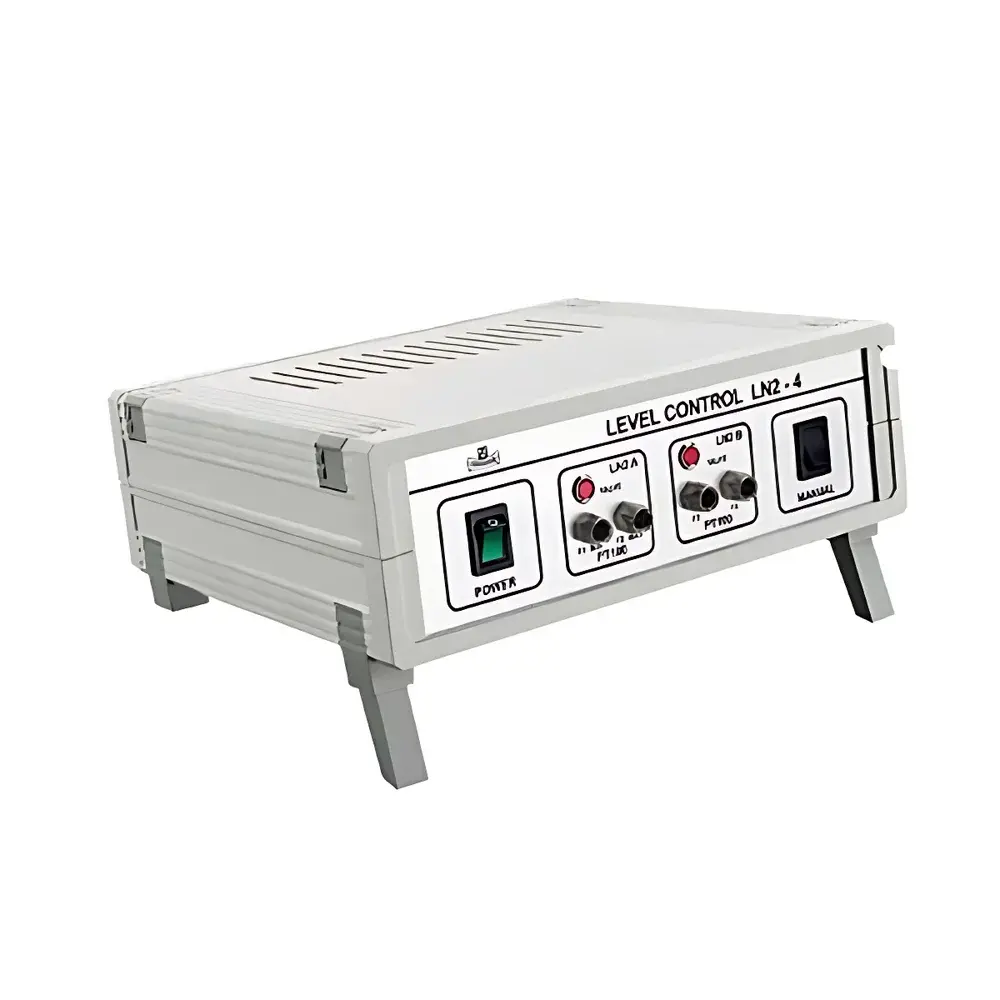
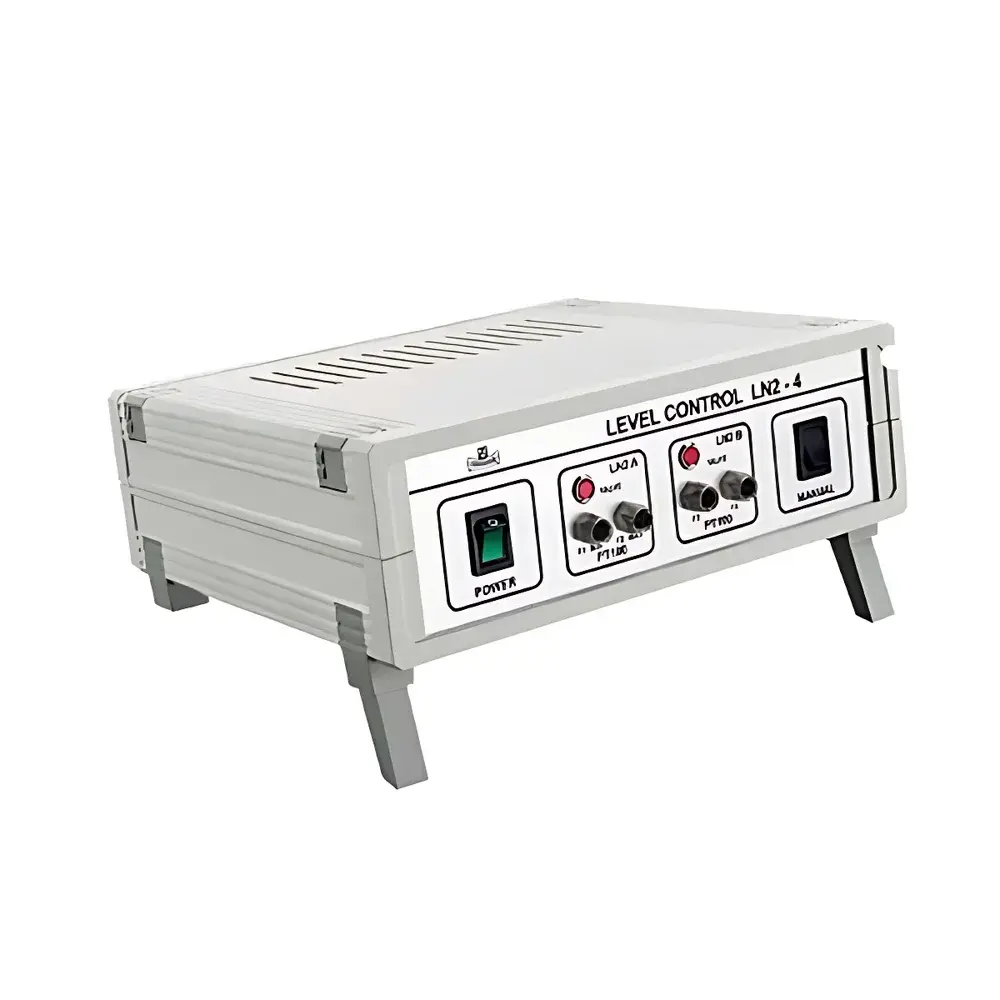
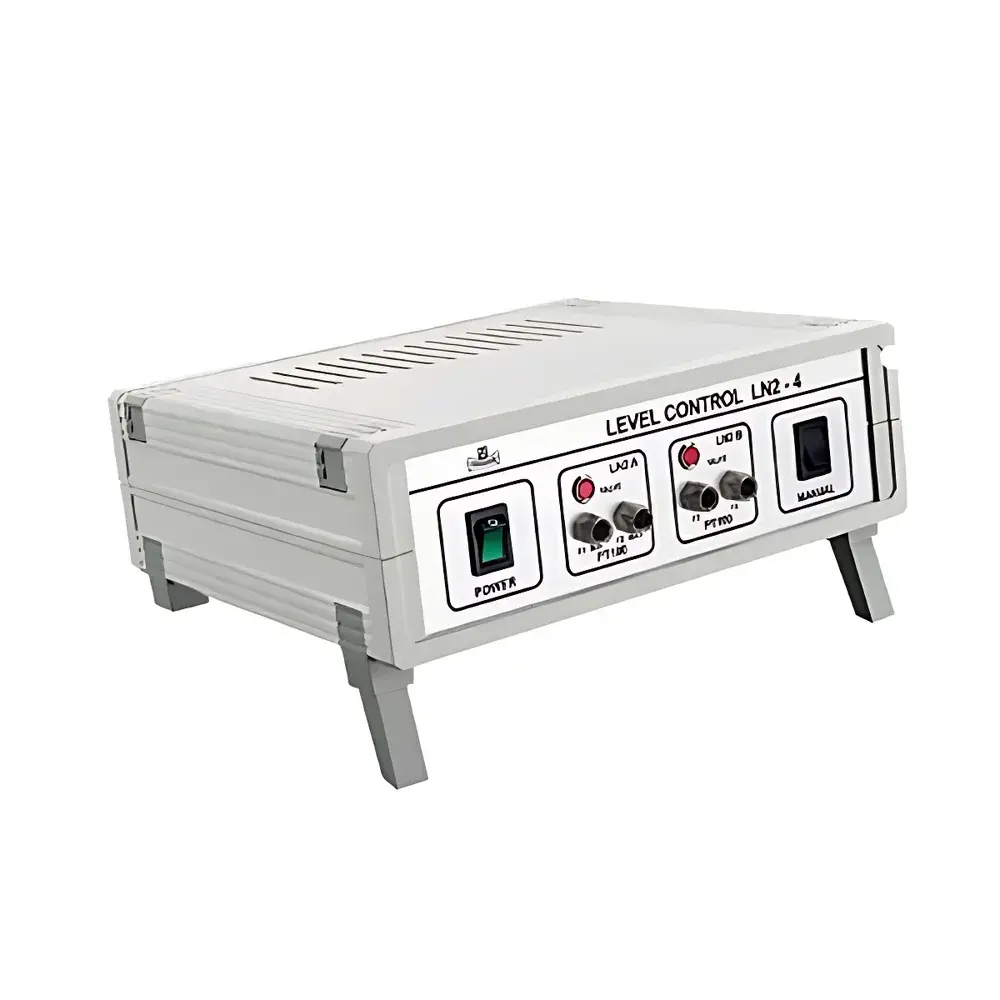
WIGGENS LN2-4 Liquid Nitrogen Level Controller
| Brand | WIGGENS |
|---|---|
| Origin | Germany |
| Model | LN2-4 |
| Sensor Inputs | 4-channel PT100 (configurable as level or temperature) |
| Output Channels | 2 relay outputs (for solenoid valve control and alarm) |
| Communication Interface | RS-232 and USB |
| Control Logic | Dual-threshold (high/low level) hysteresis-based automatic fill cycle |
| Calibration | Single-point user calibration per sensor channel |
| Power Supply | 24 V DC |
| Enclosure Rating | IP65 (industrial-grade housing) |
| Compliance | CE-marked, RoHS-compliant, designed for Class I, Div 2 hazardous location compatibility (per IEC 60079-0) |
Overview
The WIGGENS LN2-4 Liquid Nitrogen Level Controller is an industrial-grade, microprocessor-based instrumentation system engineered for precise, hands-free regulation of liquid nitrogen (LN₂) levels in cryogenic Dewar vessels used across research laboratories, biobanking facilities, and materials testing environments. It operates on a closed-loop feedback principle: four independently configurable PT100 resistance temperature detectors (RTDs) serve as level sensors—leveraging the sharp thermal transition at the LN₂–gas interface—and continuously feed real-time analog signals to the controller. Based on user-defined upper and lower setpoints, the LN2-4 executes deterministic relay logic to actuate 24 V DC solenoid valves, enabling autonomous refilling from pressurized supply dewars via self-pressurization systems. This architecture eliminates manual intervention while maintaining tight level stability (±1–2 mm typical repeatability under steady-state conditions), critical for temperature-sensitive applications such as superconducting magnet cooldown, cryo-EM sample staging, or long-term biological specimen storage.
Key Features
- Four-channel PT100 input support with individual offset calibration—enabling deployment of standard or stainless-steel-sheathed RTD probes (e.g., WIGGENS part nos. 1302, 1302-PLUS) for direct immersion or threaded/welded mounting into Dewar lids.
- Dual relay outputs: one dedicated to primary solenoid valve control (e.g., WIGGENS 1303 valve), the second programmable for fault signaling, auxiliary alarm activation, or failover switching to backup LN₂ reservoirs.
- Real-time status visualization via front-panel LED indicators: green/yellow/red LEDs denote operational state, valve actuation status, and alarm conditions—including overfill, sensor open-circuit, or communication timeout.
- Integrated timing diagnostics: logs and displays cumulative fill duration per cycle; flags anomalies such as abnormally short or prolonged valve-on periods—indicative of pressure loss, valve leakage, or sensor drift.
- Local and remote configuration: parameter setup and firmware updates performed via intuitive push-button interface or PC-connected software using RS-232/USB virtual COM port protocol.
Sample Compatibility & Compliance
The LN2-4 is compatible with standard laboratory Dewars (1–50 L capacity) and industrial cryogenic vessels equipped with accessible probe ports or lid-mounted adapters (e.g., WIGGENS 1302-QG/QS). All connected PT100 sensors must conform to DIN EN 60751 Class B tolerance (±0.3 °C at 0 °C). The controller itself meets CE marking requirements under the EU Machinery Directive 2006/42/EC and Electromagnetic Compatibility Directive 2014/30/EU. Its low-voltage 24 V DC architecture and sealed enclosure comply with IEC 61000-6-2/6-4 immunity/emission standards and are suitable for installation in non-classified zones adjacent to cryogenic storage areas. While not intrinsically safe certified, its design supports integration into safety-critical workflows aligned with ISO 13849-1 PLc functional safety principles when combined with external emergency shutoff circuits.
Software & Data Management
The included Windows-based configuration utility provides full access to all operational parameters: setpoint values (in °C-equivalent or arbitrary calibrated units), hysteresis width, fill timeout limits, relay polarity, and alarm thresholds. All changes are stored in non-volatile memory with timestamped audit trails. Data logging capability captures up to 32,000 timestamped entries—including sensor readings, relay states, error codes, and fill cycle timestamps—exportable as CSV for traceability in GLP/GMP-regulated environments. The software supports FDA 21 CFR Part 11-compliant user authentication (role-based login), electronic signatures, and immutable log archiving when deployed on validated IT infrastructure.
Applications
- Cryopreservation systems requiring uninterrupted LN₂ supply for vapor-phase storage of stem cells, embryos, or tissue samples.
- Superconducting equipment maintenance: stable cooling of MRI magnets, NMR probes, or quantum computing dilution refrigerators.
- Materials science labs performing low-temperature mechanical testing (e.g., Charpy impact, tensile tests at 77 K).
- Calibration laboratories operating reference blackbodies or infrared source standards requiring thermally stable cryogenic backgrounds.
- Automated cryo-EM grid freezing platforms where Dewar level stability directly affects plunge-freezing reproducibility.
FAQ
Can the LN2-4 control more than one Dewar simultaneously?
Yes—by configuring one relay output to trigger a secondary solenoid manifold or programmable logic controller (PLC), the system can coordinate sequential or parallel filling across multiple vessels.
Is PT100 sensor calibration traceable to national standards?
While the LN2-4 supports single-point user calibration, traceable calibration requires external metrology using a certified dry-well calibrator (e.g., Fluke 914X) and documented uncertainty budget per ISO/IEC 17025.
Does the controller support Modbus or Ethernet communication?
No—the LN2-4 communicates exclusively via RS-232 and USB CDC ACM protocols. For industrial network integration, third-party RS-232-to-Modbus gateways may be deployed.
What happens during a power failure?
All settings and logs persist in EEPROM. Upon power restoration, the controller resumes operation in its last known state; relay outputs default to de-energized (fail-safe) unless otherwise configured.
Are replacement fuses or service manuals available?
WIGGENS provides spare fuses (T1.6A, 250 V) and downloadable technical documentation—including wiring diagrams, error code tables, and firmware update procedures—via their global support portal.



