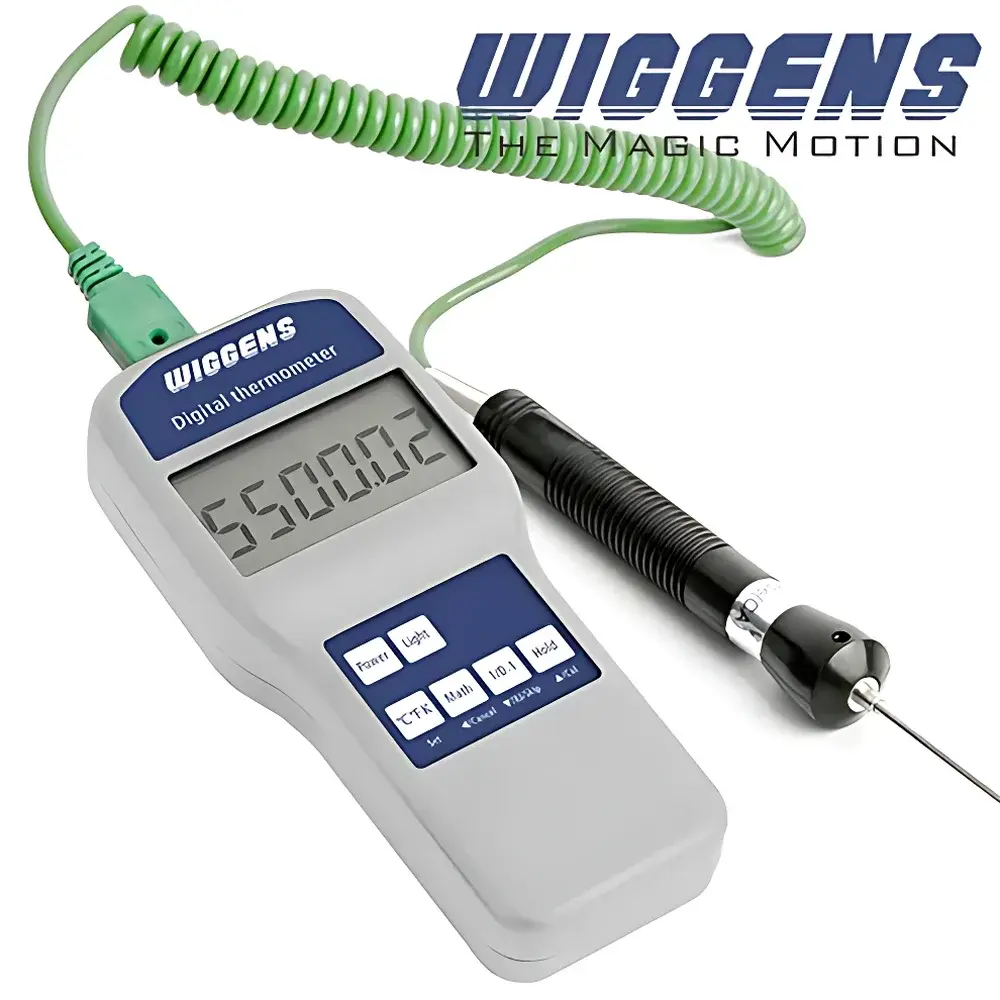
WIGGENS PR5500 Handheld Digital Precision Thermometer
| Brand | WIGGENS |
|---|---|
| Origin | Germany |
| Model | PR5500 / PR5600 |
| Temperature Range | −200.0 to +850.0 °C |
| Accuracy | Class 0.02 (per IEC 60751 for Pt100, ASTM E230 for thermocouples) |
| Resolution | 0.001 °C |
| Display | 6-digit LCD |
| Operating Environment | 18–28 °C (23 ± 5 °C recommended) |
| Power Supply | 3 × AA alkaline batteries (1.5 V each) |
| Dimensions | 155 × 70 × 30 mm |
| Weight | 0.25 kg |
| Input Types | Pt100, Pt1000, K, S, E, T, J, R, B, N thermocouples |
| Cold Junction Compensation | Internal, External, or Manual |
| Unit Selection | °C, °F, K |
| Statistical Functions | REL, MAX, MIN, AVG, PEAK-TO-PEAK, STD DEV, SAMPLE COUNT |
| Standard Sensors | 1× K-type probe (170 mm × Ø4 mm, 1.5 m SMP connector), 1× Pt100 probe (250 mm × Ø4 mm, 1.5 m USB connector) |
| Compliance | CE, RoHS, ISO/IEC 17025 traceable calibration support |
Overview
The WIGGENS PR5500 Handheld Digital Precision Thermometer is an engineered metrology-grade instrument designed for high-fidelity temperature measurement across demanding industrial, pharmaceutical, academic, and quality control environments. Utilizing dual-sensor architecture with configurable input channels, it supports both resistance temperature detectors (RTDs) — including Pt100 and Pt1000 per IEC 60751 — and multiple thermocouple types (K, S, E, T, J, R, B, N) in accordance with ASTM E230 and IEC 60584 standards. Its core measurement principle relies on high-stability analog-to-digital conversion with 24-bit resolution, enabling traceable accuracy to Class 0.02 (±0.02 % of reading ±0.02 °C typical for Pt100 at 0 °C) and a base resolution of 0.001 °C. With a total measurable range spanning −200.0 to +850.0 °C — extendable to +1200 °C using optional K-type probes — the PR5500 delivers laboratory-grade repeatability in a rugged, portable form factor compliant with IP54-rated ingress protection for dust and splash resistance.
Key Features
- 6-digit high-contrast LCD display with user-selectable resolution (0.001 °C, 0.01 °C, or 0.1 °C)
- Multi-sensor compatibility: native support for Pt100, Pt1000, and eight thermocouple types (K, S, E, T, J, R, B, N)
- Triple cold-junction compensation (CJC): internal sensor-based, external reference input, or manual offset entry for field calibration integrity
- Real-time statistical analysis: simultaneous calculation of relative value (REL), maximum, minimum, average, peak-to-peak deviation, standard deviation, and sample count
- Unit flexibility: seamless switching between °C, °F, and Kelvin without recalibration
- Configurable linearization and polynomial correction tables per sensor type for non-linear thermocouple response compensation
- Auto-power-off and low-battery indicator to preserve calibration stability and battery life
Sample Compatibility & Compliance
The PR5500 interfaces with a broad spectrum of interchangeable probes, including stainless-steel sheathed Pt100 sensors (e.g., PT100-01 to PT100-06 variants), PTFE-coated probes for chemical resistance, and glass-sheathed elements for high-purity applications. Standard K-type probes operate from −50 to +1200 °C; stainless-steel and glass probes are rated for −30 to +300 °C, while PTFE-coated variants maintain integrity up to +250 °C. All factory-supplied sensors feature ring-type 4-pin connectors compatible with WH260, WH280, WH380, WH390, PL524, TCSS, and PR-series instruments. The device complies with CE marking requirements under the EU Electromagnetic Compatibility Directive 2014/30/EU and RoHS 2011/65/EU. While not intrinsically safe, its design supports integration into GLP/GMP workflows when paired with documented calibration certificates (NIST-traceable options available upon request). It meets functional requirements for ASTM D3425 (polymer thermal analysis), ISO 17025-compliant uncertainty budgets, and routine validation per USP Analytical Instrument Qualification.
Software & Data Management
The PR5500 operates as a standalone field instrument but enables data export via optional USB-to-serial adapter (not included) for connection to Windows-based PCs. Raw measurement logs — including timestamps, statistical parameters, and sensor identification codes — can be exported in CSV format for post-processing in Excel, MATLAB, or LIMS platforms. Firmware updates are delivered via WIGGENS’ official technical support portal, ensuring alignment with evolving metrological best practices. Audit trail functionality is implemented through internal event logging (power cycles, unit changes, CJC mode switches), supporting FDA 21 CFR Part 11 readiness when deployed with validated third-party software and electronic signature protocols. No proprietary cloud platform is required; all configuration and calibration data remain locally stored and user-controllable.
Applications
- Pharmaceutical manufacturing: monitoring autoclave cycles, lyophilizer shelf temperatures, and environmental chamber validation (ICH Q1A–Q5E)
- Materials science labs: characterizing phase transitions in polymers, metals, and ceramics during thermal gravimetric analysis (TGA) and differential scanning calorimetry (DSC) setup verification
- Food safety QA/QC: verifying critical control points in retort processing, cold chain auditing, and HACCP-compliant surface temperature checks
- Aerospace component testing: validating thermal cycling profiles for composite layup ovens and turbine blade heat-treatment furnaces
- Calibration laboratories: serving as a transfer standard for secondary thermometer verification against fixed-point cells (e.g., ITS-90 gallium, indium, zinc points)
- Academic research: real-time acquisition of transient thermal responses in microfluidic devices, battery thermal management systems, and catalytic reactor beds
FAQ
What is the difference between PR5500 and PR5600 models?
The PR5500 and PR5600 share identical electronics, firmware, and user interface; the distinction lies solely in preconfigured sensor bundles and default calibration ranges — PR5500 ships with Pt100 and K-type probes optimized for −50 to +500 °C, while PR5600 includes extended-range K-probes certified to +1200 °C.
Can the PR5500 perform two-point calibration in the field?
Yes — the device supports user-initiated two-point adjustment using certified reference sources (e.g., dry-block calibrators or precision baths), with offsets stored per sensor type and retained after power cycling.
Is USB connectivity used for real-time data streaming?
USB serves only for firmware updates and batch data export; real-time streaming requires optional RS232 or Bluetooth modules (sold separately) and compatible terminal software.
Does the PR5500 meet ISO 17025 requirements for accredited calibration labs?
When operated with documented procedures, traceable reference standards, and uncertainty budgets calculated per GUM (JCGM 100), the PR5500 functions as a compliant working standard — though accreditation rests with the lab’s overall quality system, not the instrument alone.
Are custom probe geometries available for OEM integration?
Yes — WIGGENS offers mechanical and electrical customization of probe length, diameter, sheath material (316SS, Inconel, quartz, PTFE), connector type (SMP, mini-TC, DIN 43760), and cable length, subject to minimum order quantities and engineering review.