
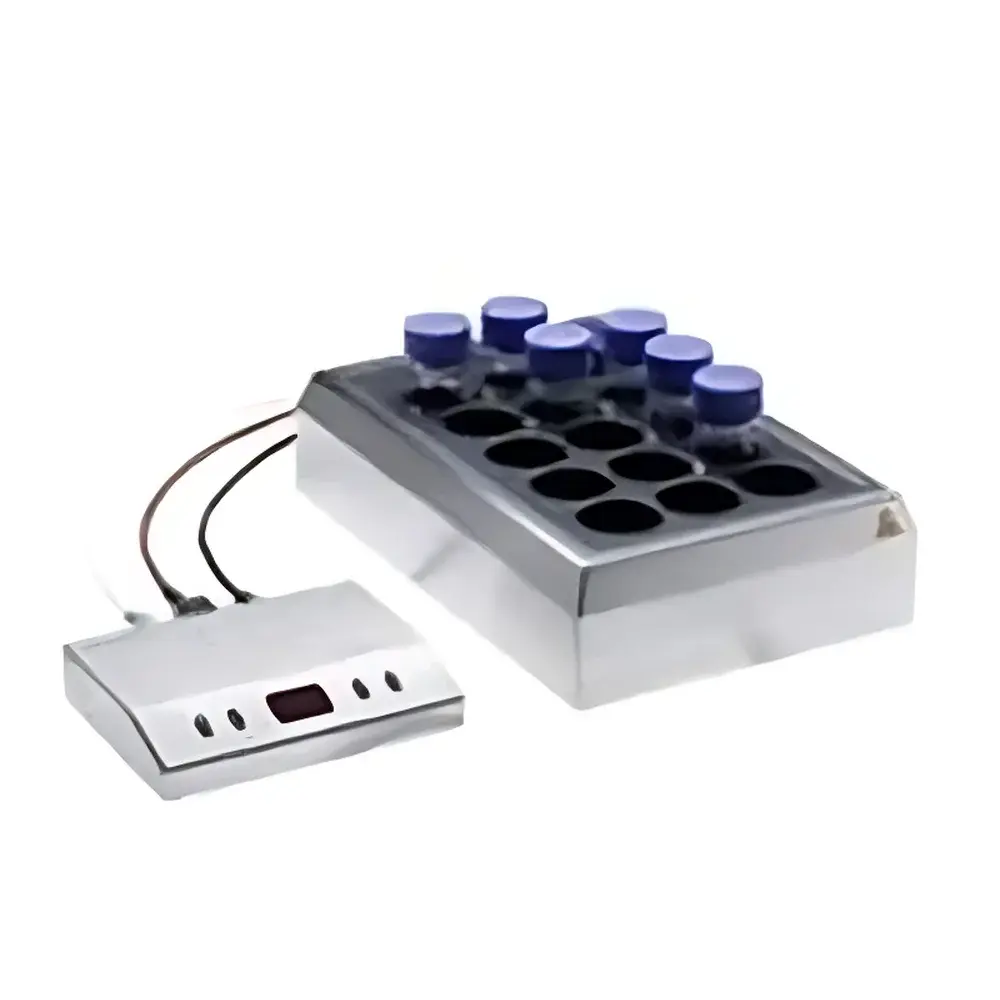
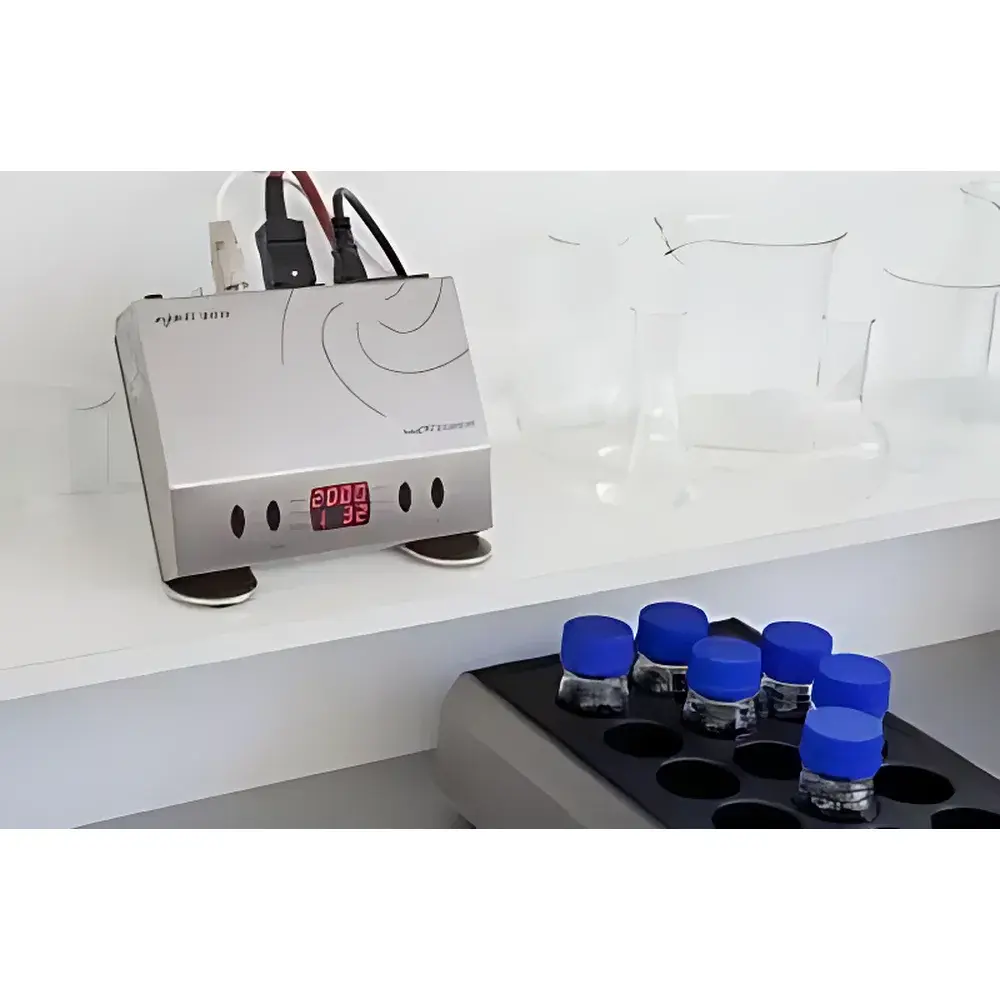
WIGGENS SD15-250 Inductive Magnetic Drive Multi-Position Heated Dry Bath Stirrer
| Brand | WIGGENS |
|---|---|
| Origin | Germany |
| Model | SD15-250 |
| Instrument Type | Magnetic Stirrer |
| Max. Stirring Positions | 15 |
| Volume per Position | 1–400 mL |
| Speed Range | 100–2000 rpm |
| Heating Max. Temp. | +200 °C |
| Power Setting | 4-level (25/50/75/100%) |
| Stirring Power | 40 W |
| Heating Power | 1000 W |
| Protection Class | IP20 |
| Ambient Operating Range | −10 to +40 °C (≤80% RH) |
| Dimensions (W×D×H) | 345 × 525 × 140 mm |
| Weight | ~31 kg |
Overview
The WIGGENS SD15-250 is an inductively coupled, multi-position heated dry bath stirrer engineered for parallel sample processing in analytical, pharmaceutical, and synthetic laboratories. Unlike conventional direct-drive magnetic stirrers, it employs contactless inductive magnetic drive technology—eliminating mechanical wear, brush arcing, and localized heat generation at the drive interface. This architecture ensures long-term rotational stability across all 15 positions, even at low speeds (100 rpm), with zero speed deviation between wells. The unit integrates precise conductive heating via a PTFE-coated aluminum heating plate and a sealed stainless-steel thermal frame, delivering uniform temperature distribution (±0.5 °C typical at 100 °C across full block) and rapid thermal response (<15 min to reach 200 °C from ambient). Designed for GLP-compliant workflows, the system supports external Pt100 probe integration for independent temperature validation and traceable calibration.
Key Features
- Contactless inductive magnetic drive: No moving parts in contact with the heating block; zero maintenance, no lubrication, and no electromagnetic interference with sensitive instrumentation.
- 15-position synchronized stirring: All positions operate at identical, user-defined rpm—critical for reproducible reaction kinetics, dissolution testing, or parallel synthesis where inter-well variability must be minimized.
- Four-step power regulation (25%/50%/75%/100%): Enables optimized torque delivery—high setting for viscous media (e.g., polymer solutions, cell lysates), low setting for extended unattended operation without self-heating of stir bars or sample degradation.
- Soft-start acceleration: Gradual ramp-up prevents vortex collapse or splashing during initiation—particularly beneficial for low-volume or volatile solvent systems.
- PTFE-coated aluminum heating plate: Chemically inert surface resists corrosion from acids, bases, and organic solvents; facilitates rapid cleaning and prevents cross-contamination between runs.
- Integrated LED control interface: Simultaneous real-time display of setpoint temperature, actual block temperature, stirring speed, and selected power level—no mode-switching required.
Sample Compatibility & Compliance
The SD15-250 accommodates standard laboratory glassware including Schott DIN 250 mL and 400 mL Erlenmeyer flasks, round-bottom flasks, and tall-form cylinders (71.5 mm diameter × 78 mm depth wells, 84 mm center-to-center spacing). Its design conforms to IEC 61010-1:2010 for electrical safety in laboratory equipment and meets IP20 ingress protection requirements for indoor, non-dusty environments. Temperature control accuracy and repeatability support compliance with ASTM E2997 (standard practice for calibration of thermal analyzers) and ISO/IEC 17025 clause 6.4.4 (equipment verification). When paired with optional external Pt100 sensors (order no. 69100/69101), the system enables documented temperature mapping per FDA 21 CFR Part 11 Annex 11 requirements for electronic records in regulated environments.
Software & Data Management
While the SD15-250 operates as a standalone instrument with analog front-panel control, its architecture supports external data acquisition via optional analog output modules (0–10 V or 4–20 mA) for temperature and speed signals. Integration with LabVIEW, MATLAB, or SCADA systems is achievable through standard signal conditioning interfaces. For audit-ready workflows, users may log timestamps, setpoints, and sensor readings using third-party DAQ software compliant with ALCOA+ principles (Attributable, Legible, Contemporaneous, Original, Accurate, Complete, Consistent, Enduring, Available). The unit does not include built-in USB/Ethernet connectivity or proprietary software—ensuring compatibility with existing LIMS and ELN platforms without vendor lock-in.
Applications
- Parallel reaction screening in medicinal chemistry and catalyst development.
- Dissolution testing per USP under controlled temperature and agitation conditions.
- Enzyme kinetics assays requiring simultaneous thermal and mechanical homogenization across replicates.
- Sample preparation for HPLC, GC, and ICP-MS—including digestion, derivatization, and solvent evaporation pre-concentration steps.
- Cell culture media equilibration and buffer warming with minimal thermal overshoot.
- Stability studies per ICH Q1A(R2), where consistent agitation and temperature are mandated across multiple timepoints.
FAQ
Is the SD15-250 suitable for use with corrosive solvents such as concentrated HCl or HF?
Yes—the PTFE-coated heating plate and stainless-steel frame provide broad chemical resistance. However, direct exposure of the control unit housing or sensor ports to aggressive vapors is not recommended; proper fume hood ventilation is required.
Can individual well speeds be programmed independently?
No—this model delivers fully synchronized rotation across all 15 positions. Independent speed control requires discrete single-position stirrers or modular robotic platforms.
What is the maximum viscosity this unit can handle at 2000 rpm?
At full power (100%), it reliably agitates aqueous glycerol solutions up to ~1500 mPa·s (25 °C); performance with higher viscosities depends on stir bar geometry and vessel aspect ratio.
Does the system support temperature ramping profiles?
No—temperature is set as a static setpoint. Programmable ramps require external PID controllers interfaced via analog output.
Is calibration documentation provided with the unit?
A factory calibration certificate (traceable to DKD/DAkkS standards) is available upon request at time of order; routine recalibration intervals should follow internal SOPs based on usage frequency and criticality of application.



