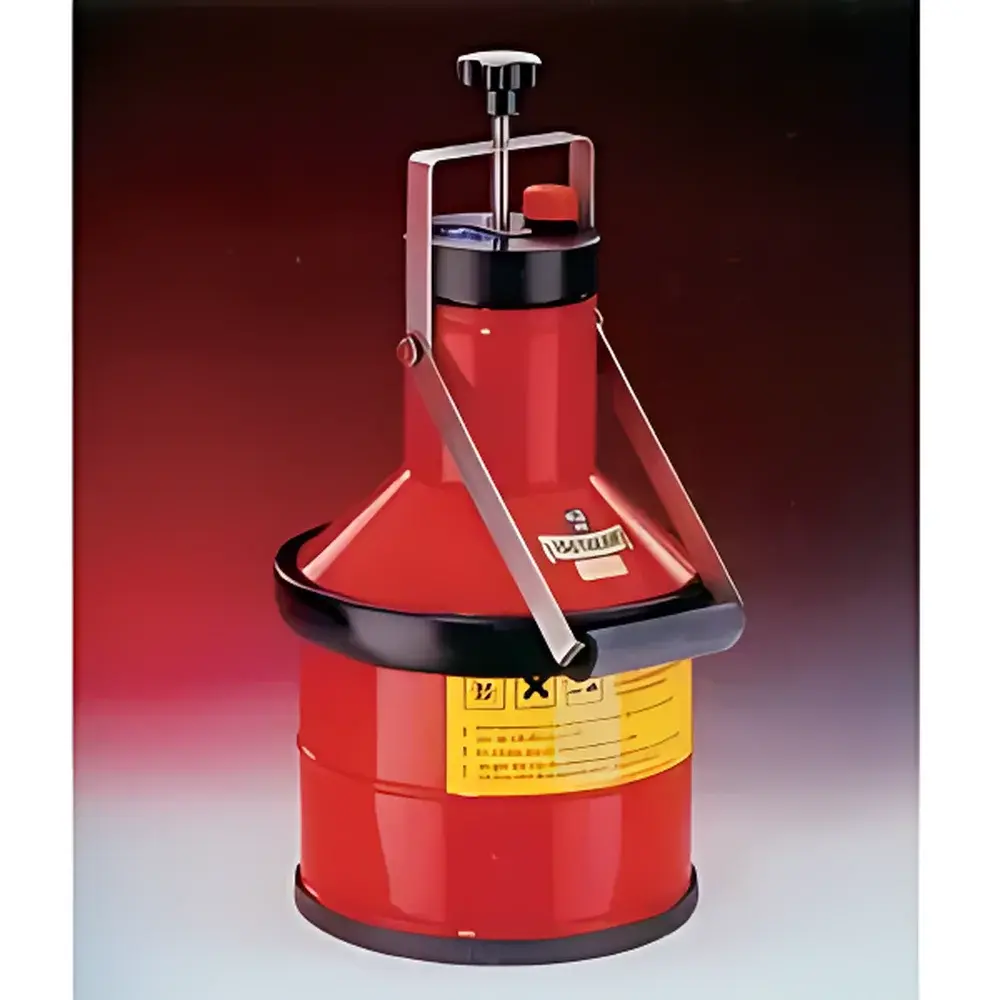
WIGGENS E-Series Waste Liquid Cryogenic Storage Dewar
| Brand | WIGGENS |
|---|---|
| Origin | Germany |
| Manufacturer | KGW (OEM supplier) |
| Model | E0 |
| Capacity | 4.8 L |
| Inner Diameter × Height | 205 × 325 mm |
| Outer Diameter × Height | 230 × 360 mm |
| Weight | 3.5 kg |
| Compliance | DIN 12111, DIN 12116, DIN 52322 |
| Construction | Aluminum outer shell, reinforced borosilicate glass inner vessel |
| Safety Features | Threaded locking lid, pressure-relief safety device, ergonomic carrying handles, red anodized exterior |
Overview
The WIGGENS E-Series Waste Liquid Cryogenic Storage Dewar is a purpose-engineered, laboratory-grade cryogenic container designed for the safe, compliant, and thermally stable storage and transport of low-temperature waste liquids—including liquid nitrogen (LN₂), dry ice slurries, and chilled chemical effluents—within bioscience and analytical laboratories. Unlike general-purpose storage vessels, the E-Series integrates dual-material construction: a high-strength aluminum outer shell provides mechanical robustness and corrosion resistance, while the inner vessel is fabricated from reinforced borosilicate glass (equivalent to ASTM E438 Type I, Class A), engineered to withstand thermal shock down to –196 °C and resist aggressive solvents encountered in routine lab workflows. Its design adheres to the fundamental principles of vacuum-insulated dewar architecture—though not actively evacuated, its double-wall geometry with low-conductivity spacer elements minimizes conductive and convective heat ingress, enabling extended hold times for cryogenic media without active refrigeration. This passive thermal management system ensures operational continuity during short-term transfers or intermediate staging of temperature-sensitive waste streams prior to downstream disposal or recovery.
Key Features
- Reinforced borosilicate glass inner vessel offering exceptional chemical inertness against organic solvents, diluted acids, alcohols, and aqueous buffers—validated per DIN 12111 for laboratory glassware durability and DIN 12116 for resistance to thermal shock.
- Aluminum outer housing with red anodized finish—providing electromagnetic shielding, non-magnetic compatibility, and enhanced surface hardness (HV ≥ 200) per ISO 7583, suitable for cleanroom-adjacent environments.
- Integrated threaded locking lid with silicone O-ring seal (FKM elastomer, resistant to LN₂ embrittlement) and calibrated pressure-relief safety valve meeting DIN 52322 requirements for overpressure protection in closed cryogenic systems.
- Ergonomic dual-position carrying handles—designed for secure manual handling under gloved conditions and optimized load distribution to minimize torsional stress on the glass liner.
- Dimensionally standardized footprint compatible with common benchtop cryo-workstations and integration-ready with JULABO FT402/FT902 ultra-low temperature circulators for closed-loop cold trap applications.
Sample Compatibility & Compliance
The E0 model is validated for containment of non-pressurized, low-viscosity cryogenic and sub-zero waste streams, including liquid nitrogen, ethanol/dry ice mixtures, chilled acetone baths, and buffered saline solutions below 0 °C. It is explicitly not rated for hydrofluoric acid (HF), concentrated alkalis (>6 M NaOH/KOH), or molten salts due to known susceptibility of borosilicate glass to dissolution under those conditions. All units conform to German national standards DIN 12111 (laboratory glassware specifications), DIN 12116 (thermal shock testing protocol), and DIN 52322 (safety requirements for pressurized cryogenic containers). While not certified to ASME BPVC Section VIII or PED 2014/68/EU, its construction meets GLP-aligned documentation practices for traceable lab equipment—serial-numbered units support audit-ready asset registers in regulated environments.
Software & Data Management
As a passive, non-electronic storage system, the E-Series Dewar requires no firmware, drivers, or software integration. However, it supports digital lab infrastructure through physical interoperability: QR-coded serial labels enable direct linkage to LIMS entries (e.g., LabWare, STARLIMS) for chain-of-custody logging; standardized dimensions allow automated inventory recognition via robotic arm vision systems (e.g., Hamilton STAR, Tecan Fluent); and its pressure-relief interface is mechanically compatible with third-party IoT pressure-monitoring modules (e.g., Sensirion SDP3x series) when retrofitted per internal SOPs. No data encryption or 21 CFR Part 11 compliance applies—consistent with FDA guidance for non-computerized labware (FDA Guidance for Industry: Computerized Systems Used in Clinical Trials, 2023).
Applications
- Intermediate holding of LN₂-quenched tissue samples prior to cryo-sectioning or RNA extraction workflows.
- Collection and temporary stabilization of cold-trap condensates from rotary evaporation or vacuum distillation systems operating at –40 °C to –80 °C.
- On-bench containment of spent cryoprotectant solutions (e.g., DMSO/glycerol mixtures) awaiting centrifugal recovery or incineration.
- Transport of temperature-sensitive enzyme assay reagents between cold rooms and analytical instrumentation suites.
- Backup storage buffer for JULABO FT-series circulators during maintenance cycles—maintaining system thermal inertia without compressor dependency.
FAQ
Is the E0 Dewar suitable for long-term liquid nitrogen storage?
No. It is designed for short-term (48 h applications.
Can the glass liner be autoclaved?
No. Borosilicate glass liners are not rated for saturated steam sterilization (121 °C, 15 psi). Clean with isopropanol and air-dry; avoid thermal cycling beyond –196 °C to +60 °C.
Does the pressure-relief valve require recalibration?
Yes. Per DIN 52322 Annex B, annual functional verification using traceable pressure sources is recommended. KGW provides calibration certificates upon request (order code CAL-E0-DIN52322).
What is the maximum fill level for safe handling?
Do not exceed 85% of internal volume (4.1 L for E0) to prevent splashing during movement and ensure adequate ullage space for thermal expansion of cryogens.
Is the red anodized coating chemically resistant?
Yes. The Class II hard-anodized layer (per MIL-A-8625 Type II) resists 10% HNO₃, 5% NaCl, and IPA immersion for ≥72 h—verified by salt-spray testing (ISO 9227 NSS).