
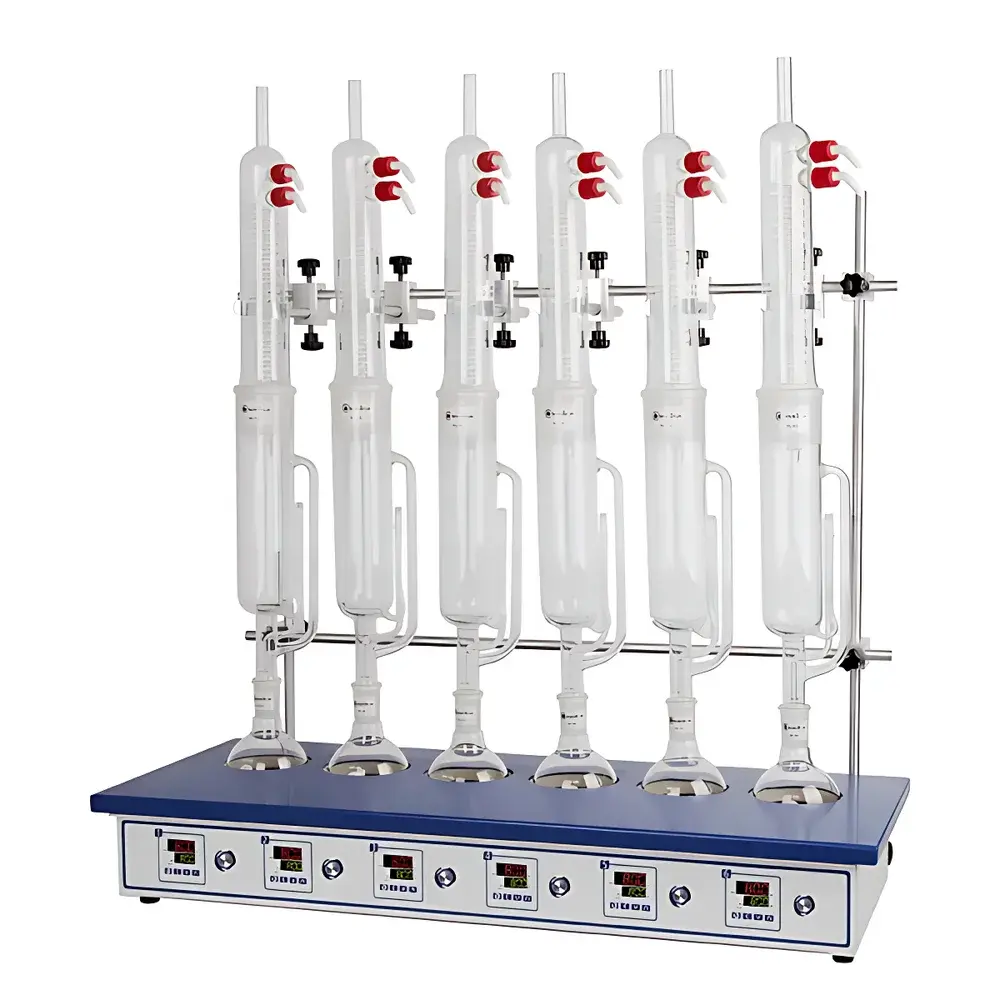
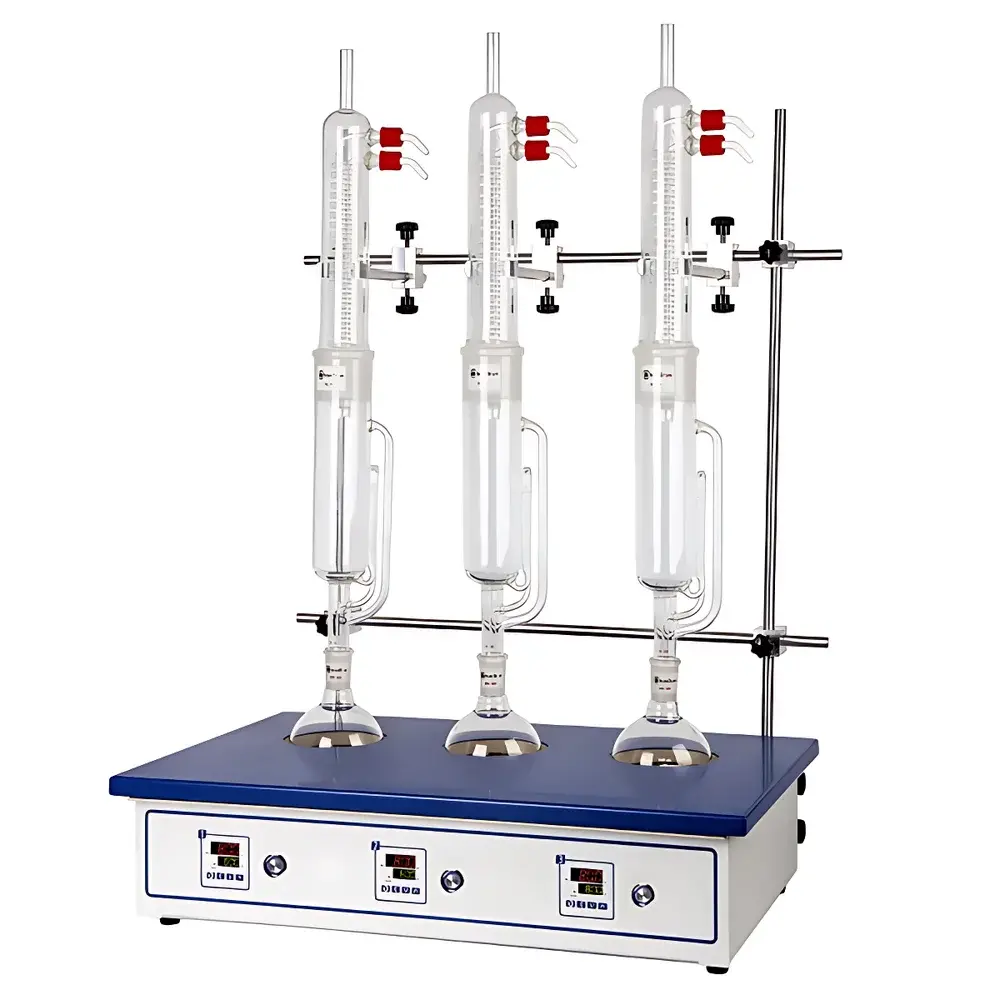
WIGGENS SES635 Multi-Position Soxhlet Extractor
| Brand | WIGGENS |
|---|---|
| Origin | Germany |
| Model | SES635 |
| Extraction Chamber Volume | 500/1000 mL |
| Receiver Flask Volume | 500/1000 mL |
| Temperature Range | RT +5 °C to +450 °C |
| Temperature Control Accuracy | ±0.01 °C |
| Number of Channels | 3 |
Overview
The WIGGENS SES635 Multi-Position Soxhlet Extractor is a precision-engineered laboratory instrument designed for quantitative solvent extraction of lipids, waxes, pesticides, residual solvents, and other organic analytes from solid or semi-solid matrices. It operates on the classical Soxhlet principle—continuous cyclic percolation of hot solvent through a thimble containing the sample, followed by condensation, reflux, and automatic return of condensed solvent to the extraction chamber. Unlike conventional open-heating systems, the SES635 employs individually controlled, thermostatically regulated heating mantles with embedded Pt100 sensors, ensuring uniform thermal distribution across all three extraction positions. Its maximum operational temperature of 450 °C enables compatibility with high-boiling solvents (e.g., chlorobenzene, n-butanol), while the ±0.01 °C control stability supports method reproducibility required in regulated environments such as ISO 1479-1 (fat determination in animal and vegetable fats), AOAC 991.36 (crude fat in feed), and USP <467> (residual solvents in pharmaceuticals).
Key Features
- Triple-channel parallel extraction architecture with independent PID temperature control per position—enabling simultaneous analysis under identical or divergent thermal profiles
- High-temperature ceramic-insulated heating mantles (rated to 450 °C), each rated at 125 W, minimizing thermal lag and improving energy efficiency
- Integrated LED display showing both setpoint and real-time bath temperature with 0.1 °C resolution and auto-calibration capability
- Modular glassware system compatible with both round-bottom and flat-bottom receiver flasks (300 mL standard; optional 500/1000 mL configurations)
- One-piece sintered glass extraction thimbles (pore size: 20–35 µm or 100–200 µm) optimized for solvent permeability and mechanical robustness during prolonged reflux cycles
- Full solvent recovery loop with air-cooled condenser and drip-return design—reducing reagent consumption by >90% versus batch methods and lowering VOC emissions
- CE-marked electrical safety compliance (EN 61010-1), IP20 enclosure rating, and integrated over-temperature cut-off protection
Sample Compatibility & Compliance
The SES635 accommodates heterogeneous samples including powdered foodstuffs (e.g., cereals, dairy powders), granular feeds, homogenized soils, freeze-dried biological tissues, polymer pellets, and textile fibers. Its sealed heating environment eliminates direct flame exposure and minimizes operator exposure to volatile organics—supporting OSHA 29 CFR 1910.1200 (Hazard Communication) and CLP Regulation (EC) No 1272/2008 requirements. Method validation data demonstrate inter-day RSD <2.1% (n=6) for triplicate lipid extractions in corn flour per AOAC 991.36. The system meets GLP documentation prerequisites when paired with audit-trail-enabled software (see Software & Data Management section) and is routinely deployed in laboratories undergoing ISO/IEC 17025 accreditation audits.
Software & Data Management
While the SES635 operates as a standalone benchtop unit, it integrates seamlessly with WIGGENS’ optional PC-based LabControl Suite v3.2. This validated application provides time-stamped parameter logging (temperature, duration, cycle count), electronic signature support per FDA 21 CFR Part 11, and automated report generation compliant with ISO/IEC 17025 clause 7.8.2. All raw data—including individual channel temperature profiles and extraction start/stop timestamps—are stored in encrypted SQLite databases with immutable audit trails. Export formats include CSV, PDF, and XML for LIMS ingestion (e.g., Thermo Fisher SampleManager, LabVantage). Firmware updates are delivered via secure HTTPS with SHA-256 signature verification.
Applications
- Determination of crude fat content in animal feed, infant formula, and edible oils per AOAC, ISO, and DIN standards
- Residual solvent quantification in active pharmaceutical ingredients (APIs) and excipients per ICH Q3C guidelines
- Extraction and gravimetric analysis of hydrophobic contaminants (e.g., PCBs, PAHs) from environmental soil and sediment samples (EPA Method 3541)
- Wax and resin isolation from natural plant materials (e.g., beeswax, rosin) for quality control in cosmetics and nutraceuticals
- Leachable organic compound profiling from rubber, PVC, and polyolefin packaging materials per USP <661.1>
- Preparative-scale purification of natural product extracts prior to HPLC or GC-MS analysis
FAQ
What solvent types are compatible with the SES635?
Diethyl ether, petroleum ether, hexane, chloroform, acetone, ethanol, and chlorobenzene are routinely used. Solvent selection must consider boiling point relative to the instrument’s 450 °C upper limit and compatibility with sintered glass (avoid HF or strong alkalis).
Can I run different solvents simultaneously across the three channels?
Yes—each channel operates independently; however, cross-contamination risk necessitates strict physical separation of glassware and post-run cleaning per SOP.
Is the SES635 suitable for moisture-sensitive extractions?
When coupled with anhydrous solvent handling protocols (e.g., molecular sieve drying, glovebox transfer), the system supports moisture-sensitive applications such as lipid oxidation studies.
Does the unit include certified calibration documentation?
Factory calibration certificates (traceable to PTB, Germany) are provided for temperature sensors; user-performed periodic verification using NIST-traceable thermometers is recommended per ISO/IEC 17025 clause 6.4.
What maintenance intervals are recommended?
Heating mantle insulation integrity should be verified annually; sintered thimbles require ultrasonic cleaning after every 20 extractions and replacement every 12 months under continuous use.



