
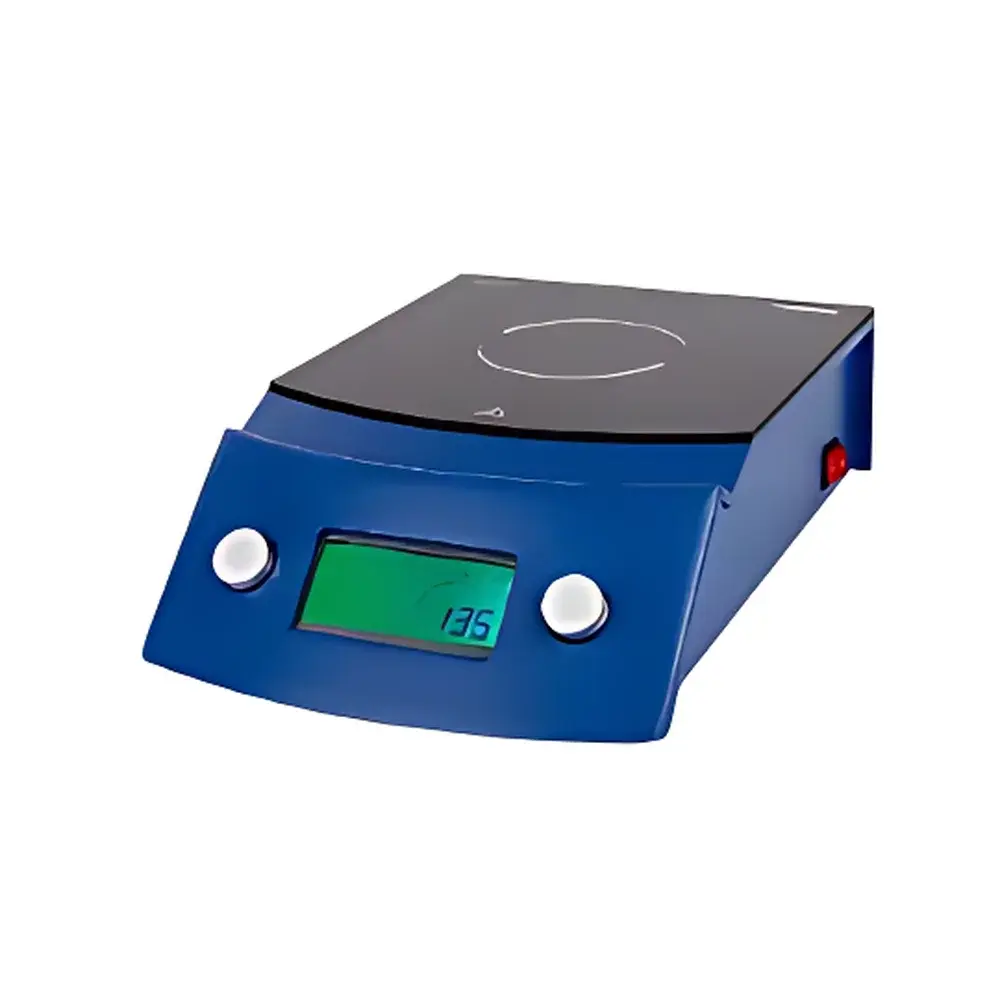
WIGGENS SLK1-T Infrared Electric Heating Plate
| Brand | WIGGENS |
|---|---|
| Origin | Germany |
| Model | SLK1-T |
| Heating Power | 1.8 kW (220 V) / 1.5 kW (110 V) |
| Max. Heating Plate Temperature | 550 °C |
| Temperature Uniformity | ±1 °C |
| Plate Dimensions | 280 × 280 mm |
| Heating Zone Diameter | 90 mm |
| Display | LCD |
Overview
The WIGGENS SLK1-T Infrared Electric Heating Plate is a precision-engineered laboratory heating platform designed for rapid, uniform, and chemically inert thermal treatment of samples during sample preparation, digestion, evaporation, and reaction support protocols. Unlike conventional resistive heating plates, the SLK1-T employs infrared-emitting ceramic-glass (glass-ceramic) top plate technology, enabling efficient radiative heat transfer with minimal thermal inertia. This architecture ensures fast ramp-up times, high thermal stability, and exceptional resistance to thermal shock—capable of withstanding abrupt temperature changes up to 700 °C without cracking or delamination. The device operates on a robust 220 V/50 Hz (or 110 V/60 Hz) supply and delivers up to 1.8 kW of heating power, making it suitable for demanding applications involving high-boiling-point solvents, acid digestions, and prolonged thermal treatments under controlled conditions.
Key Features
- Glass-ceramic top plate: Chemically inert, non-porous, scratch-resistant, and highly resistant to corrosion from strong acids (e.g., HNO₃, HCl, HF), bases, and organic solvents—ideal for trace-metal analysis and EPA-compliant digestion workflows.
- Precision temperature control: Digital PID regulation with ±1 °C uniformity across the 90 mm active heating zone; setpoint range: ambient to 550 °C.
- Intuitive analog control interface: Rotary encoder (flywheel-style knob) for tactile, drift-free temperature and timer adjustment; large backlit LCD displays real-time plate temperature, setpoint, elapsed time, and operational mode.
- Programmable timer: Adjustable from 1 to 1999 minutes or continuous operation; automatic shut-off upon completion enhances safety and protocol reproducibility.
- Integrated safety architecture: Adjustable overtemperature cut-off (50–600 °C), spill-resistant front-panel channel design to divert liquids away from electronics, and thermal fuse redundancy compliant with IEC 61010-1 Class II safety standards.
- Compact footprint and ergonomic form factor: 280 × 280 mm heating surface within a 450 × 290 × 120 mm chassis; net weight: 4.1 kg—optimized for benchtop integration in ISO 17025-accredited labs and GLP environments.
Sample Compatibility & Compliance
The SLK1-T accommodates standard laboratory vessels including borosilicate glass beakers (50–1000 mL), PTFE and quartz digestion tubes, and stainless-steel crucibles. Its inert surface eliminates leaching risks and supports USP , EPA Method 3050B/3052, and ISO 11466-compliant sample digestion procedures. While the SLK1-T controls plate surface temperature only, its thermal uniformity and low thermal mass ensure consistent energy delivery to common container geometries—validated using 500 mL water heated to 80 °C per internal calibration protocol. The unit meets CE marking requirements and conforms to EN 61326-1 (EMC) and EN 61010-1 (safety) directives. It is not intended for use in explosion-proof or intrinsically safe areas unless installed within certified secondary containment systems.
Software & Data Management
The SLK1-T operates as a standalone instrument with no embedded data logging or PC connectivity in base configuration. However, its RS232 serial interface (standard) enables integration into centralized lab automation systems via ASCII command protocol for remote start/stop, setpoint modification, and status polling. When deployed alongside external Pt100 probes (as supported by the SLK2-T variant), users may implement third-party SCADA or LIMS-integrated temperature monitoring solutions compliant with FDA 21 CFR Part 11 requirements—including electronic audit trails, user authentication, and data integrity validation—provided the host software layer satisfies ALCOA+ principles.
Applications
- Acid digestion of environmental, geological, and biological matrices prior to ICP-OES/MS analysis.
- Controlled solvent evaporation in gravimetric residue determination (e.g., ASTM D189, ISO 6296).
- Pre-heating and temperature conditioning of reagents and standards in QC/QA laboratories.
- Supporting solid-phase extraction (SPE) manifold activation and drying steps.
- Thermal pretreatment of catalysts, polymers, and nanomaterials in materials science R&D.
- Heating baths for viscosity measurements requiring stable thermal platforms (e.g., ASTM D445).
FAQ
Does the SLK1-T measure or control sample temperature directly?
No—the SLK1-T regulates only the heating plate surface temperature. For direct sample temperature control, the SLK2-T model supports external Pt100 probe feedback.
Is the glass-ceramic surface compatible with hydrofluoric acid (HF)?
Yes—the WIGGENS glass-ceramic formulation exhibits superior resistance to HF etching compared to standard borosilicate or alumina ceramics, though prolonged exposure above 120 °C should be avoided per manufacturer guidelines.
Can the timer function be used simultaneously with temperature ramping?
Yes—the timer operates independently of temperature control; users may initiate timed runs at any setpoint, including multi-step protocols executed manually.
What is the recommended maintenance interval for calibration verification?
Annual verification using a NIST-traceable contact thermometer (e.g., Fluke 1523 with dry-well calibrator) is recommended per ISO/IEC 17025 Clause 6.4.2 for accredited laboratories.
Does the unit include overtemperature protection for the electronics compartment?
Yes—dual thermal cutoffs monitor both plate temperature and internal chassis ambient; automatic shutdown occurs if either exceeds preset thresholds, ensuring compliance with IEC 61010-1 Clause 10.2.



