
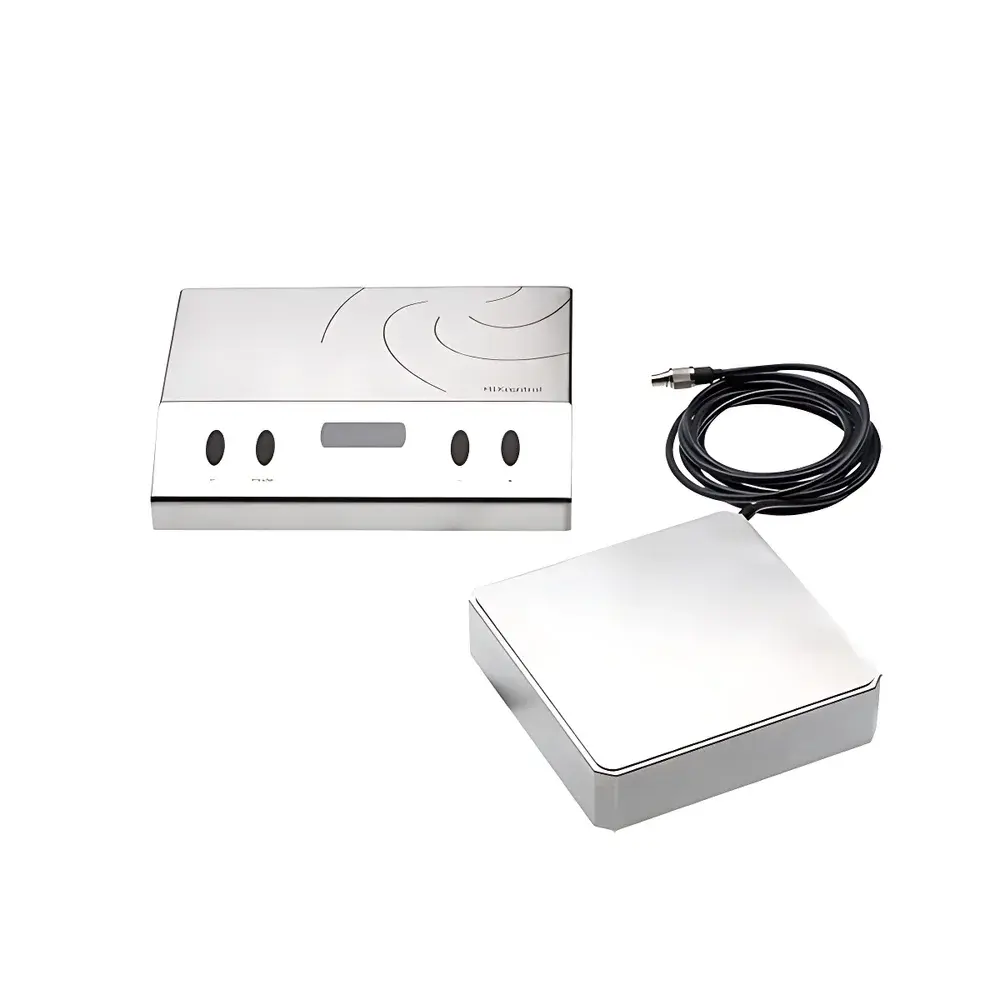
WIGGENS STERIMIX Drive & STERIMIX Control Sterilizable Magnetic Stirrer System
| Brand | WIGGENS |
|---|---|
| Origin | Germany |
| Model | STERIMIX Drive / STERIMIX Control |
| Stirrer Type | Sterilizable Magnetic Stirrer |
| Max. Mixing Volume | 40 L |
| Speed Range | 60–1200 rpm |
| IP Rating | IP68 (Drive), IP20 (Control) |
| Operating Temp. | −10 to +150 °C (100% RH) |
| Power Supply | 48 VDC (Drive), 100–240 VAC, 50/60 Hz (Control) |
| Housing Material | Stainless Steel (AISI 316L) |
| Motor Type | Maintenance-Free MAG Stepper Motor |
| Compliance | Suitable for Autoclaving (121 °C, 2 bar, 20 min per cycle) |
| Software Feature | MIX Watch™ Real-Time Stir Bar Monitoring & Auto-Recovery |
| Control Interface | Digital Display with Soft-Start, QuickStop™ Emergency Brake, and Programmable Pause Interval (0–240 s) |
Overview
The WIGGENS STERIMIX Drive & STERIMIX Control is an engineered sterilizable magnetic stirrer system designed specifically for demanding bioprocess, fermentation, and aseptic laboratory applications where equipment integrity under repeated autoclave cycles is non-negotiable. Unlike conventional magnetic stirrers, the STERIMIX Drive employs a maintenance-free MAG stepper motor — eliminating brush wear, electrical arcing, and thermal drift — enabling precise, low-speed torque delivery (down to 60 rpm) even in highly viscous culture media such as glycerol-supplemented bacterial broths or methylcellulose-based mammalian suspension cultures. Its fully sealed, monolithic stainless steel (AISI 316L) housing achieves IP68 ingress protection, permitting safe operation inside pressurized steam autoclaves (121 °C, 2 bar, 20 min), vacuum chambers, and high-humidity incubators without risk of condensation ingress or corrosion. The system operates on a galvanically isolated 48 VDC supply — inherently safe for wet environments — and integrates seamlessly with the STERIMIX Control unit for programmable, audit-ready operation.
Key Features
- MAG stepper motor technology ensures zero self-heating, eliminating thermal artifacts during long-term cell culture or temperature-sensitive reactions.
- IP68-rated drive unit withstands full-cycle autoclaving, repeated steam exposure, and immersion — validated per DIN EN 60529 and ISO 17664-1 for reprocessing of lab equipment.
- MIX Watch™ real-time monitoring detects stir bar displacement, stalling, or asynchronous rotation; automatically initiates brake-and-reposition sequence without manual intervention — critical for unattended overnight runs or opaque vessels (e.g., glass-jacketed bioreactors, stainless steel fermenters).
- Digital soft-start prevents abrupt torque application that could fracture fragile glassware or dislodge adherent cell monolayers; “QuickStop™” emergency brake halts motion within <150 ms and logs event timestamp.
- Programmable pause intervals (0–240 s) support gas exchange protocols in anaerobic cultivation or intermittent mixing in shear-sensitive protein formulations.
- Stainless steel surface finish complies with ISO 13485 and FDA 21 CFR Part 11 requirements for cleanability (Ra ≤ 0.8 µm); no crevices or gaskets trap biofilm.
Sample Compatibility & Compliance
The STERIMIX system accommodates standard PTFE- or PTFE-coated stir bars (diameters 10–30 mm, lengths 30–80 mm) across vessel geometries from 50 mL conical flasks to 40 L jacketed reactors. It maintains consistent vortex formation and radial flow profiles in both low-viscosity aqueous buffers (e.g., PBS, Tris-HCl) and high-viscosity media (up to 10,000 mPa·s). All materials contacting steam or process fluids meet USP Class VI and EC 1935/2004 food-contact compliance. The system supports GLP/GMP workflows through traceable parameter logging (speed, duration, pause intervals, fault events) when paired with optional RS485 or Ethernet-enabled data acquisition modules.
Software & Data Management
The STERIMIX Control features a backlit LCD interface with non-volatile memory storing up to 10 user-defined protocols, including speed ramping profiles and inter-pause timing sequences. Each session records operational metadata (start time, total runtime, max/min speed, MIX Watch interventions) to internal flash memory — exportable via USB-C for integration into LIMS or electronic lab notebooks (ELN). Audit trail functionality satisfies 21 CFR Part 11 requirements when used with password-protected administrator mode and electronic signature validation. Firmware updates are delivered via signed .hex files with SHA-256 checksum verification.
Applications
- Aseptic seed train expansion in biopharmaceutical upstream processing (USP)
- Long-duration microbial fermentation under controlled O2/CO2 atmospheres
- In vitro tissue engineering scaffold perfusion with shear-sensitive stem cells
- Preparation of sterile injectables and ophthalmic solutions requiring ISO 5 cleanroom compatibility
- Accelerated stability studies per ICH Q1A(R3) with simultaneous thermal and mechanical stress conditioning
- High-integrity mixing of GMP-grade excipients in lyophilization formulation development
FAQ
Can the STERIMIX Drive be operated inside an autoclave chamber during sterilization?
Yes — the Drive unit is rated for direct placement in Class B and Class N steam autoclaves per EN 285 and ISO 17664-1; verify cycle parameters do not exceed 121 °C, 2 bar, 20 min.
Is MIX Watch compatible with all stir bar geometries?
MIX Watch reliably detects standard cylindrical and oval stir bars ≥10 mm diameter; performance may vary with custom asymmetric or ceramic-coated designs.
Does the system support remote control via LabVIEW or Python?
Yes — optional RS485 Modbus RTU and TCP/IP interfaces enable programmatic control and telemetry using standard SCPI-like command sets.
What is the maximum allowable vessel wall thickness for effective coupling?
Up to 25 mm borosilicate glass (e.g., Schott DURAN®) or 12 mm stainless steel (316L) at 600 rpm; torque transmission decreases exponentially beyond these thresholds.
How often does the system require calibration or preventive maintenance?
None — the MAG stepper motor and solid-state electronics are lifetime-sealed; only periodic visual inspection of housing integrity and cleaning validation per SOP are required.



