
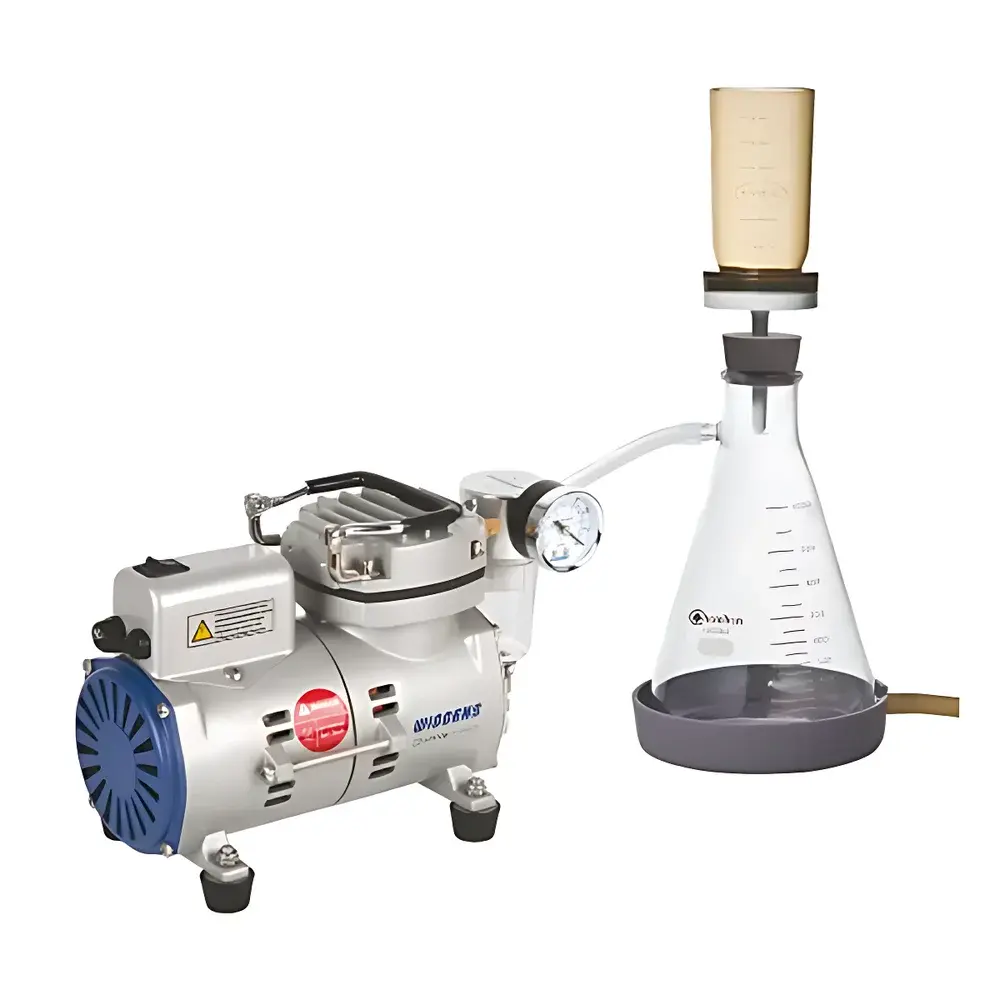
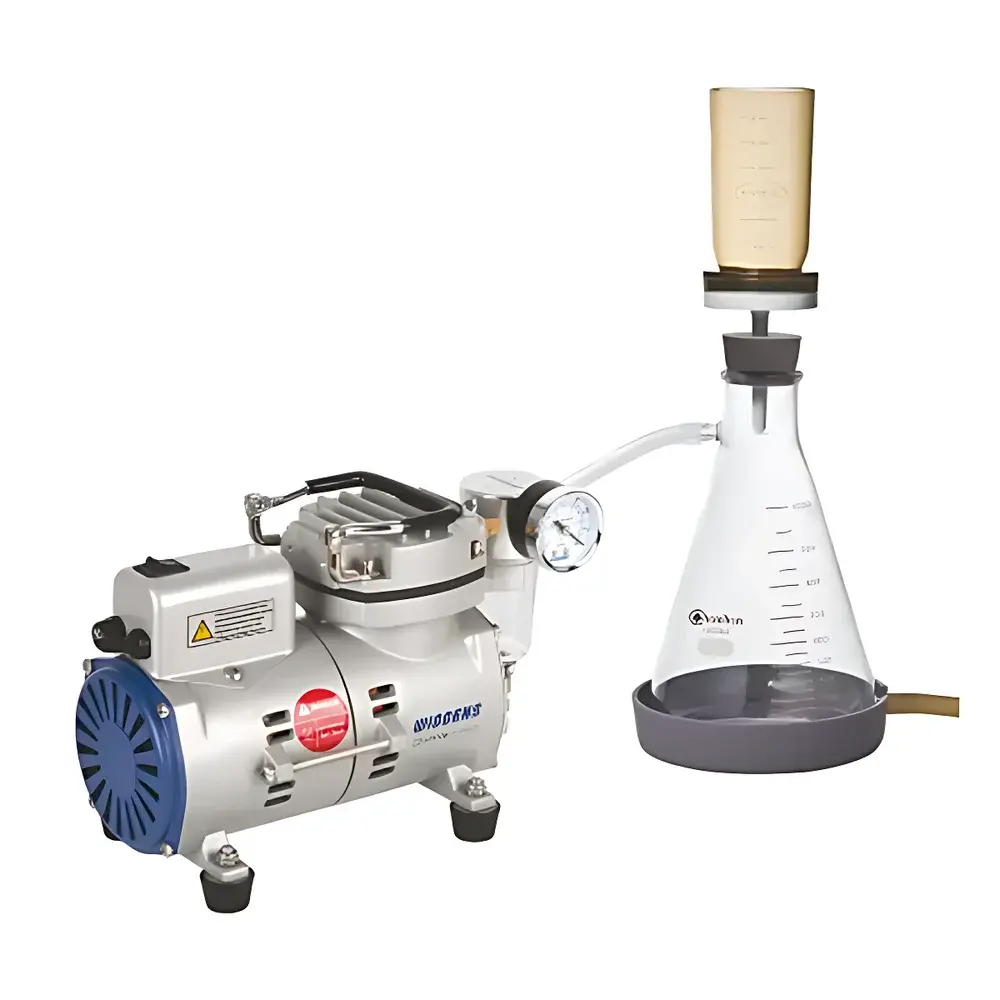
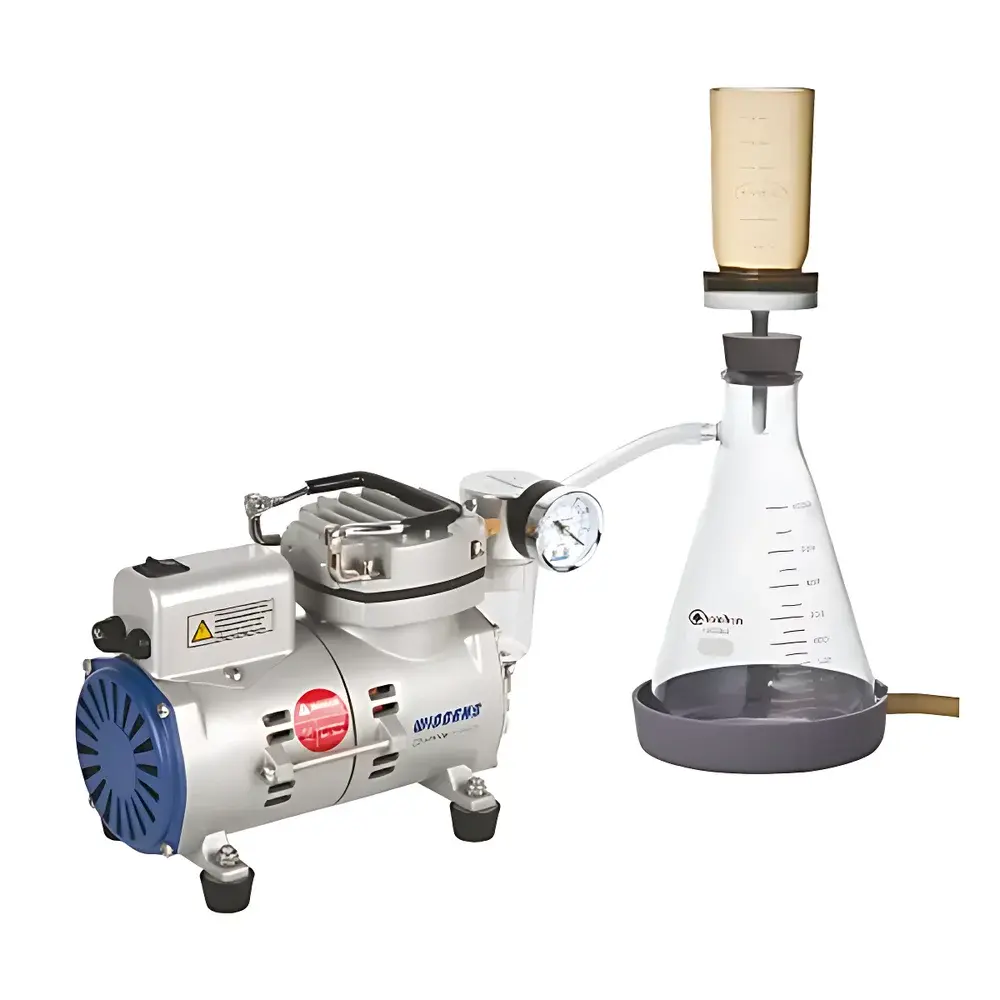
WIGGENS V300A Vacuum Filtration Kit
| Brand | WIGGENS |
|---|---|
| Origin | Germany |
| Model | V300A |
| Vacuum Level | ≥150 mbar |
| Pumping Speed | ≤17 L/min |
| Waste Bottle Capacity | 1000 mL |
| Membrane Diameter | 47/50 mm |
| Filtration Funnel Capacity | 300 mL |
| Glass Funnel Effective Filtration Area | 8 cm² |
| Tubing Inner Diameter | 8 mm |
| Power Supply | 220–240 V / 50 Hz |
| Rated Power | 60 W |
| Included Glass Filtration Assembly | VF6 |
Overview
The WIGGENS V300A Vacuum Filtration Kit is a purpose-engineered, modular laboratory filtration system designed for reproducible, high-efficiency liquid-phase separation under controlled vacuum conditions. Based on the fundamental principle of pressure-driven membrane filtration—where differential pressure across a porous support medium induces selective passage of solvent while retaining suspended particulates—the V300A delivers consistent performance in routine and regulatory-grade applications. Its architecture integrates a diaphragm-type vacuum pump (V300), a borosilicate glass filtration funnel assembly (VF6), flat-bottomed disc filters, and a rapid-drain waste bottle with magnetic base stabilization. This configuration minimizes operator intervention during filtrate disposal, reduces risk of tipping or spillage, and supports seamless integration into standardized workflows such as EPA Method 160.1 (suspended solids), ISO 7899-2 (coliform enumeration), or USP microbiological assay preparation.
Key Features
- Diaphragm vacuum pump (V300) delivering stable vacuum down to ≥150 mbar with low pulsation and oil-free operation—ensuring compatibility with aqueous, organic, and mildly corrosive solvents.
- VF6 glass filtration assembly featuring a 300 mL Pyrex®-grade funnel with 8 cm² effective filtration area and calibrated volume markings for gravimetric or volumetric quantification.
- Dual-diameter filter support platform accommodating standard 47 mm and 50 mm membrane discs—including mixed cellulose ester (MCE), polycarbonate (PC), polyethersulfone (PES), and nylon membranes.
- 1000 mL heavy-walled borosilicate waste bottle with integrated quick-release drain valve and magnetic base for secure positioning on stainless steel or ferromagnetic benchtops.
- Pre-assembled silicone tubing (ID 8 mm) with reinforced wall thickness to resist collapse under sustained vacuum and minimize gas permeability.
- Compact footprint (280 × 180 × 320 mm) and 60 W power consumption enable deployment in biosafety cabinets, laminar flow hoods, or shared analytical labs without thermal load concerns.
Sample Compatibility & Compliance
The V300A system is validated for use with aqueous matrices (e.g., drinking water, wastewater effluent, pharmaceutical rinse solutions), buffered biological suspensions (e.g., microbial cultures, cell lysates), and HPLC/GC mobile phase filtrates. It complies with mechanical safety requirements per EN 61000-6-2 (EMC immunity) and EN 61000-6-4 (EMC emission). When used with certified sterile-filter membranes and autoclavable glassware, the setup supports GLP-compliant documentation of filtration parameters—including time-stamped vacuum onset, duration, and final filtrate volume—per FDA 21 CFR Part 11–aligned data integrity practices when paired with external logging software. The system does not include intrinsic sterilization capability; validation of sterility assurance level (SAL) requires user-defined autoclaving protocols per ISO 17665.
Software & Data Management
The V300A operates as a standalone analog instrument with no embedded microcontroller or digital interface. Vacuum output is manually regulated via an integrated needle valve on the V300 pump housing, enabling fine-tuned control over filtration rate and membrane loading. While the kit itself lacks data logging functionality, its mechanical stability and repeatable vacuum profile allow integration with third-party pressure transducers (e.g., Keller PA-23Y) and USB data acquisition modules (e.g., National Instruments USB-9211) for traceable parameter recording. All components—including the VF6 funnel, waste bottle, and magnetic base—are uniquely serialized to facilitate asset tracking and maintenance history in LIMS environments.
Applications
- Quantitative determination of total suspended solids (TSS) in environmental water samples per ASTM D5907 and ISO 11923.
- Microbial colony enumeration on membrane filters for potable water testing (e.g., ISO 9308-1, APHA 9222B).
- Pre-filtration of HPLC mobile phases and sample extracts to prevent column clogging and extend C18 cartridge lifetime.
- Clarification of protein solutions prior to size-exclusion chromatography or ultrafiltration steps.
- Removal of catalyst residues from synthetic reaction mixtures in medicinal chemistry workflows.
- Routine solvent purification for ICP-MS and AAS analysis where particulate contamination must be minimized below 0.22 µm.
FAQ
Is the V300A suitable for filtering aggressive solvents such as acetone or chloroform?
Yes—provided that chemically resistant membranes (e.g., PTFE or PVDF) and compatible silicone tubing are used. The V300 pump’s diaphragm material is EPDM-rated; prolonged exposure to ketones or halogenated hydrocarbons may reduce service life.
Can the VF6 funnel be autoclaved?
Yes—the borosilicate glass components (funnel, base, and waste bottle) are autoclavable at 121 °C for 20 minutes. Avoid thermal shock by allowing gradual cooling post-cycle.
What is the maximum operating temperature for continuous filtration?
The system is rated for ambient operation up to 40 °C. Sustained inlet fluid temperatures above 60 °C require pre-cooling to prevent membrane deformation and vacuum seal degradation.
Does WIGGENS provide calibration certificates for the V300A?
No—vacuum level and flow rate are non-calibratable mechanical outputs. Users requiring documented metrological traceability must employ external NIST-traceable pressure gauges and flow meters during qualification.
How often should the V300 pump’s diaphragm be replaced?
Under typical lab usage (≤4 hr/day), replacement is recommended every 12–18 months. Increased frequency is advised when filtering viscous or particulate-laden streams.



