
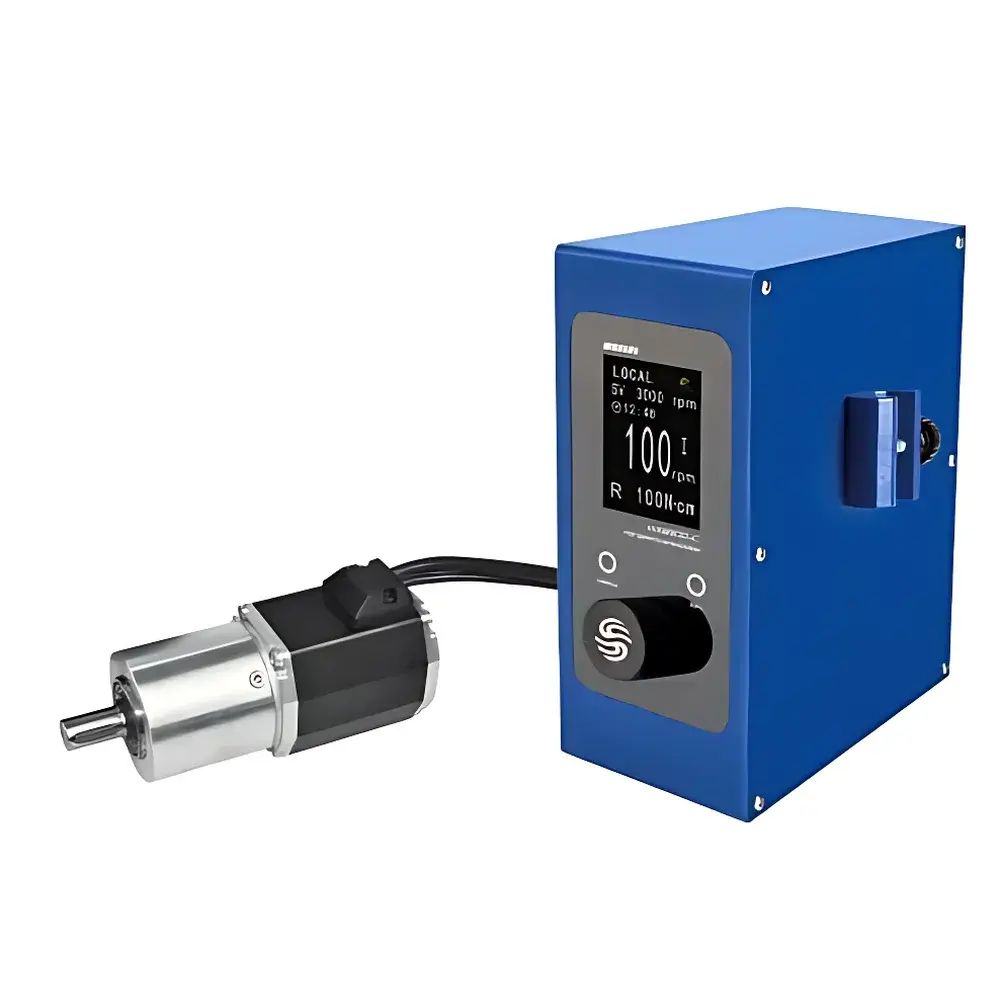
WIGGENS WB3000-EC and WB1800-EC Separated High-Speed High-Torque Laboratory Stirrers
| Brand | WIGGENS |
|---|---|
| Origin | Germany |
| Model | WB3000-EC / WB1800-EC |
| Max. Stirring Volume | 100 L |
| Speed Range | 20–3000 rpm |
| Torque | up to 1640 N·cm (WB1800-EC), 410 N·cm (WB3000-EC) |
| Continuous Rated Torque | 46 N·cm (WB1800-EC), 116 N·cm (WB3000-EC) |
| Viscosity Range | ≤300,000 cP (WB1800-EC), ≤200,000 cP (WB3000-EC) |
| Control Accuracy | ±1 rpm |
| Input/Output Power | 450 W |
| Motor Dimensions (W×D×H) | 225×75×75 mm (WB1800-EC), 165×75×75 mm (WB3000-EC) |
| Motor Weight | 3.4 kg (WB1800-EC), 2.8 kg (WB3000-EC) |
| Interface | USB 2.0, 0–10 V analog input/output, 0–20 mA input, footswitch port |
| Cable Length (standard) | 3 m (optional: 1.5 / 6 / 10 m) |
Overview
The WIGGENS WB3000-EC and WB1800-EC are modular, high-performance laboratory stirrers engineered for demanding mixing, dispersion, and homogenization tasks in research, quality control, and pilot-scale production environments. Designed with a physically separated motor unit and electronic controller, these stirrers eliminate thermal coupling and electromagnetic interference between drive electronics and the motor—critical for stable operation in temperature-sensitive reactors, gloveboxes, biosafety cabinets, or fume hoods. Both models utilize brushless DC motors coupled with sealed planetary gearheads, delivering precise speed regulation via closed-loop current feedback that dynamically compensates for load-induced torque fluctuations. This architecture ensures constant rotational speed across wide viscosity ranges—from low-viscosity solvents to highly structured polymer melts or ceramic slurries—without manual recalibration or speed drift.
Key Features
- Modular separation of motor head and controller enables flexible integration into custom reactor systems, jacketed vessels, or automated platforms while maintaining operator safety and thermal isolation.
- Real-time torque monitoring with digital display (N·cm) provides immediate insight into process load dynamics—essential for detecting phase transitions, gelation onset, or agglomeration events during mixing.
- TFT touchscreen interface with intuitive menu navigation supports rapid parameter setup, direction reversal, and programmable ramp profiles (acceleration/deceleration).
- Dual analog I/O (0–10 V input/output, 0–20 mA input) and footswitch compatibility allow seamless integration with PLCs, SCADA systems, or external process controllers for synchronized multi-unit operation.
- USB 2.0 interface enables direct connection to Windows-based PCs; supplied software supports data logging (speed, torque, time), script-based sequence execution, and audit-trail generation compliant with GLP and FDA 21 CFR Part 11 requirements.
- Aluminum motor housing ensures efficient heat dissipation and mechanical rigidity; IP54-rated construction provides protection against dust ingress and incidental splashes.
- No maintenance required: brushless motor and sealed planetary gearbox eliminate carbon brush wear, lubricant degradation, and periodic servicing intervals.
Sample Compatibility & Compliance
These stirrers accommodate a broad spectrum of sample types—including Newtonian and non-Newtonian fluids, suspensions, emulsions, pastes, and highly viscous thermosets—across volumes from 50 mL to 100 L (depending on impeller geometry and vessel configuration). The WB1800-EC is optimized for high-torque, low-to-medium speed applications (20–800 rpm), ideal for viscous polymer processing or solid-liquid suspension. The WB3000-EC targets high-speed dispersion (70–3000 rpm) with enhanced dynamic response, suitable for nanoparticle deagglomeration or rapid solvent blending. Both units comply with IEC 61000-6-3 (EMC emission standards) and IEC 61000-6-2 (immunity), and meet CE marking requirements for laboratory equipment within the European Economic Area. Design and documentation support traceability under ISO/IEC 17025-accredited calibration workflows.
Software & Data Management
The included WIGGENS StirControl software runs natively on Windows 10/11 and supports real-time acquisition of speed, torque, and elapsed time at user-defined sampling intervals (100 ms to 5 s). All logged data are timestamped and stored in CSV format with embedded metadata (operator ID, session notes, instrument serial number). Software features include configurable alarm thresholds (e.g., torque overload, stall detection), exportable PDF reports with graphical overlays, and password-protected user roles (Operator, Supervisor, Administrator) to enforce data integrity controls. Audit trails record all parameter changes, software updates, and user logins—fully aligned with 21 CFR Part 11 electronic signature and record retention expectations.
Applications
- Chemical synthesis: Controlled addition and mixing in exothermic reactions under inert atmosphere.
- Pharmaceutical formulation: Wet granulation, suspension preparation, and API dispersion in non-aqueous media.
- Materials science: Homogenization of battery electrode slurries, ceramic green bodies, and composite preforms.
- Food & cosmetics R&D: Emulsion stabilization, thickener hydration, and sensory consistency profiling.
- Environmental testing: Standardized sediment resuspension protocols per ASTM D5907 and ISO 11277.
- Biotechnology: Agitation of high-density microbial cultures in single-use bioreactors without compromising sterility.
FAQ
What distinguishes the WB1800-EC from the WB3000-EC?
The WB1800-EC prioritizes maximum torque output (up to 1640 N·cm) at lower speeds (20–800 rpm) for ultra-viscous materials, whereas the WB3000-EC delivers higher rotational speeds (70–3000 rpm) with optimized acceleration dynamics for dispersion-intensive tasks.
Can the motor be mounted directly onto a reactor lid?
Yes—the compact, low-vibration motor units feature standardized M12 threaded mounting holes and optional flange kits for rigid, coaxial installation on glass or stainless-steel vessels.
Is calibration traceable to national standards?
Speed and torque sensors are factory-calibrated using NIST-traceable reference instruments; calibration certificates (including uncertainty budgets) are available upon request.
How is electrical safety ensured in wet or conductive environments?
The motor operates at SELV (Safety Extra-Low Voltage) levels via an isolated AC/DC power adapter; physical separation of power supply and motor eliminates risk of electric shock during routine handling.
Does the system support remote start/stop via external logic signals?
Yes—digital trigger inputs (TTL-compatible) and analog setpoint control enable full automation integration without requiring PC intervention.



