
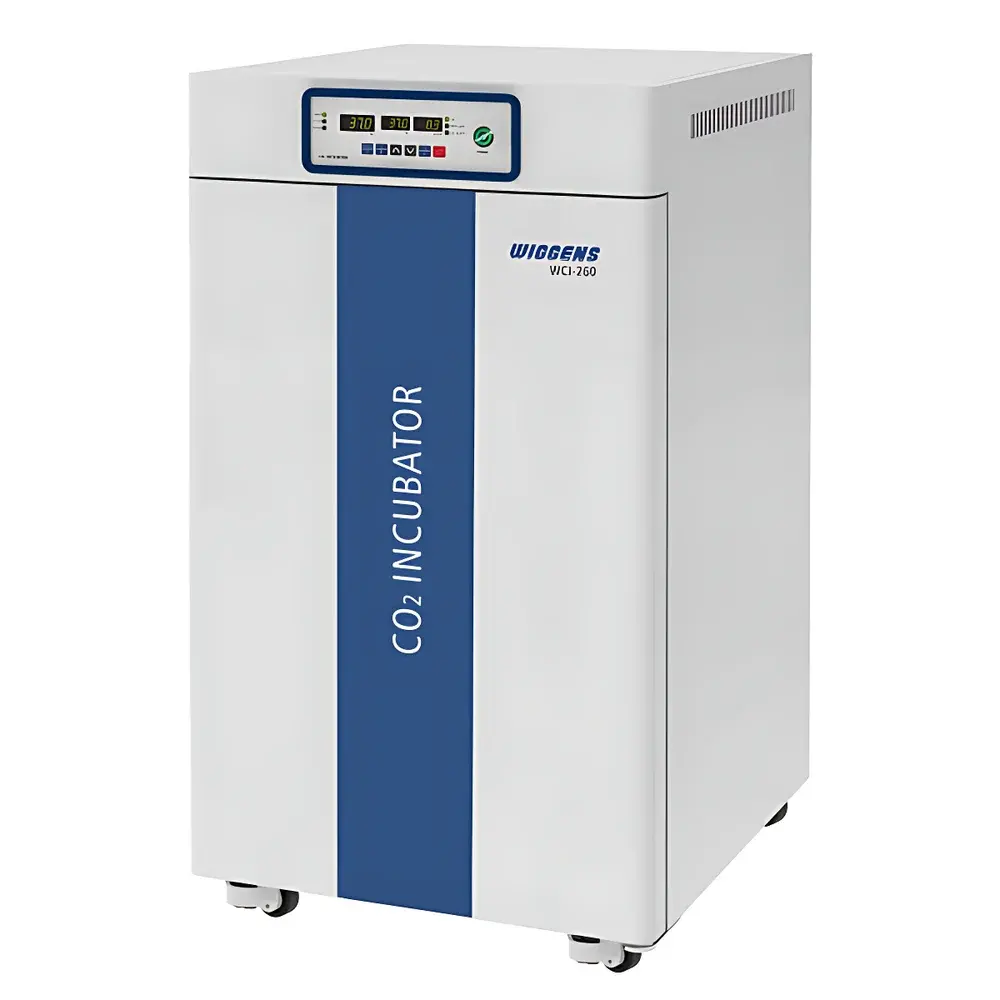
WIGGENS WCI-260 Gas-Jacketed CO₂ Incubator
| Brand | WIGGENS |
|---|---|
| Origin | Germany |
| Model | WCI-260 |
| Instrument Type | Gas-Jacketed CO₂ Incubator |
| Temperature Range | Ambient +5°C to 60°C |
| Temperature Uniformity | ±0.4°C (at 37°C / ambient 20°C) |
| Chamber Volume | 260 L |
| External Dimensions | 630 × 680 × 1125 mm |
| Heating Power | 610 W |
| CO₂ Range | 0–20% |
| CO₂ Accuracy | ±0.1% (at 5% / 37°C) |
| CO₂ Resolution | 0.1% |
| CO₂ Sensor | Dual-Beam Infrared |
| Temperature Display Resolution | 0.1°C |
| Temperature Display Accuracy | ±0.1°C (at 37°C) |
| Control Method | Digital PID |
| Chamber Material | AISI 304 Stainless Steel |
| Standard Shelves | 3 (max 8) |
| Internal Dimensions (W×D×H) | 530 × 590 × 900 mm |
| Net Weight | 115 kg |
| Supply Pressure | 0.6–0.7 bar |
| Humidification | Passive Water Pan with Bottom Heater & Forced-Air Circulation |
| Door | Double-Layer Glass with Anti-Condensation Design |
| Filtration | Integrated HEPA Filter (≥99.99% @ 0.3 µm) |
| Optional Functions | Automatic Sterilization Cycle, O₂ Control Module, UV Germicidal Lamp, Refrigeration Unit |
Overview
The WIGGENS WCI-260 is a precision-engineered gas-jacketed CO₂ incubator designed for reliable, long-term cultivation of mammalian cells, primary tissues, stem cells, and microaerophilic or capnophilic microorganisms. Its operational principle centers on independent thermal regulation of the chamber walls via six-sided gas-jacketed heating elements—eliminating reliance on water jackets while delivering rapid temperature equilibration, minimal thermal inertia, and superior stability across the full operating range (ambient +5°C to 60°C). The dual-beam infrared CO₂ sensor ensures high-fidelity, drift-resistant gas concentration monitoring with ±0.1% accuracy at 5% CO₂ and 37°C—critical for maintaining physiological pH in bicarbonate-buffered media. Chamber humidity is maintained passively through a heated stainless steel water pan combined with a top-mounted axial fan that promotes laminar, non-turbulent air circulation—minimizing shear stress on sensitive monolayers and ensuring uniform moisture distribution without condensation on the inner observation window.
Key Features
- Six-sided gas-jacketed heating architecture with three independently calibrated PT100 sensors—one per chamber zone—enabling real-time spatial temperature mapping and adaptive thermal compensation.
- Dual-beam NDIR (Non-Dispersive Infrared) CO₂ sensor with automatic baseline correction, immune to cross-sensitivity from water vapor or ambient temperature fluctuations.
- Passive humidification system featuring a recessed 304 stainless steel water reservoir heated from below and integrated into the forced-air convection path—eliminating need for external humidifiers or complex plumbing.
- Anti-condensation double-glazed door with low-emissivity coating and thermally decoupled frame—ensuring unobstructed optical access during extended incubation periods.
- Integrated Class H14 HEPA filter (EN 1822-1 compliant) positioned upstream of the recirculation blower, delivering ≥99.995% particle removal efficiency for particles ≥0.3 µm—meeting ISO 5 cleanroom requirements within the chamber.
- Digital PID control system with independent setpoint regulation for temperature, CO₂, and (optional) O₂; configurable alarm thresholds with audible dual-tone alert (high/low frequency) and automatic power cutoff upon thermal runaway (>±5°C deviation).
- Rounded internal corners and seamless 304 stainless steel chamber construction—facilitating ISO 14644-compliant cleaning protocols and compatibility with validated disinfectants including 70% ethanol, hydrogen peroxide vapor (HPV), and sodium hypochlorite solutions.
Sample Compatibility & Compliance
The WCI-260 supports adherence to critical regulatory frameworks governing cell culture integrity and process validation. Its stable CO₂ and temperature profiles meet the performance criteria outlined in ASTM E1262–22 (Standard Practice for Validation of CO₂ Incubators) and ISO 13408-2 (Aseptic processing of health care products — Part 2: Filtration). The HEPA filtration system satisfies ISO 14644-1 Class 5 (ISO 5) requirements for viable particle counts when operated under steady-state conditions. For GLP- and GMP-regulated environments, optional configurations include 21 CFR Part 11–compliant audit trail logging (via external data acquisition module), dry-heat sterilization cycles (180°C for 2 hours, validated per ISO 17665-1), and UV-C germicidal irradiation (254 nm, 40 mJ/cm² dose) with interlocked door safety cutoff. All standard models are CE-marked per Directive 2014/30/EU (EMC) and 2014/35/EU (LVD), and comply with IEC 61010-1:2010 for laboratory equipment safety.
Software & Data Management
While the WCI-260 operates via an embedded microcontroller with LED interface and tactile keypad navigation, it supports optional RS-485 Modbus RTU or Ethernet TCP/IP connectivity for integration into centralized facility monitoring systems (e.g., Siemens Desigo, Schneider EcoStruxure). Real-time parameters—including chamber temperature, CO₂ concentration, relative humidity (derived from dew point calculation), and alarm status—are exportable as CSV or XML files for traceability. When equipped with the optional data logger module, the system records timestamped values at user-defined intervals (1–60 min), stores up to 30 days of data onboard, and generates PDF reports compliant with ALCOA+ principles (Attributable, Legible, Contemporaneous, Original, Accurate, Complete, Consistent, Enduring, Available). Audit trails capture operator ID, parameter changes, alarm events, and sterilization cycle logs—including cycle time, peak temperature, and hold duration—with digital signature capability.
Applications
The WCI-260 is routinely deployed in academic core facilities, biopharmaceutical R&D labs, and clinical diagnostic centers for applications requiring stringent environmental control. These include: maintenance of human embryonic stem cell (hESC) lines under 5% CO₂ and 37°C; long-term expansion of CAR-T lymphocytes with oxygen modulation (when O₂ option installed); co-culture of intestinal organoids with aerobic and anaerobic bacteria; mycobacterial growth studies requiring elevated CO₂ (10–12%) and precise temperature ramping; and quality control testing of monoclonal antibody-producing CHO cell banks per ICH Q5D. Its robust thermal recovery (<15 min to re-stabilize after 30-sec door opening at 37°C) makes it suitable for high-throughput workflows involving frequent sample access, while its corrosion-resistant 304 stainless steel interior withstands repeated exposure to aggressive decontamination agents used in BSL-2 containment environments.
FAQ
What is the difference between gas-jacketed and water-jacketed CO₂ incubators?
Gas-jacketed designs use heated air circulated between insulated chamber walls, enabling faster temperature recovery, lower energy consumption, and elimination of water maintenance—unlike water-jacketed units which rely on thermal mass but require periodic refilling and risk microbial contamination.
Does the WCI-260 support remote monitoring and alarm notification?
Yes—via optional Ethernet or RS-485 interface, users can integrate the incubator into building management systems (BMS) or LabVantage/LIMS platforms for real-time alerts via email/SNMP traps upon parameter deviation or door-open events.
Can the unit be validated for ISO 13408-2 compliance?
Yes—the WCI-260’s documented temperature uniformity (±0.4°C), CO₂ accuracy (±0.1%), and HEPA filtration performance provide foundational evidence for IQ/OQ/PQ protocols; WIGGENS provides Factory Acceptance Test (FAT) documentation and supports User Requirement Specification (URS) alignment.
Is the stainless steel chamber compatible with hydrogen peroxide vapor (HPV) decontamination?
Yes—AISI 304 stainless steel is fully compatible with HPV cycles up to 1000 ppm concentration and 60°C; no surface degradation or passivation layer compromise has been observed in accelerated aging tests per ASTM F2338.
What is the maximum number of shelves supported, and are they adjustable?
Up to eight (8) perforated 304 stainless steel shelves can be installed; all positions are height-adjustable via standardized slotting (25 mm pitch) and load-rated to 15 kg per shelf when evenly distributed.




