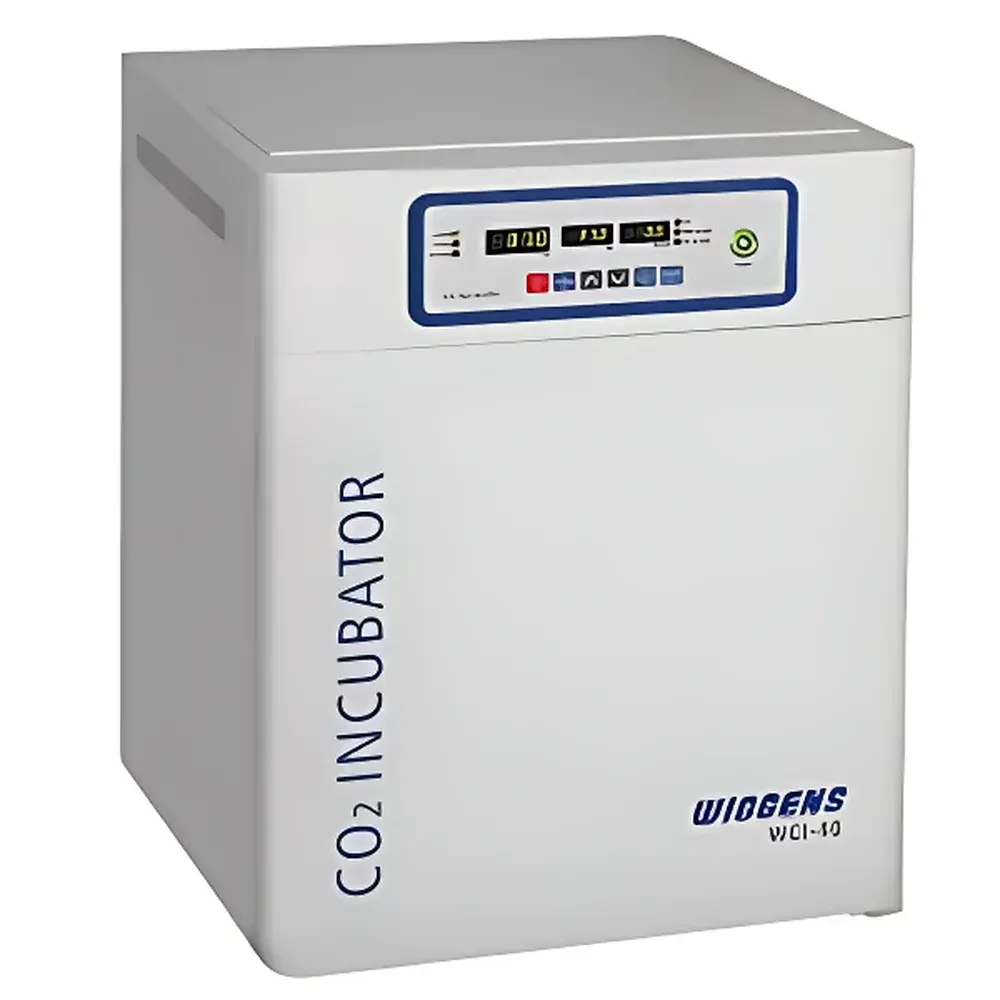
WIGGENS WCI-40P Low-Temperature CO₂ Incubator
| Brand | WIGGENS |
|---|---|
| Origin | Germany |
| Model | WCI-40P |
| Temperature Control Range & Accuracy | +20 to +60 °C, ±0.1 °C display accuracy (at 37 °C), 0.1 °C resolution |
| Temperature Uniformity | ±0.3 °C (at 37 °C and ambient 20 °C) |
| CO₂ Concentration Range & Accuracy | 0–20%, ±0.1% (at 5% setpoint, 37 °C), 0.1% resolution |
| Chamber Volume | 40 L |
| External Dimensions (W×D×H) | 420 × 460 × 570 mm |
| Chamber Material | AISI 304 stainless steel |
| Heating Method | Air-jacketed (6-sided gradient heating) |
| Cooling Method | Peltier-based thermoelectric cooling |
| CO₂ Sensor Type | Dual-beam infrared (NDIR) |
| Control System | Microprocessor-based PID control with independent dual-channel keypad interface |
| Inlet Gas Pressure Range | 0.3–0.5 bar |
| Heating Power | 320 W |
| Standard Shelving | 2 shelves (up to 4 optional) |
| Net Weight | 42 kg |
Overview
The WIGGENS WCI-40P Low-Temperature CO₂ Incubator is a compact, precision-engineered cell culture environment system designed for laboratories requiring stable, low-heat-load incubation conditions in the +20 °C to +60 °C range. Unlike conventional compressor-based CO₂ incubators, the WCI-40P employs solid-state Peltier thermoelectric technology for active cooling—enabling precise sub-ambient temperature control without refrigerants, mechanical compressors, or associated vibration. This architecture eliminates oil contamination risks, reduces acoustic noise, and significantly lowers power consumption while maintaining thermal stability essential for sensitive mammalian, insect, or primary cell lines. The air-jacketed chamber features six-sided gradient heating combined with intelligent PID regulation to minimize thermal gradients across the 40 L stainless steel (AISI 304) interior. Dual-beam non-dispersive infrared (NDIR) CO₂ sensing ensures long-term drift-free gas concentration monitoring at resolutions of 0.1%, calibrated against reference standards traceable to NIST-equivalent protocols.
Key Features
- Peltier-based thermoelectric cooling system: Enables stable operation down to +20 °C without refrigerants, moving parts, or external condensate management.
- Air-jacketed 6-sided gradient heating: Ensures rapid temperature recovery and uniformity of ±0.3 °C across the working volume at both 37 °C and ambient (20 °C) setpoints.
- Dual-beam NDIR CO₂ sensor: Delivers high specificity, minimal cross-sensitivity to water vapor or ethanol, and ±0.1% accuracy at 5% CO₂ (37 °C), compliant with ISO 13485 environmental monitoring requirements for bioprocessing support.
- Microprocessor-controlled PID algorithm: Supports independent, real-time adjustment of temperature and CO₂ setpoints via tactile dual-channel keypad; LED display shows simultaneous readouts with 0.1 °C / 0.1% resolution.
- Stainless steel (AISI 304) chamber and door seal: Facilitates routine decontamination using alcohol wipes, hydrogen peroxide vapor (HPV), or dry heat (optional integrated dry-heat sterilization module available under order code W6012040).
- Gas inlet pressure regulation: Integrated pressure regulator maintains consistent CO₂ delivery at 0.3–0.5 bar, compatible with standard lab gas manifolds and mass flow controllers.
Sample Compatibility & Compliance
The WCI-40P supports standard T-25, T-75, and multi-well plate formats on up to four adjustable stainless steel shelves (2 included). Its sealed, corrosion-resistant chamber accommodates humidified or low-humidity applications—ideal for stem cell expansion, co-culture assays, and hypoxia-relevant studies where precise CO₂ modulation below 5% is required. The system complies with IEC 61010-1:2010 for laboratory equipment safety and meets electromagnetic compatibility (EMC) requirements per EN 61326-1. While not certified as a medical device, its design aligns with GLP documentation practices and supports audit-ready operation when paired with external data loggers for 21 CFR Part 11-compliant record retention.
Software & Data Management
The WCI-40P operates as a standalone unit with no proprietary software dependency. All operational parameters—including setpoints, real-time readings, alarm history, and door-open events—are stored in non-volatile memory and accessible via the front-panel interface. For integration into centralized lab infrastructure, analog voltage outputs (0–5 V) are provided for temperature and CO₂ signals, enabling connection to building management systems (BMS) or third-party SCADA platforms. Optional RS-232/RS-485 interfaces (available upon request) support ASCII command protocols for remote parameter interrogation and basic event logging—compatible with LabVIEW, Python-based automation scripts, and LIMS middleware.
Applications
- Mammalian cell culture requiring tight CO₂ control at physiological (5%) or low-CO₂ conditions (e.g., neuronal differentiation, organoid maturation).
- Microbial cultivation of fastidious strains sensitive to thermal overshoot or mechanical vibration (e.g., Helicobacter pylori, Neisseria gonorrhoeae).
- Short-term storage and recovery of cryopreserved cells prior to passaging or assay initiation.
- Environmental simulation studies involving temperature-CO₂ interaction effects on metabolic activity or gene expression profiles.
- Quality control testing of CO₂-sensitive reagents, media supplements, or bioprinted scaffolds under GMP-aligned environmental monitoring.
FAQ
Does the WCI-40P require external water reservoirs or humidification trays?
No—the WCI-40P is designed for low-humidity operation; optional external humidification modules are not supported. Users requiring >95% RH should select larger-capacity models (e.g., WCI-120P+) with integrated steam generators.
Can the Peltier cooling system operate continuously at +20 °C ambient?
Yes—thermal modeling confirms sustained operation at +20 °C setpoint with ≤3 K ambient delta, provided ambient room temperature remains stable and ventilation clearance (≥10 cm rear/side) is maintained.
Is the dual-beam CO₂ sensor field-calibratable?
Yes—calibration is performed using certified 0% and 5% CO₂ gas standards; procedure requires no disassembly and is documented in the operator manual per ISO/IEC 17025 traceability guidelines.
What dry-heat sterilization cycle is supported?
The optional dry-heat module (order code W6012040) delivers 120 °C for 2 hours, validated to achieve ≥6-log reduction of Geobacillus stearothermophilus spores per ISO 14644-1 cleanroom validation protocols.
Are replacement shelves and gaskets available as spare parts?
Yes—AISI 304 shelves (W6011001), silicone door gaskets (W6011002), and Peltier module assemblies (W6011003) are stocked globally with lead times under 10 business days.