
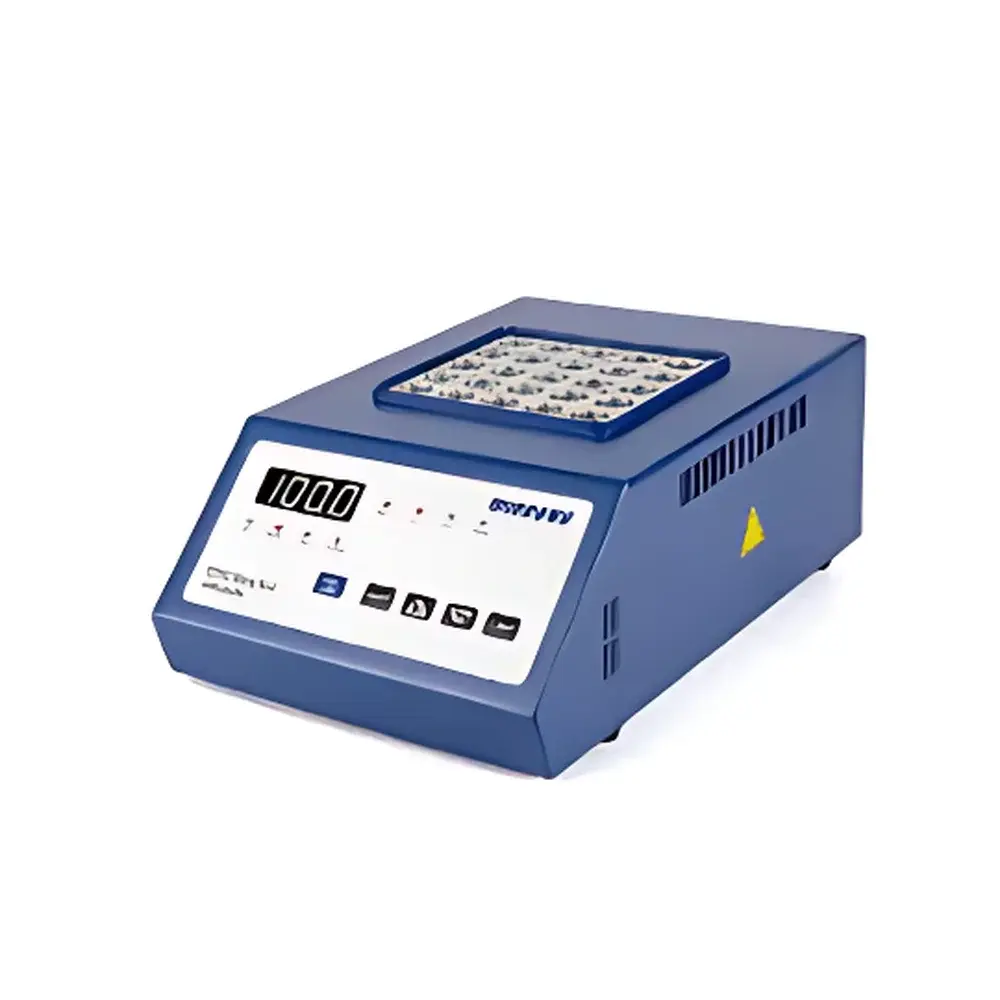
WIGGENS WD325 COD Digestion Block
| Brand | WIGGENS |
|---|---|
| Origin | Germany |
| Model | WD325 |
| Digestion Method | Rapid Digestion |
| Heating Module | Single Aluminum Block |
| Batch Capacity | 25 samples |
| Temperature Range | 60–200 °C (programmable) and fixed 150 °C (COD mode) |
| Temperature Accuracy | ±2 °C at 150 °C |
| Timer Range | 1–999 min (or continuous) |
| Display | 4-digit LED |
| Power Supply | 220 V, 50 Hz |
| Dimensions (W×H×D) | 189 × 116 × 315 mm |
| Weight | 4.5 kg |
| Safety Features | Overheat warning (>70 °C), auto-shutdown (>240 °C) |
| Memory | 3 user-programmable protocols |
Overview
The WIGGENS WD325 COD Digestion Block is a precision-engineered thermal digestion system designed for standardized chemical oxygen demand (COD) analysis in environmental laboratories. It operates on the principle of closed-vessel, high-temperature acid digestion—specifically optimized to meet the procedural requirements of USEPA Method 410.4 for wastewater and surface water testing. The instrument employs a single, high-mass aluminum heating block with uniform thermal conductivity, ensuring consistent temperature distribution across all 25 sample positions. Its dedicated COD program automatically ramps to and maintains 150 °C for exactly 120 minutes—a critical parameter defined by regulatory methodology—then triggers an audible alarm and terminates heating without user intervention. This eliminates timing variability and operator dependency, directly supporting method reproducibility and data traceability in compliance-driven environments.
Key Features
- Dedicated COD protocol: Pre-configured 150 °C / 120 min cycle aligned with USEPA 410.4 and ISO 6060:1989 requirements.
- Programmable flexibility: Independent temperature setting from 60 to 200 °C and timer control from 1 to 999 minutes—or continuous operation—for non-COD applications including total phosphorus, total nitrogen, or heavy metal digestion.
- Three-step safety architecture: Visual LED warning activates at >70 °C; thermal cutoff engages at >240 °C; redundant solid-state relay ensures fail-safe shutdown.
- Non-volatile memory storage: Retains up to three custom temperature/time profiles for rapid recall—ideal for multi-method labs operating under GLP or ISO/IEC 17025 frameworks.
- High-stability aluminum block: Precision-machined Ø16.5 × 55 mm wells accommodate standard 16 mm borosilicate digestion tubes; thermal homogeneity ≤±1.5 °C across full load.
- Minimalist, lab-grade interface: Four-digit LED display provides real-time temperature and countdown feedback; tactile push-button controls ensure reliable operation with gloves.
Sample Compatibility & Compliance
The WD325 accommodates standard 16 mm outer-diameter digestion vials—compatible with common reagent kits (e.g., Hach, Merck, and Thermo Scientific COD vials) and laboratory-prepared sulfuric acid–potassium dichromate solutions. Its thermal performance meets the temperature stability and ramp-rate criteria specified in ASTM D1252–22 (Test Methods for Chemical Oxygen Demand of Water) and supports validation per ISO/IEC 17025:2017 Clause 7.2.2 (method validation). While the unit itself is not CE-marked as a medical device, its construction adheres to IEC 61010-1:2010 safety standards for electrical equipment used in laboratory environments. No internal pressure regulation is provided; users must employ externally rated digestion vessels rated for ≥200 °C and 1.5 bar.
Software & Data Management
The WD325 is a standalone hardware platform with no embedded software or digital connectivity (e.g., USB, Ethernet, or Bluetooth). All operational parameters are entered and monitored via front-panel controls and LED display. For audit-trail compliance in regulated settings (e.g., EPA-certified labs or ISO 17025-accredited facilities), users are expected to record run parameters—including date, time, setpoint, duration, and batch ID—in external logbooks or LIMS-integrated electronic notebooks. The instrument’s deterministic behavior (no firmware updates, no clock drift, no memory corruption) inherently supports 21 CFR Part 11-compliant workflows when paired with validated procedural documentation and manual signature logs.
Applications
- Routine COD determination in municipal wastewater treatment plants, industrial effluent monitoring, and environmental consulting labs.
- Pre-digestion step for spectrophotometric (e.g., Hach DR3900) or titrimetric (e.g., burette-based dichromate back-titration) quantification methods.
- Method development for alternative oxidizable parameter assays requiring controlled thermal decomposition—such as total organic carbon (TOC) pre-oxidation screening or sulfate reduction studies.
- Educational use in university environmental chemistry labs where reproducible, hands-on digestion training is required without complex automation overhead.
FAQ
Does the WD325 include a cooling function?
No. The unit provides only heating; post-digestion cooling must be performed passively (e.g., ambient air rack) or with external fan-assisted coolers.
Can I use glass digestion tubes other than Ø16.5 mm?
Only tubes matching the block’s well geometry (Ø16.5 × 55 mm depth) ensure optimal thermal contact and safety. Substituting larger or tapered tubes may cause uneven heating or mechanical stress.
Is calibration traceable to NIST standards?
The WD325 does not ship with a calibration certificate. Users must perform periodic verification using a calibrated NIST-traceable thermometer (e.g., PRT or thermocouple) inserted into a representative well under load.
What maintenance is required?
Annual visual inspection of heating block integrity, cleaning of residual acid deposits with dilute sodium bicarbonate solution, and verification of LED/display functionality constitute routine maintenance. No consumables or scheduled service intervals apply.







