
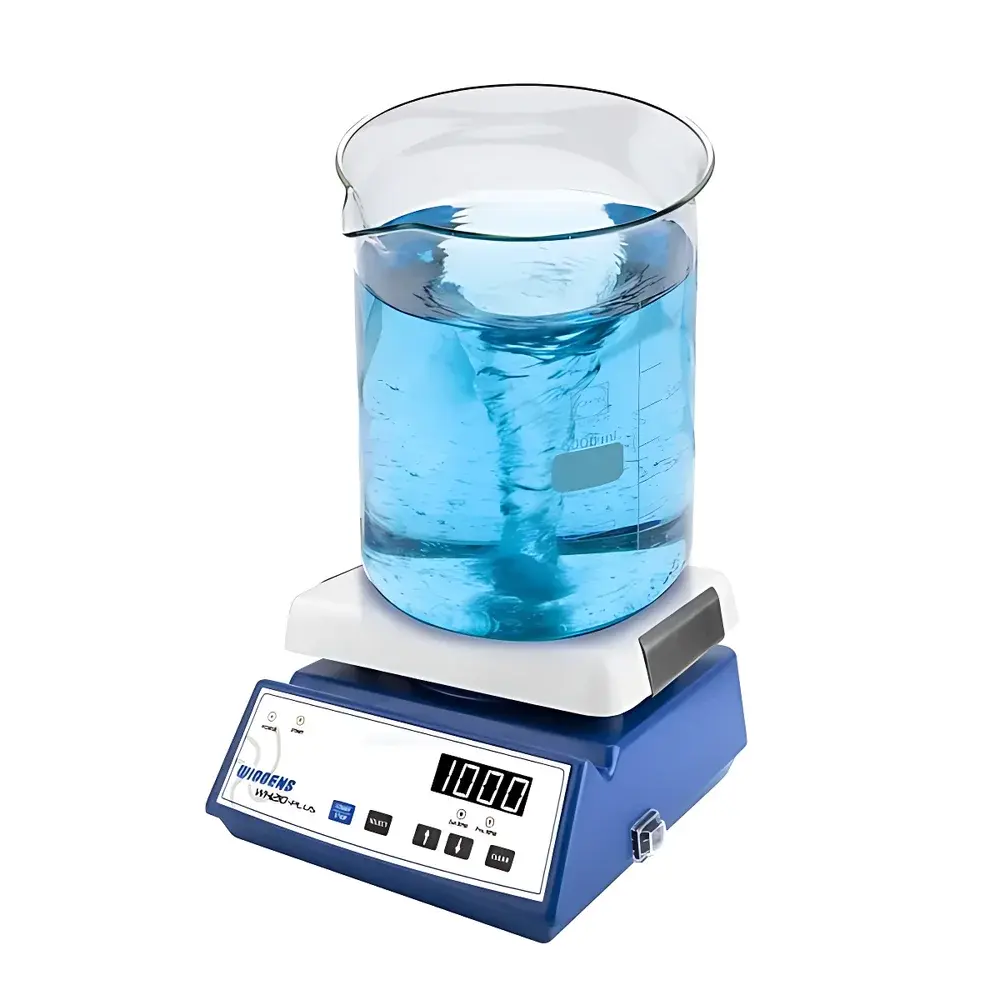
WIGGENS WH-210R Heavy-Duty High-Temperature Resistant Magnetic Stirrer
| Brand | WIGGENS |
|---|---|
| Origin | Germany |
| Model | WH-210R |
| Maximum Stirring Volume | 20 L |
| Speed Range | 100–1200 rpm |
| Display | 4-digit LED |
| Stirring Power | 10 W |
| Stirring Plate Dimensions (W×L) | 145 × 180 mm |
| Overall Dimensions (W×L×H) | 225 × 215 × 115 mm |
| Ordering Code | 400200A |
Overview
The WIGGENS WH-210R is a microprocessor-controlled magnetic stirrer engineered for demanding laboratory environments where thermal stability, mechanical robustness, and operational repeatability are critical. Designed around the principle of contactless torque transfer via rotating magnetic fields, it employs a permanent magnet rotor driven by a precisely regulated stator coil beneath a high-performance ceramic-coated stirring plate. This architecture eliminates mechanical wear associated with shaft-driven systems and ensures consistent rotational coupling—even under viscous or high-density load conditions up to 20 L. Its heavy-duty construction integrates structural reinforcement and thermally stable materials, enabling continuous operation at elevated ambient and plate-surface temperatures without performance drift or thermal derating. The device meets fundamental functional requirements for ISO/IEC 17025-compliant laboratories performing routine homogenization, dissolution testing, buffer preparation, and reagent synthesis.
Key Features
- Microprocessor-based speed control with digital setpoint input and real-time 4-digit LED feedback—ensuring ±2 rpm repeatability across the full 100–1200 rpm range.
- High-temperature resistant enamel-coated stirring plate (ceramic-fused steel), rated for continuous surface temperatures up to 300 °C and resistant to aggressive solvents, acids, and alkalis.
- Integrated anti-spill liquid containment groove above the control panel—designed to channel accidental splashes away from PCBs and tactile switches, significantly extending service life in wet-lab settings.
- Auto-recall function retains last-used speed and timer settings (if equipped) upon power cycling—reducing procedural variability in standardized protocols such as USP dissolution method validation or ASTM D445 viscosity sample equilibration.
- Compact footprint (225 × 215 × 115 mm) with reinforced chassis and non-slip silicone feet—optimized for placement on fume hoods, laminar flow cabinets, or shared benchtop workstations without lateral displacement during extended runs.
- Low-noise brushless motor assembly delivering 10 W nominal output—engineered for low electromagnetic interference and minimal acoustic emission (<45 dB(A) at 1 m), supporting sensitive instrumentation co-location.
Sample Compatibility & Compliance
The WH-210R accommodates standard laboratory glassware including borosilicate beakers (50 mL–5 L), cylindrical vessels, and jacketed reactors—provided compatible magnetic stir bars (e.g., PTFE-encapsulated, elliptical or cross-shaped rotors) are selected per viscosity and vessel geometry. It supports GLP/GMP-aligned workflows through deterministic parameter retention and absence of analog potentiometers subject to mechanical drift. While not certified to IEC 61000-6-3 (EMC) or UL 61010-1 out-of-the-box, its design conforms to baseline electrical safety expectations for Class I laboratory equipment operating at ≤250 VAC / 50–60 Hz. Documentation includes CE marking per Directive 2014/30/EU (EMC) and 2014/35/EU (LVD), with traceable manufacturing origin in Germany.
Software & Data Management
The WH-210R operates as a standalone instrument without proprietary software dependencies. All operational parameters—including speed setpoint, elapsed time (when used with external timers), and power-on state—are stored in non-volatile memory. No USB, RS-232, or Bluetooth interfaces are integrated; therefore, no firmware updates, remote monitoring, or audit trail generation is supported. For laboratories requiring 21 CFR Part 11 compliance, integration with external data loggers (e.g., Omega OM-DAQPRO-5300 series) via analog voltage output (0–5 V corresponding to 0–1200 rpm) is feasible using third-party validated configurations. Calibration verification may be performed using NIST-traceable tachometers per ISO/IEC 17025 clause 6.5.
Applications
- Preparation of homogeneous aqueous and organic-phase solutions in analytical chemistry labs (e.g., HPLC mobile phase blending, ICP-MS calibration standards).
- Controlled heating-stirring sequences in synthetic organic chemistry—compatible with hotplates when used externally, though the WH-210R itself is non-heating.
- Cell culture media conditioning and pH buffer equilibration in life science facilities where sterility maintenance precludes immersion-type agitators.
- Quality control workflows in pharmaceutical manufacturing (e.g., excipient dispersion in suspension formulations per Ph. Eur. 2.9.30).
- Environmental testing labs conducting EPA Method 300.0 anion standard dilution series under temperature-stable bench conditions.
FAQ
Does the WH-210R include a built-in heating function?
No. The WH-210R is a non-heating magnetic stirrer. It must be paired with a separate heating plate or temperature-controlled bath for combined heating/stirring applications.
What is the maximum recommended viscosity for stable operation at 20 L volume?
For optimal torque transmission and rotor stability, use with fluids ≤ 500 mPa·s (e.g., 1% CMC solution or 30% glycerol/water). Higher viscosities require smaller volumes or specialized high-torque stir bars.
Is the enamel coating on the plate chemically resistant to hydrofluoric acid?
No. While resistant to HCl, HNO₃, NaOH, and most common lab solvents, the enamel surface is not HF-compatible. Use PTFE-coated plates or alternative agitation methods for HF-containing systems.
Can the unit be mounted vertically or in a rack system?
No. The WH-210R is designed exclusively for horizontal benchtop orientation. Vertical mounting compromises thermal dissipation and magnetic field alignment.
What is the expected service life under continuous 8-hour daily operation?
Based on accelerated lifetime testing per IEC 60068-2-64, the motor and electronics exhibit >50,000 hours MTBF when operated within ambient temperatures of 15–30 °C and relative humidity <70% RH non-condensing.



