
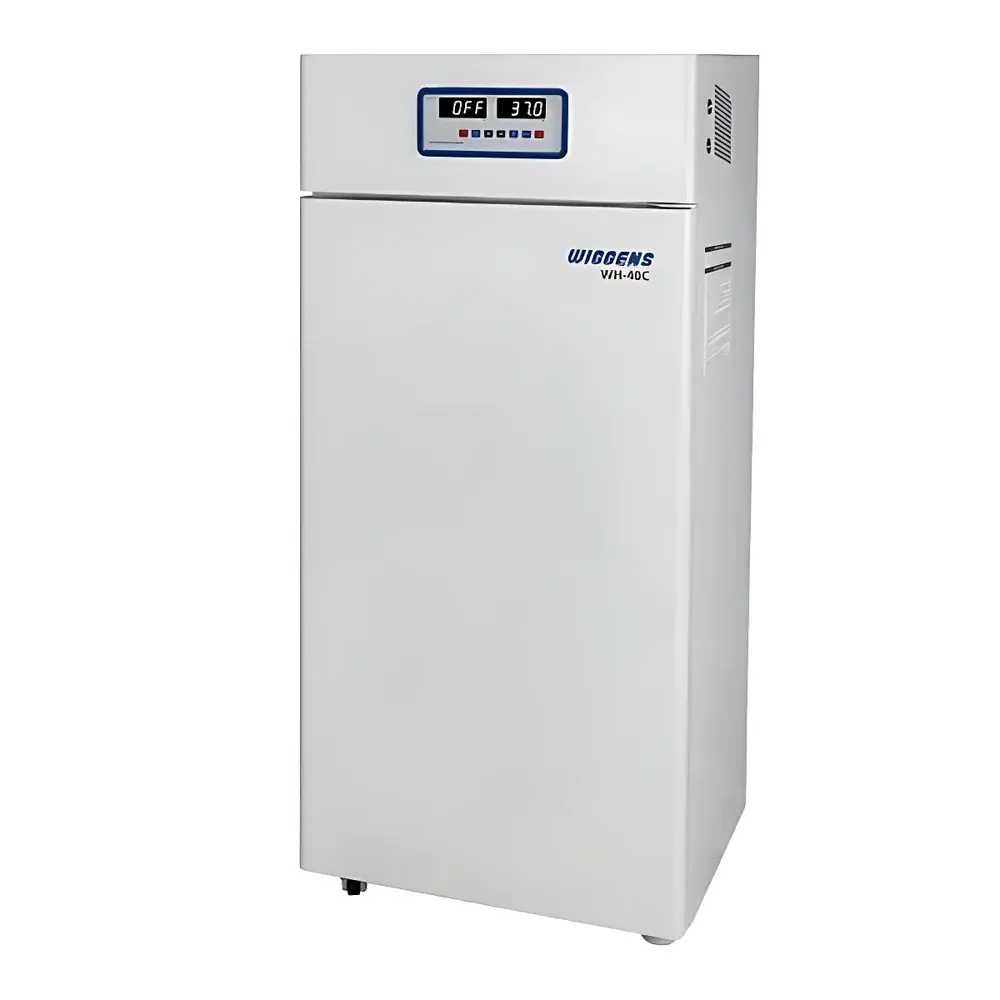
WIGGENS WH-40C Low-Temperature Biochemical Incubator
| Brand | WIGGENS |
|---|---|
| Origin | Germany |
| Model | WH-40C |
| Temperature Range | +4 °C to 60 °C |
| Temperature Accuracy (ATC-calibrated) | < ±0.1 °C |
| Temperature Stability | ±1 °C at 37 °C |
| Chamber Volume | 400 L |
| Interior Dimensions (W×D×H) | 630 × 600 × 1100 mm |
| Exterior Dimensions (W×D×H) | 750 × 730 × 1550 mm |
| Net Weight | 160 kg |
| Heating Power | 450 W |
| Refrigeration Power | 400 W |
| Power Supply | AC 220–240 V, 50/60 Hz |
| Shelving | 2 standard / up to 5 stainless steel adjustable shelves |
| Control Interface | Membrane keypad with digital PID temperature regulation |
| Timer Functions | Programmable start/stop/alarm (1 min to 99 h 59 min) |
| Safety Features | Overtemperature cut-off, door-open alarm & auto fan/heater shutdown, audible alert, dual-seal insulated door with anti-fog double-glazed observation window |
| Optional Accessories | Data logging software, external port for sensor calibration or probe insertion, internal power socket, top-mounted LED illumination |
Overview
The WIGGENS WH-40C Low-Temperature Biochemical Incubator is an engineered environmental control system designed for precise, stable, and reproducible temperature management in life science laboratories. Operating on a compressor-based refrigeration cycle with eco-friendly R134a refrigerant, the WH-40C delivers consistent thermal performance across its full operational range of +4 °C to 60 °C — making it suitable for both low-temperature microbial preservation and elevated-temperature cell culture, enzyme kinetics, and biochemical reaction studies. Its ATC (Automatic Temperature Calibration)-enabled digital PID controller ensures temperature accuracy better than ±0.1 °C under calibrated conditions, while stability remains within ±1 °C at physiologically relevant setpoints such as 37 °C. The unit’s robust architecture — including cold-rolled steel exterior with electrostatic powder coating, seamless stainless-steel interior chamber, and double-gasketed, double-glazed observation door — minimizes thermal leakage and condensation, supporting long-duration experiments under stringent GLP and ISO 17025-aligned workflows.
Key Features
- Compressor-driven cooling system with R134a refrigerant, enabling reliable sub-ambient operation down to +4 °C without dry ice or liquid nitrogen dependency
- Dual-seal insulated door with anti-fog double-glazed window for real-time visual monitoring without compromising thermal integrity or humidity retention
- Intelligent PID temperature controller with membrane keypad interface, bias correction function, and selectable °C/°F display
- 9-segment programmable temperature profile capability — each segment supports independent setpoint and duration (up to 99 h 59 min), with up to 200 loop repetitions and non-volatile memory for uninterrupted operation after power recovery
- Integrated safety suite: overtemperature cut-off, door-open detection (triggers immediate fan and heater deactivation plus delayed audible alarm), and automatic alarm activation upon deviation beyond user-defined thresholds
- Stainless-steel interior chamber and adjustable shelving (2 standard, expandable to 5) optimized for airflow uniformity, cleanability, and compatibility with sterilization protocols (e.g., vaporized hydrogen peroxide or ethanol wipe-down)
Sample Compatibility & Compliance
The WH-40C accommodates a broad spectrum of biological and chemical samples — including bacterial and fungal cultures, mammalian cell monolayers, enzymatic assay plates, tissue explants, and reagent storage vials — within its 400 L chamber. Its uniform internal air circulation, validated via ISO 15189-compliant mapping procedures, ensures spatial temperature homogeneity ≤±0.8 °C across all shelf levels at 37 °C. The incubator meets IEC 61010-1:2010 safety requirements for laboratory equipment and complies with EN 60335-1 for household and similar electrical appliances, reflecting its suitability for continuous-duty operation in regulated environments. While not intrinsically compliant with FDA 21 CFR Part 11, the optional data logging software supports ALCOA+ principles (Attributable, Legible, Contemporaneous, Original, Accurate) when deployed with audit-trail-enabled configurations and user access controls.
Software & Data Management
An optional PC-based software package enables remote monitoring, real-time graphing, and export of time-stamped temperature logs in CSV or PDF format. When paired with certified external probes (e.g., Class A Pt100 sensors), the system supports traceable calibration documentation aligned with ISO/IEC 17025 clause 6.4.2. All logged data include operator ID, timestamp, setpoint, actual chamber temperature, and event flags (e.g., door open, alarm trigger, power interruption). Firmware updates are delivered via USB interface and retain historical configuration settings post-installation.
Applications
- Microbial growth studies requiring strict low-temperature maintenance (e.g., psychrophilic bacteria, cold-shock protein expression)
- Cell culture incubation where tight thermal control mitigates phenotypic drift in primary isolates or stem cell lines
- Enzyme activity assays conducted at defined temperatures between 4 °C and 60 °C
- Stability testing of biologics, vaccines, or diagnostic reagents under ICH Q5C guidelines
- Long-term sample archiving of clinical specimens, nucleic acids, or purified proteins at +4 °C
- Environmental simulation for pharmacokinetic or toxicological screening models
FAQ
What is the minimum operating temperature of the WH-40C?
The unit maintains stable operation from +4 °C, achieved via a high-efficiency compressor and optimized heat exchange design.
Does the WH-40C support humidity control?
No — this model is a dry-air incubator; humidity control requires optional add-on modules not included in the base configuration.
Can the incubator be validated for GMP use?
Yes — IQ/OQ protocols are available upon request, and the unit’s mechanical design, calibration traceability, and alarm logging capabilities align with Annex 15 and EU GMP Chapter 4 expectations.
Is the internal power socket grounded and rated for lab equipment?
Yes — the 230 V, 5 A socket conforms to IEC 60320 C13 standards and is electrically isolated from the control circuitry.
How is temperature uniformity verified inside the chamber?
Uniformity is confirmed using 9-point mapping per ASTM E145-22 Annex A3 methodology, with results documented in the factory acceptance test report supplied with each unit.
Related Products




