
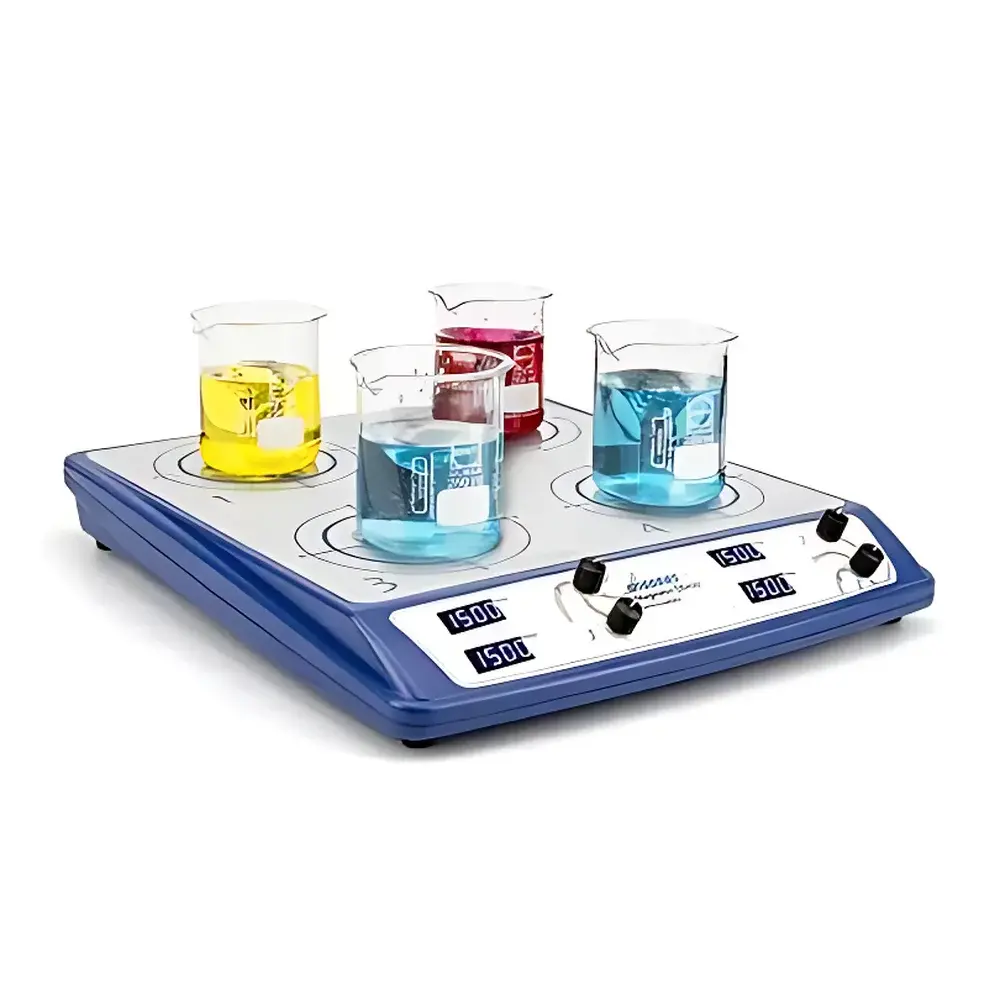
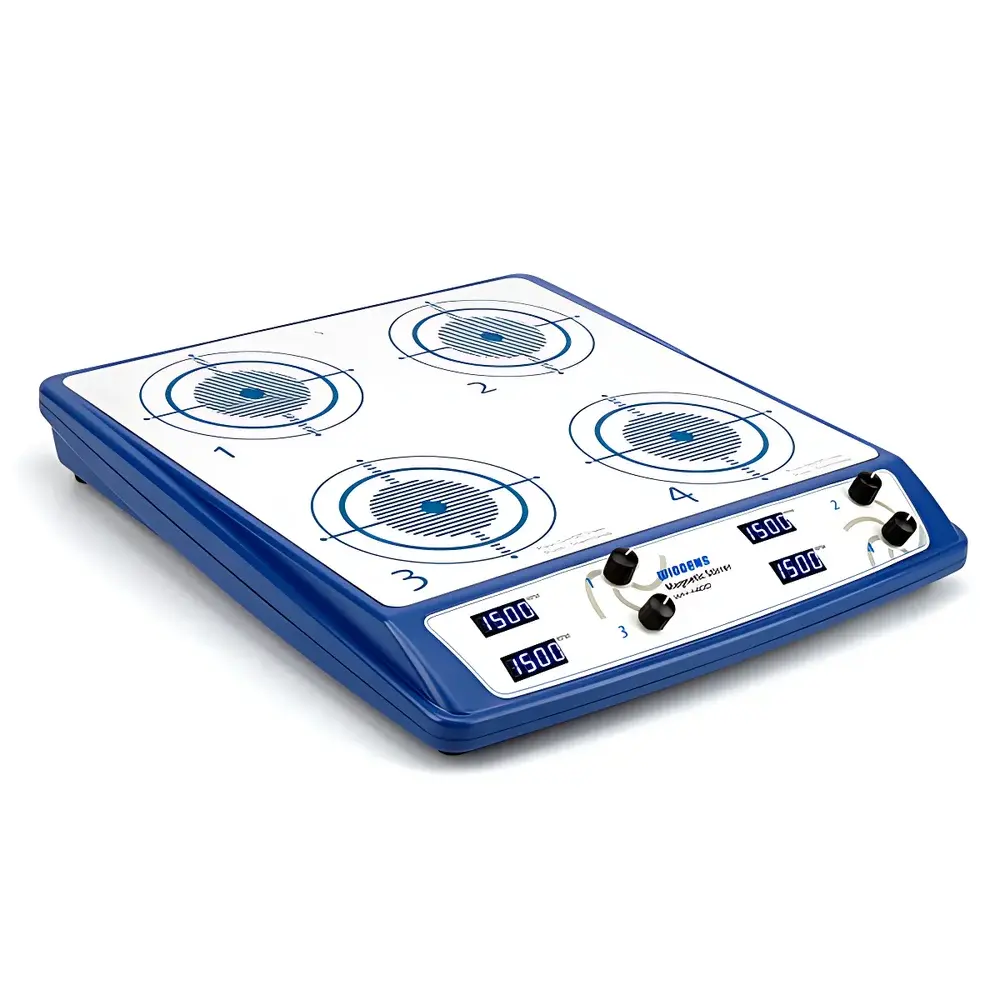
WIGGENS WH-410D Four-Position Digital Magnetic Stirrer
| Brand | WIGGENS |
|---|---|
| Origin | Germany |
| Model | WH-410D |
| Display | LED |
| Speed Range | 150–1500 rpm |
| Number of Stirring Positions | 4 |
| Max. Volume per Position | 2000 mL |
| Stirring Plate Dimensions (W×L) | 313 × 303 mm |
| Overall Dimensions (W×L×H) | 344 × 377 × 48 mm |
| Housing Material | Powder-Coated Stainless Steel |
| Drive Type | Brushless DC Motor |
| Control Method | Analog Knob with Real-Time Digital Feedback |
| Power Regulation | Viscosity-Compensated Output |
| Compliance | CE, RoHS, IEC 61010-1 |
Overview
The WIGGENS WH-410D is a four-position digital magnetic stirrer engineered for precision, stability, and operational transparency in routine laboratory workflows. It operates on the principle of magnetic coupling—where a rotating permanent magnet beneath the plate induces rotational motion in a magnetic stir bar immersed in the sample vessel. Unlike basic analog stirrers, the WH-410D integrates closed-loop speed control via real-time torque feedback: as sample viscosity changes during heating, dissolution, or reaction progression, the microprocessor continuously monitors motor load and dynamically adjusts power delivery to maintain the user-defined setpoint speed within ±3% accuracy across the full 150–1500 rpm range. This active regulation ensures reproducible mixing conditions essential for kinetic studies, standard solution preparation, buffer equilibration, and multi-vessel comparative experiments.
Key Features
- Four independent stirring positions with fully decoupled speed control—each channel operates without cross-interference, enabling simultaneous yet distinct protocols (e.g., varying rpm across four reaction flasks).
- Brushless DC motor drive delivers high starting torque and silent, vibration-free operation—even at low speeds or under high-viscosity loads up to 2000 mL per position.
- LED display shows both set speed and real-time actual speed for each position, supporting immediate verification and troubleshooting without external instrumentation.
- Powder-coated stainless steel top plate resists corrosion from acids, bases, organic solvents, and repeated thermal cycling—suitable for fume hood and wet-lab environments.
- Analog rotary knob interface provides tactile, drift-free adjustment; no touchscreens or firmware dependencies reduce failure modes and simplify GLP-compliant documentation.
- Compact footprint (344 × 377 × 48 mm) and low-profile design optimize bench space while maintaining structural rigidity and thermal isolation from adjacent equipment.
Sample Compatibility & Compliance
The WH-410D accommodates standard laboratory glassware including beakers (50–2000 mL), Erlenmeyer flasks, and round-bottom vessels with compatible stir bars (e.g., PTFE-coated, elliptical, or cross-shaped). Its temperature-independent speed control eliminates need for external hotplate integration—making it ideal for ambient or pre-heated applications where thermal input is managed separately. The unit complies with IEC 61010-1:2010 for electrical safety in laboratory equipment, carries CE marking per EU Directive 2014/30/EU (EMC) and 2011/65/EU (RoHS), and meets EN 61326-1 requirements for electromagnetic immunity in scientific environments. While not a temperature-controlled device, its robust construction supports use alongside certified heating mantles or water baths under ISO/IEC 17025-accredited quality systems.
Software & Data Management
The WH-410D is a standalone, embedded-control instrument with no proprietary software, drivers, or network connectivity. All operational parameters are configured locally via front-panel controls, ensuring deterministic behavior, audit trail simplicity, and compatibility with air-gapped or regulated IT infrastructures. No data logging, USB export, or remote access capabilities are implemented—aligning with laboratories prioritizing minimal validation scope, reduced cybersecurity surface area, and adherence to FDA 21 CFR Part 11 principles for manual record integrity. Calibration verification is performed using a non-contact tachometer against displayed rpm values; no firmware updates or service tools are required during typical 10-year service life.
Applications
- Routine sample homogenization in QC/QA labs for pharmaceutical excipient blending, environmental water extraction, or food emulsion testing.
- Multi-vessel reaction monitoring in synthetic chemistry—e.g., parallel hydrolysis kinetics or catalyst screening under identical shear conditions.
- Teaching laboratories requiring intuitive, durable equipment for undergraduate instruction in analytical chemistry, biochemistry, and materials science.
- Preparation of standardized calibration standards, mobile phase solvents, and reagent stock solutions where speed consistency directly impacts analytical precision (e.g., HPLC, ICP-MS).
- Integration into modular lab setups where independent stirring control complements thermostatic circulators, pH meters, or dissolved oxygen probes without signal interference.
FAQ
Does the WH-410D include heating functionality?
No. The WH-410D is a magnetic stirrer only. It does not incorporate heating elements or temperature control. For combined stirring and heating, WIGGENS offers separate hotplate-stirrer models (e.g., WH-410HT series).
Can the unit operate continuously for extended periods?
Yes. Rated for continuous duty under normal laboratory conditions (20–30°C ambient, non-condensing environment). Thermal protection circuitry automatically reduces output if internal temperature exceeds safe thresholds.
Is the stir plate compatible with non-magnetic containers such as aluminum or ceramic?
No. Magnetic coupling requires ferromagnetic or paramagnetic interaction. Only glass, plastic, or quartz vessels containing a magnetic stir bar will function. Aluminum or thick-walled ceramic vessels may attenuate the magnetic field and impair performance.
What maintenance is required?
None beyond periodic cleaning of the plate surface with isopropanol and lint-free cloth. The brushless DC motor has no brushes to replace, and there are no user-serviceable parts.
How is speed accuracy verified during qualification?
Using a traceable optical tachometer calibrated to NIST standards, measure actual rotation of a stir bar in a defined vessel (e.g., 1000 mL beaker, 5 cm depth, 10 mm bar) at three points across the speed range (300, 900, 1400 rpm) and compare to displayed values.



