
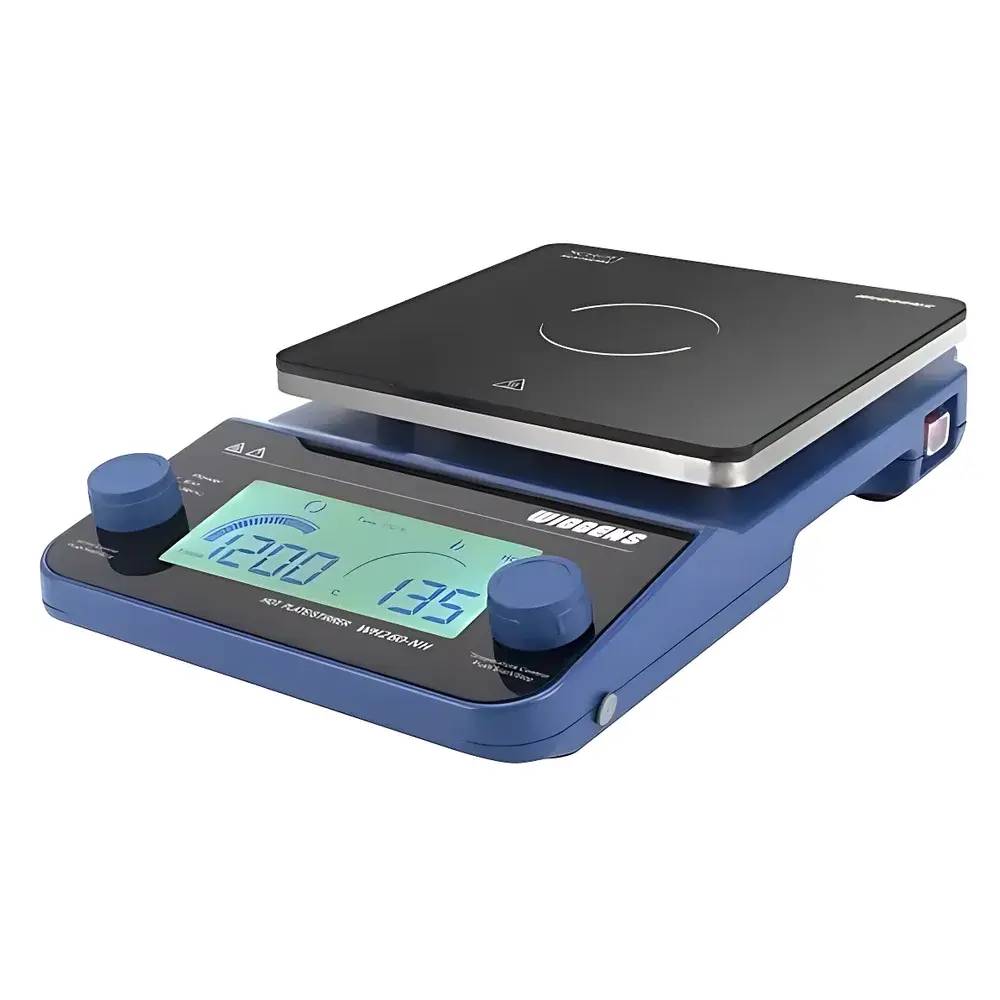
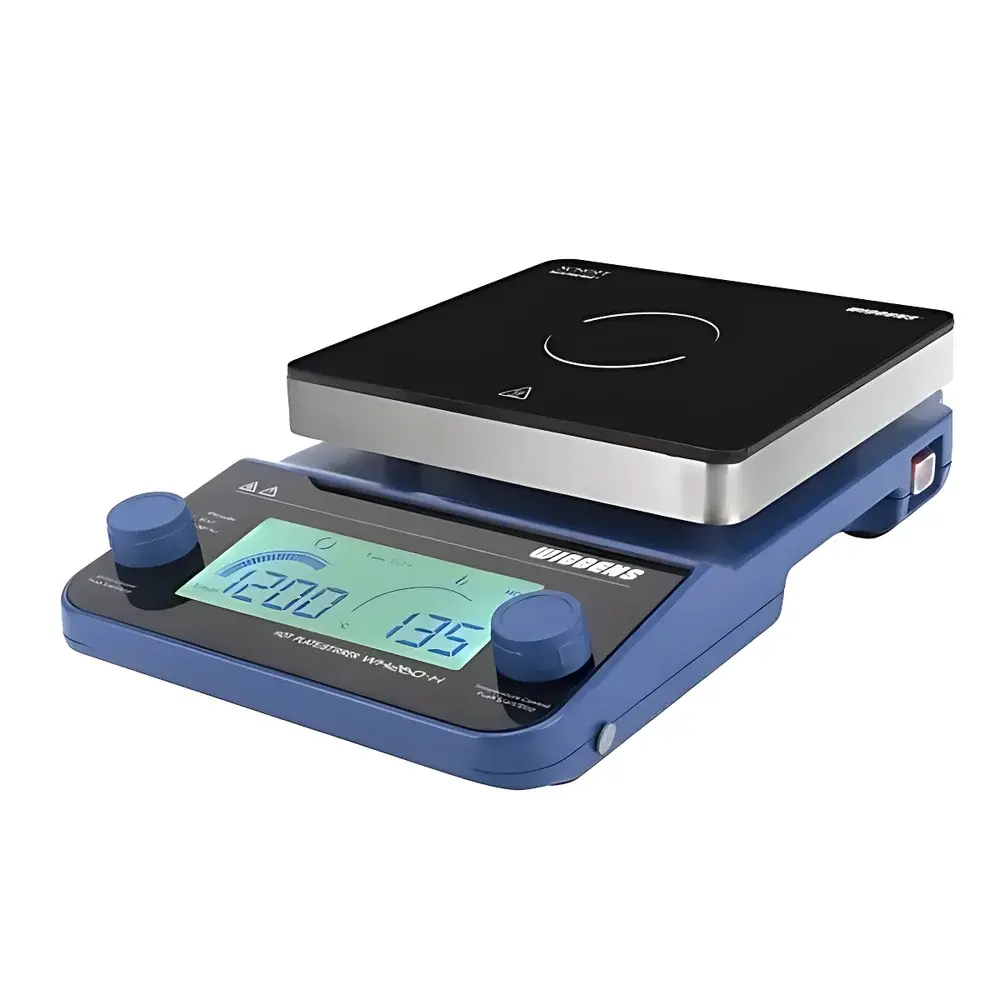
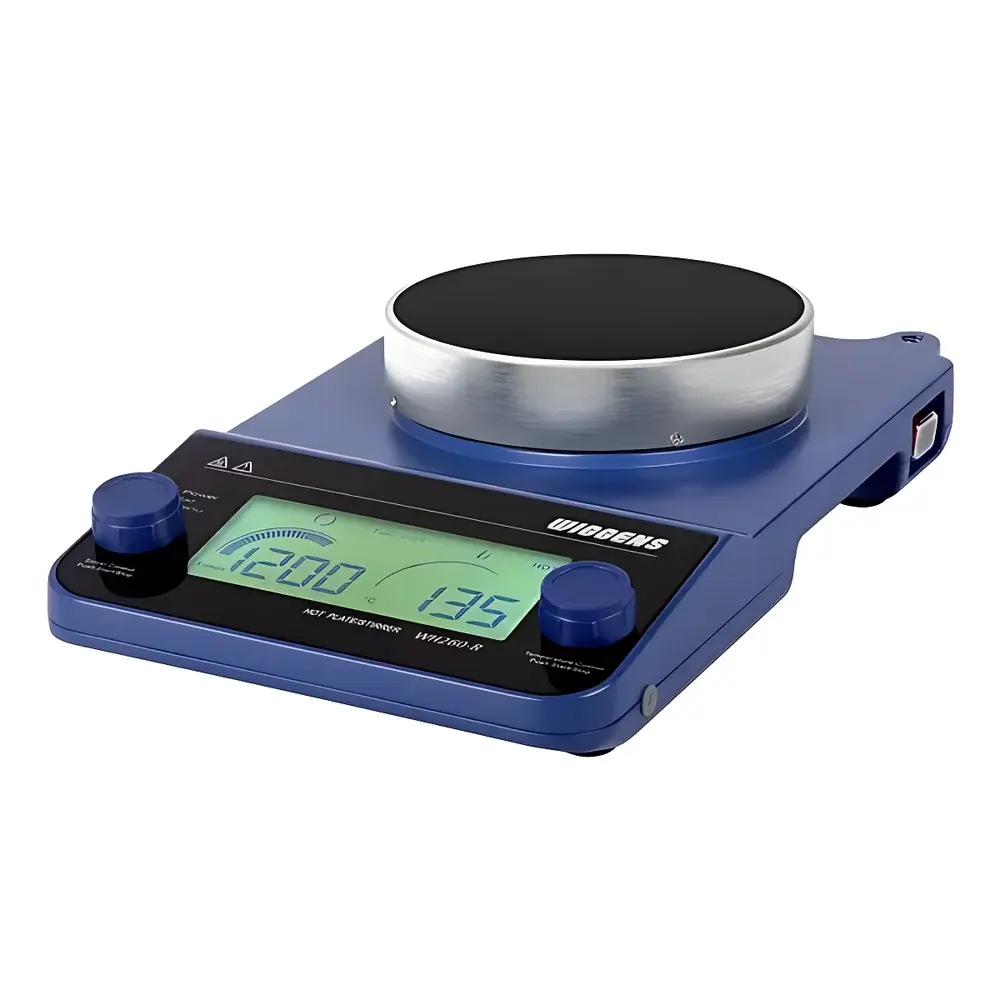
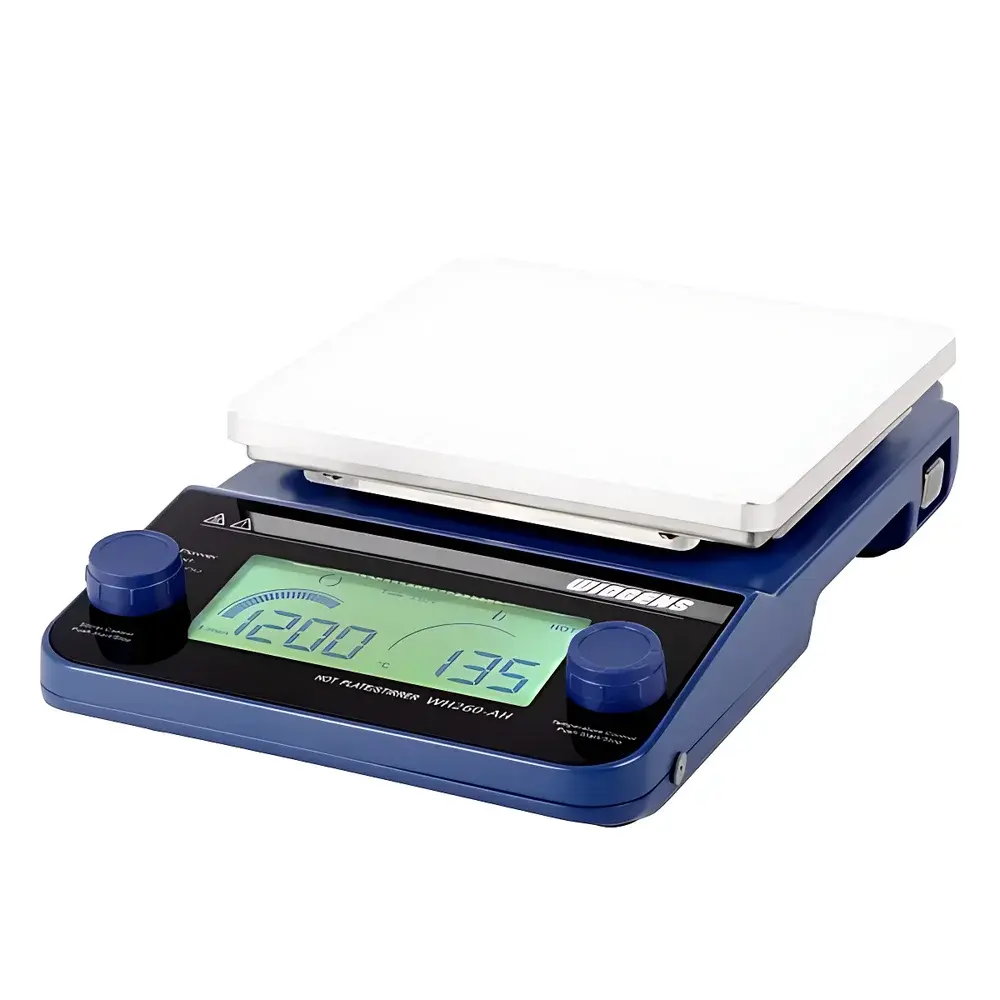
WIGGENS WH260-AH Pro Series Infrared Heating Magnetic Stirrer
| Brand | WIGGENS |
|---|---|
| Origin | Germany |
| Model | WH260-AH |
| Maximum Stirring Volume | 20 L |
| Speed Range | 100–1500 rpm |
| Temperature Control Range | 0–450 °C |
| Heating Plate Max Temperature | ≤380 °C |
| Sample Temperature Control (with Pt100) | ≤200 °C |
| Safety Cut-off Temp Range | 50–430 °C Adjustable |
| Over-Temp ΔT Protection | 10–50 °C Adjustable |
| Temperature Stability (with Pt100) | ±1 °C |
| Heating Power | 800 W |
| Plate Material | Nano-coated Enamel Stainless Steel |
| Plate Dimensions | 180 × 180 mm |
| Display | LCD with Digital Keypad |
| Timer | 1–1999 min or Continuous |
| External Temperature Sensor | Pt100 |
| PID Control | 3 Presets (PID1–PID3) |
| USB-A Interface | Yes |
| Dimensions (W×D×H) | 187 × 315 × 86 mm |
| Weight | 3.7 kg |
| Power Supply | 220 V / 50 Hz |
Overview
The WIGGENS WH260-AH Pro Series Infrared Heating Magnetic Stirrer is an engineered solution for laboratories requiring precise, reproducible thermal and mechanical control during sample preparation, reaction monitoring, dissolution testing, and synthesis workflows. Unlike conventional resistive-heating stirrers, the WH260-AH integrates a high-efficiency infrared heating module—optimized for rapid energy transfer to glass and metal vessels—enabling faster ramp rates and improved thermal uniformity across the heating surface. Its dual-control architecture simultaneously regulates magnetic stirring speed (100–1500 rpm) and plate temperature (0–450 °C), while optional Pt100 probe feedback enables closed-loop sample temperature regulation (up to 200 °C). Designed for ISO/IEC 17025-compliant environments, the unit supports GLP documentation requirements through its non-volatile parameter memory and timestamped operational logging via USB-A interface.
Key Features
- Triple-PID algorithm selection (PID1–PID3) optimized for distinct thermal mass scenarios: PID1 for low-heat-capacity samples (e.g., organic solvents in small vials); PID3 for rapid heating of high-volume aqueous solutions (up to 20 L).
- Nano-ceramic enamel-coated stainless steel heating plate (180 × 180 mm) offering exceptional chemical resistance, scratch resilience, and consistent IR emissivity across repeated thermal cycles.
- Integrated anti-spill liquid containment groove above the control panel—designed to channel accidental splashes away from electronics, meeting IEC 61010-1 Class II safety standards.
- Programmable over-temperature protection with adjustable differential (ΔT = 10–50 °C above setpoint), backed by independent bimetallic safety cutoff (50–430 °C range) compliant with EN 61000-6-3 EMC requirements.
- Real-time LCD display showing setpoint and actual values for speed, plate temperature, sample temperature (when Pt100 connected), timer status, and system alerts—including active PID mode and safety lock status.
- Non-volatile memory retains last-used parameters (speed, temperature, timer, PID mode) after power cycle—critical for SOP-driven QA/QC labs performing repetitive dissolution or stability studies.
Sample Compatibility & Compliance
The WH260-AH accommodates standard laboratory glassware including round-bottom flasks (up to 5 L), beakers (up to 10 L), and jacketed reactors (with external cooling loop integration). Its magnetic coupling design ensures stable agitation of low-viscosity to moderately viscous media (≤500 mPa·s), with compatibility verified for borosilicate 3.3, Pyrex®, and quartz vessels. The unit conforms to key international regulatory frameworks: CE marking per Directive 2014/30/EU (EMC) and 2014/35/EU (LVD); RoHS 2011/65/EU compliance; and electrical safety certification to IEC 61010-1:2010 + A1:2019. When operated with Pt100 sensor input and validated calibration protocols, it supports data integrity requirements under FDA 21 CFR Part 11 for electronic records in pharmaceutical development labs.
Software & Data Management
While the WH260-AH operates as a standalone instrument, its USB-A port enables direct connection to Windows/Linux hosts for firmware updates and parameter export. Logged operational data—including start/stop timestamps, setpoints, actual readings, and alarm events—can be exported as CSV files for traceability audits. Optional WIGGENS LabControl Suite (v3.2+) provides remote configuration, batch parameter deployment across multiple WH260 units, and integration into LIMS via ASCII-based serial command protocol (RS-232 emulation over USB). All stored settings are protected by password-locked menu access to prevent unauthorized modification—a requirement for ISO 13485-certified medical device manufacturing facilities.
Applications
- Pharmaceutical dissolution testing per USP , where precise temperature maintenance (±1 °C) and consistent agitation (e.g., 50–100 rpm) are critical for drug release profiling.
- Chemical synthesis involving exothermic reactions requiring dynamic thermal compensation—leveraging PID3’s aggressive ramp profile to counteract heat loss during scale-up trials.
- Materials science dispersion protocols for nanocomposites, where infrared heating minimizes localized hot spots that could degrade polymer matrices during sonication-assisted mixing.
- Environmental sample digestion (EPA Method 3050B) using HNO₃/HF mixtures at elevated temperatures (200–300 °C), enabled by corrosion-resistant plate coating and sealed electronics housing.
- Biotechnology buffer equilibration, where gentle stirring (100–300 rpm) combined with tight temperature control (<±0.5 °C deviation) preserves protein conformational integrity during formulation.
FAQ
Can the WH260-AH maintain temperature stability when heating viscous silicone oil?
Yes—when used with an externally mounted Pt100 probe immersed in the medium, the unit achieves ±1 °C stability at setpoints up to 200 °C, provided the oil volume remains within the 20 L water-equivalent capacity limit.
Is the infrared heating element compatible with aluminum heating blocks?
No—the IR emitter is calibrated for optimal absorption by glass and ceramic surfaces; aluminum reflects >90% of mid-infrared radiation and will result in inefficient heating and potential surface damage.
Does the USB interface support real-time data streaming?
No—it is designed for batch export of historical logs and firmware updates only; continuous streaming requires third-party DAQ hardware interfaced via analog voltage outputs (0–10 V) available on select WH260-R models.
How often should the Pt100 sensor be recalibrated?
Per ISO/IEC 17025:2017 Clause 7.8.3, calibration is recommended before each critical study or at least every 6 months using NIST-traceable reference thermometers and fixed-point cells (e.g., ice point, zinc point).
Can the WH260-AH be integrated into a fume hood with limited vertical clearance?
Yes—its low-profile height (86 mm) and rear-mounted power cord routing allow unobstructed installation beneath standard sash positions, with ventilation grilles positioned to avoid airflow disruption from hood laminar flow patterns.



