
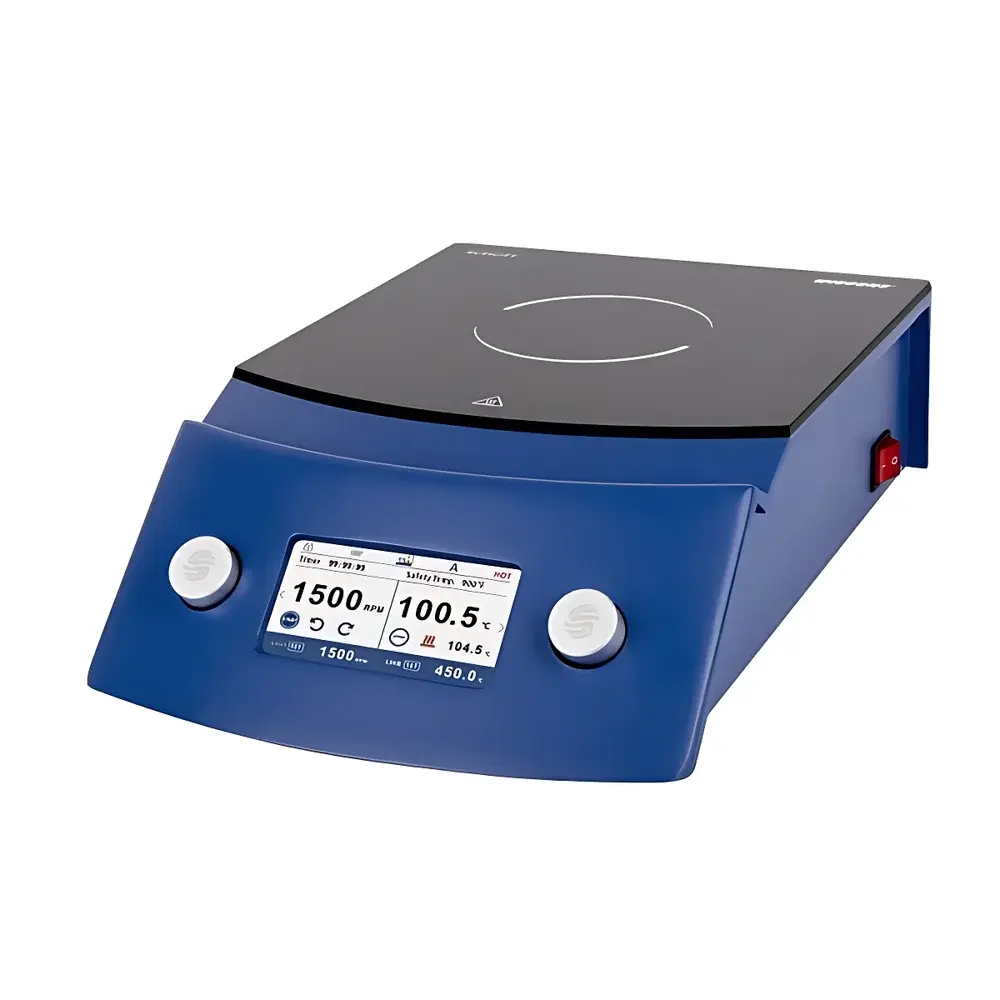
WIGGENS WH395 Infrared Heating Magnetic Stirrer
| Brand | WIGGENS |
|---|---|
| Origin | Germany |
| Model | WH395 |
| Maximum Stirring Volume | 30 L |
| Speed Range | 100–1500 rpm |
| Heating Plate Temperature | ≤450 °C |
| Sample Setpoint Temperature (with Pt100) | ≤300 °C |
| Adjustable Over-Temperature Protection | 50–600 °C |
| Solution Over-Temp Cut-off | 10–50 °C |
| Temperature Stability (with Pt100) | ±1 °C |
| Heating Power | 1800 W |
| Display | TFT touchscreen |
| Interface | RS232 / RS485 |
| Plate Material | Enamelled Glass |
| Plate Dimensions | 280 × 280 mm |
| Heating Zone Diameter | Ø190 mm |
| Dimensions (W×D×H) | 290 × 450 × 120 mm |
| Weight | 4.1 kg |
| Power Supply | 220 V / 50 Hz |
Overview
The WIGGENS WH395 Infrared Heating Magnetic Stirrer is an engineered solution for laboratories requiring precise, uniform, and rapid thermal control during magnetic stirring of large-volume samples. Unlike conventional resistive heating plates, the WH395 employs high-efficiency infrared radiation to deliver direct energy transfer to both the vessel bottom and its contents—minimizing thermal lag, reducing ambient heat loss, and improving temperature homogeneity across the sample. Its integrated ICC (Intelligent Current Control) algorithm dynamically adjusts power delivery to maintain setpoint stability within ±1 °C when used with an external Pt100 sensor, making it suitable for applications demanding reproducible thermal profiles in analytical, synthetic, and quality control workflows. Designed for continuous operation under demanding conditions, the WH395 complies with IEC 61010-1 safety standards for laboratory electrical equipment and features a robust mechanical architecture optimized for long-term reliability in regulated environments.
Key Features
- Infrared heating system delivering up to 1800 W output with ≤450 °C plate temperature limit—enabling rapid ramp rates and improved thermal efficiency versus conduction-based alternatives.
- Enamelled glass heating surface (280 × 280 mm) with Ø190 mm active zone, offering exceptional resistance to thermal shock (up to 700 °C), chemical corrosion, and mechanical abrasion.
- Intelligent ICC speed control ensures stable rotational performance from 100 to 1500 rpm—even under variable load or viscosity conditions—without manual recalibration.
- Dual-sensor capability: supports simultaneous use of Pt100 for sample temperature feedback and thermocouple for reference plate monitoring, enabling closed-loop thermal regulation.
- Programmable over-temperature protection with independent adjustable thresholds: one for plate safety (50–600 °C), another for solution integrity (10–50 °C).
- TFT touchscreen interface with intuitive navigation, real-time dual-parameter display (temperature + speed), and built-in timer supporting durations from 1 minute to 99 hours 59 minutes.
- RS232/RS485 digital interface for integration into automated lab systems, supporting remote parameter setting, data logging, and audit-trail-capable operation per FDA 21 CFR Part 11 requirements when paired with compliant software.
Sample Compatibility & Compliance
The WH395 accommodates standard laboratory vessels—including borosilicate glass beakers, stainless steel reactors, and PTFE-coated containers—up to 30 L capacity (water-equivalent). Its flat, non-porous enamelled surface prevents residue accumulation and simplifies decontamination between runs. The unit meets EN 61326-1 (EMC) and EN 61010-1 (safety) standards, and its sealed housing—constructed from flame-retardant rigid plastic and coated cast iron—ensures operational integrity in corrosive fume hood environments. Optional accessories include Pt100 sensors (models PT100-01 and PT100-05), universal mounting brackets for probe fixation, and chemically inert stirring bars (e.g., WIGGENS catalog no. 001.230.8). All components are compatible with GLP/GMP documentation practices and support traceable calibration protocols.
Software & Data Management
While the WH395 operates as a standalone instrument, its RS232/RS485 port enables bidirectional communication with third-party laboratory information management systems (LIMS) or custom SCADA platforms. Users may configure automated start/stop sequences, export timestamped temperature-speed logs, and enforce electronic signatures for critical process steps. When deployed with validated firmware and secure network configuration, the device satisfies data integrity expectations outlined in ISO/IEC 17025 and USP for analytical instrument qualification. Firmware updates are distributed via WIGGENS’ official technical portal and require authenticated access to ensure version control and regulatory alignment.
Applications
- Kinetic studies requiring controlled heating and agitation of reaction mixtures (e.g., esterification, polymerization, enzymatic assays).
- Preparation of homogeneous standards and reference materials for spectroscopy or chromatography.
- Accelerated solvent extraction (ASE) and hotplate digestion of environmental or biological matrices prior to ICP-MS or AAS analysis.
- Quality assurance testing of pharmaceutical excipients and APIs where thermal history directly impacts crystallinity or dissolution behavior.
- Material science research involving temperature-dependent rheological profiling of suspensions and nanocomposites.
FAQ
Does the WH395 support external temperature feedback for closed-loop control?
Yes—the instrument accepts input from Pt100 sensors (supplied in standard kit) and supports configurable PID or ICC algorithms to maintain sample temperature within ±1 °C accuracy.
Can the WH395 be used in inert atmosphere gloveboxes?
It is not rated for Class I Division 1 hazardous locations; however, its low-outgassing construction and absence of internal fans make it suitable for nitrogen- or argon-purged enclosures when installed with appropriate cable feedthroughs.
Is calibration documentation provided with the unit?
A factory calibration certificate (traceable to national standards) is included. Users may perform routine verification using NIST-traceable reference thermometers and calibrated tachometers per ISO/IEC 17025 guidelines.
What maintenance is required to sustain long-term performance?
No scheduled maintenance is specified beyond periodic cleaning of the enamelled surface with mild detergent and inspection of stir bar integrity. The sealed electronics compartment eliminates need for internal servicing under normal operating conditions.
How does infrared heating compare to traditional ceramic or aluminum hotplates in terms of energy consumption?
Independent lab testing shows ~22% reduction in energy use per heating cycle compared to equivalent-power resistive plates, attributable to minimized thermal mass and directional IR emission targeting the vessel base.



