
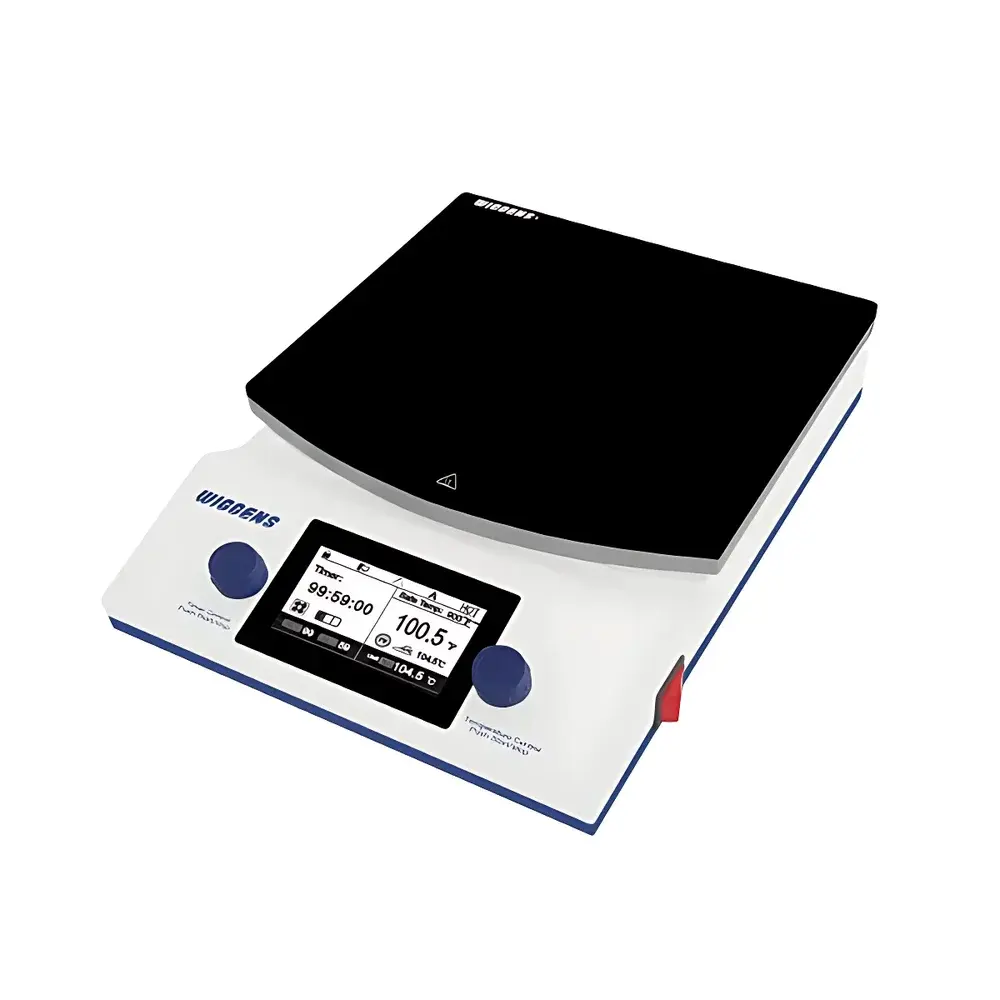
WIGGENS WH500D-2K High-Power Ceramic Heating Plate
| Brand | WIGGENS |
|---|---|
| Origin | Germany |
| Model | WH500D-2K |
| Heating Power | 2000 W |
| Max. Surface Temperature | 0–450 °C |
| Temperature Uniformity | ±1 °C |
| Plate Dimensions | 280 × 287 mm (U-shaped) |
| Control Stability (with Pt100) | ±1 °C |
| External Temperature Sensor | Pt100 compatible |
| Safety Cut-off Temp. | 500 °C |
| Over-Temp Offset ΔT | 2–50 °C |
| Timer Range | 00:01:00 to 99:59:00 or continuous |
| Interface | RS232/RS485 |
| Plate Material | Glass-Ceramic with Nanometal Coating |
| Weight | 7.5 kg |
| Dimensions (W×D×H) | 286 × 430 × 70 mm |
Overview
The WIGGENS WH500D-2K High-Power Ceramic Heating Plate is an engineered solution for precise, stable, and chemically resistant thermal control in demanding laboratory sample preparation workflows. Designed around a robust glass-ceramic heating surface coated with a proprietary nanometal layer, it delivers rapid thermal response, exceptional resistance to thermal shock (up to 700 °C differential), and long-term stability under aggressive chemical exposure. Unlike conventional stainless-steel or aluminum plates, the non-porous, smooth ceramic surface prevents reagent absorption, eliminates micro-crack formation, and enables effortless decontamination—critical for trace-level analysis, digestion protocols, and multi-step synthesis where cross-contamination must be avoided. Its core operating principle relies on resistive heating elements embedded beneath the ceramic substrate, coupled with intelligent ICC (Intelligent Control Circuit) temperature regulation that continuously adjusts power output based on real-time feedback from either the integrated surface sensor or an externally connected Pt100 probe immersed directly in the sample vessel.
Key Features
- 2000 W high-power heating capacity enabling rapid ramp-up to 450 °C surface temperature, suitable for high-boiling-point solvents and accelerated digestion procedures
- U-shaped 280 × 287 mm glass-ceramic plate with nanometal coating ensures uniform heat distribution (±1 °C across active zone) and mechanical durability
- Integrated corrosion-resistant liquid containment channel above the control panel, preventing ingress of spilled reagents into electronics
- Dual-mode temperature control: surface-set mode for general heating or Pt100-feedback mode for direct sample temperature regulation (0–300 °C range)
- Full-color TFT touchscreen with rotary encoder interface for intuitive parameter entry—temperature, timer, safety offset, and stirring speed (when used with compatible magnetic stirrer modules)
- Programmable timer supporting durations from 1 minute to 99 hours 59 minutes, plus continuous operation mode; last-used settings are auto-saved
- Hardware-level over-temperature protection: independent thermal cutoff switch triggers at 500 °C, while user-definable ΔT-based solution overheat protection (2–50 °C above setpoint) adds process-layer safety
- RS232 and RS485 communication ports support integration into centralized lab automation systems and GLP-compliant data logging environments
Sample Compatibility & Compliance
The WH500D-2K accommodates a wide range of laboratory vessels—including borosilicate glass beakers (50–2000 mL), PTFE digestion tubes, quartz crucibles, and ceramic evaporating dishes—without risk of surface degradation or adhesion. Its chemical inertness meets ISO 17025 requirements for equipment suitability in accredited testing laboratories. The device complies with IEC 61010-1:2010 for electrical safety in laboratory equipment and incorporates design features aligned with Good Laboratory Practice (GLP) and Good Manufacturing Practice (GMP) expectations, including audit-trail-capable parameter logging when interfaced with validated software platforms. While not intrinsically rated for hazardous area use, its sealed enclosure and isolation of critical components make it suitable for fume hood–integrated applications involving concentrated acids (e.g., HNO₃/HF mixtures in EPA Method 3052) or organic solvents.
Software & Data Management
Via RS232/RS485, the WH500D-2K supports bidirectional communication with third-party LIMS or ELN systems using ASCII-based command protocols. Temperature setpoints, actual surface/solution readings, timer status, and alarm events (e.g., over-temperature, sensor fault) can be streamed in real time. When paired with compliant data acquisition software, the unit supports 21 CFR Part 11–aligned electronic records—including user authentication, immutable timestamps, and change history—enabling full traceability for regulated QC/QA environments. Firmware updates are performed via serial interface using manufacturer-provided utilities, ensuring version control and validation readiness.
Applications
- Acid digestion of environmental, geological, and biological samples prior to ICP-MS or AAS analysis
- Controlled solvent evaporation in gravimetric analysis and residue determination (e.g., ASTM D129, ISO 6296)
- Pre-heating and temperature conditioning of reaction mixtures in synthetic chemistry workflows
- Standardized drying of filter papers, precipitates, or calibration standards per USP & Ph. Eur. guidelines
- Stabilization of thermal baths for viscosity or density measurements requiring constant plateau temperatures
- Supporting multi-vessel parallel processing in method development labs where reproducible thermal profiles are essential
FAQ
Can the WH500D-2K be used without an external Pt100 probe?
Yes—the unit operates in surface temperature control mode using its internal ceramic-embedded sensor. However, for applications requiring precise sample-core temperature regulation (e.g., digestion kinetics), external Pt100 feedback is strongly recommended.
Is the glass-ceramic plate resistant to hydrofluoric acid (HF)?
The plate surface is highly resistant to most mineral and organic acids, but prolonged direct contact with concentrated HF (>5%) may cause etching. Use appropriate secondary containment and follow institutional chemical handling protocols.
Does the timer function retain settings during power interruption?
No—the timer resets upon power loss. However, the last-used temperature, ΔT offset, and other operational parameters are retained in non-volatile memory and restored at power-up.
What is the maximum recommended load weight on the heating surface?
The plate is structurally rated for up to 5 kg distributed load. Avoid placing heavy, asymmetric, or unbalanced vessels to maintain thermal uniformity and mechanical longevity.
How often should calibration verification be performed?
Per ISO/IEC 17025, periodic verification using NIST-traceable Pt100 reference probes is advised at least every 6 months—or before critical validation runs—especially when operating near temperature extremes (≥400 °C).



