
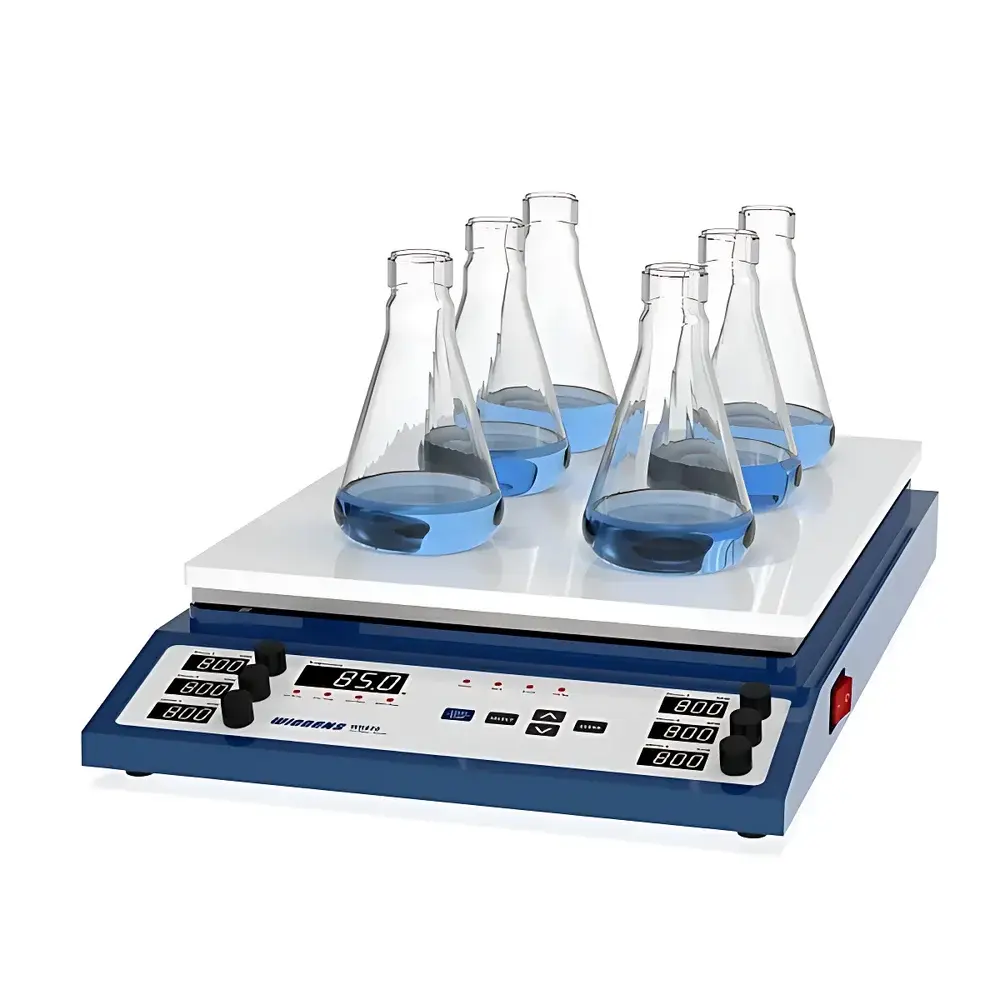
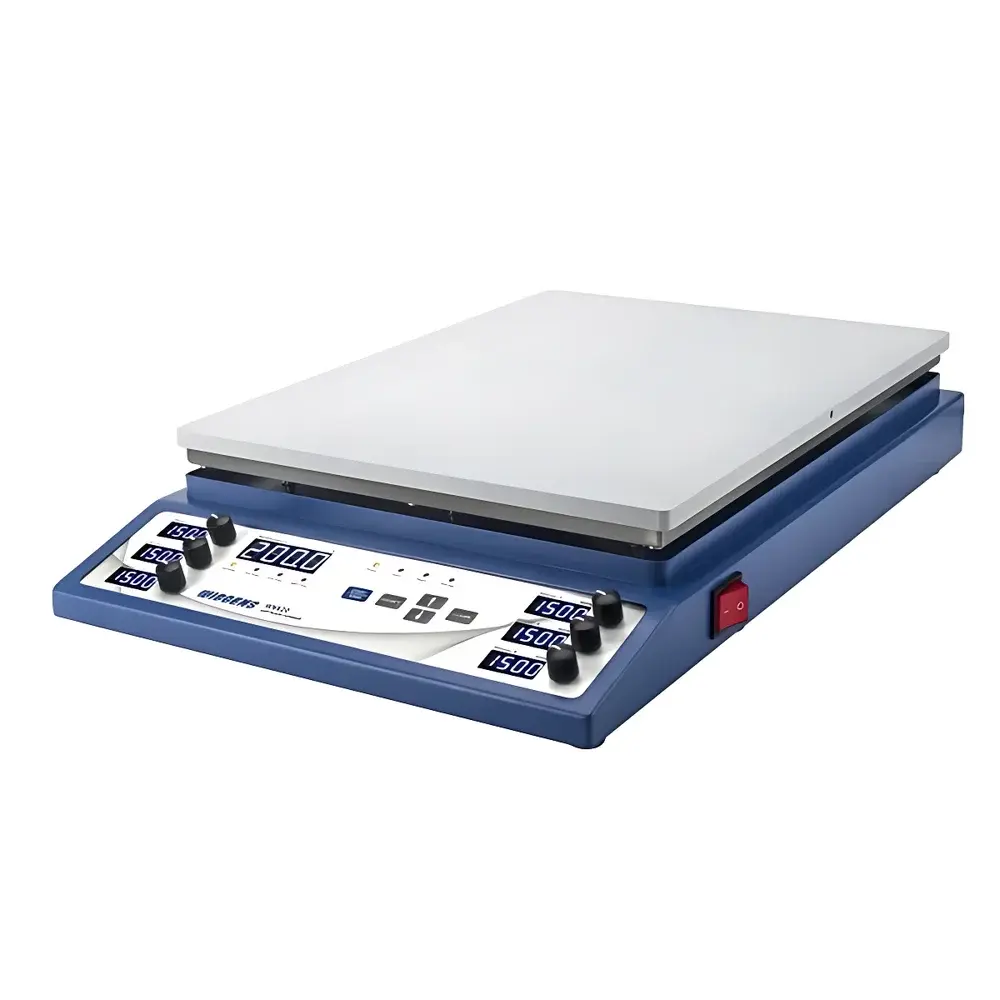
WIGGENS WH620 Advanced Multi-Position Heating Magnetic Stirrer
| Brand | WIGGENS |
|---|---|
| Origin | Germany |
| Model | WH620 |
| Instrument Type | Heating Magnetic Stirrer |
| Max. Stirring Volume | 2 L |
| Speed Range | 150–1500 rpm |
| Temperature Control Range | 40–300 °C |
| Heating Power | 1500 W |
| Plate Material | Anodized Aluminum with Ceramic Coating |
| Temperature Stability (with Pt100) | ±1 °C |
| Safety Cut-off Temp. | 370 °C |
| Timer Range | 1–9959 min or Continuous |
| Stirring Positions | 6 |
| Interface | RS232 |
| Plate Dimensions | 6 × (150 × 133 mm) |
| Overall Dimensions | 525 × 320 × 87 mm |
| Weight | 6.2 kg |
Overview
The WIGGENS WH620 Advanced Multi-Position Heating Magnetic Stirrer is an engineered solution for laboratories requiring simultaneous, independent thermal and mechanical control across six parallel reaction vessels. Designed around a robust microprocessor-based control architecture, the WH620 employs closed-loop PID temperature regulation—calibrated against external Pt100 sensors—to maintain precise thermal setpoints within ±1 °C across the full 40–300 °C operating range. Its magnetic stirring mechanism utilizes high-torque neodymium drive magnets and optimized rotor geometry to deliver stable, laminar-to-turbulent agitation at speeds from 150 to 1500 rpm—sufficient for low-viscosity aqueous solutions up to 2 L per position and compatible with standard PTFE- or glass-coated stir bars. The unit integrates dual-safety logic: real-time surface temperature monitoring (with flashing LED warning above 60 °C) and hardware-level thermal cut-off at 370 °C, compliant with IEC 61010-1 safety standards for laboratory electrical equipment.
Key Features
- Six independently controllable heating/stirring positions, each with dedicated digital display of actual and setpoint temperature and speed
- Ceramic-coated aluminum heating plates offering rapid thermal response, uniform heat distribution, and corrosion resistance against common solvents and reagents
- Integrated anti-spill design: recessed control panel with chemical-resistant liquid guide channel prevents ingress into electronics during accidental splashes
- Full-sealed enclosure with isolated internal components—rated IP20 for operation in demanding lab environments including fume hoods and controlled humidity areas
- Auto-recall memory function retains last-used parameters (temperature, speed, timer), reducing setup time for routine protocols
- RS232 interface enables remote parameter configuration, data logging, and integration into centralized lab management systems supporting ASTM E2500 and 21 CFR Part 11-compliant audit trails
Sample Compatibility & Compliance
The WH620 accommodates standard round-bottom flasks (50–1000 mL), beakers, and reaction vials via its modular plate layout. Compatibility extends to water, organic solvents (e.g., ethanol, acetone, DMF), mineral acids (dilute HCl, HNO₃), and basic solutions when used with chemically inert stir bars (PTFE-, glass-, or PEEK-coated). All temperature measurements referenced to Pt100 Class A sensors meet DIN EN 60751 tolerances. The device conforms to CE marking requirements under the EU Machinery Directive 2006/42/EC and Low Voltage Directive 2014/35/EU. Its thermal control performance aligns with ISO 17025 clause 5.4.2 for calibration traceability when paired with accredited Pt100 probes. No hazardous substances are used in construction per RoHS Directive 2011/65/EU.
Software & Data Management
While the WH620 operates autonomously via front-panel controls, its RS232 port supports bidirectional communication using ASCII command protocol. Third-party software—including LabVIEW drivers, Python-based serial utilities (pySerial), and WIGGENS’ optional PC Control Suite—enables scripting of multi-step temperature ramps, speed profiles, and timed hold phases. All parameter changes, alarm events (e.g., overtemperature, sensor fault), and runtime logs are timestamped and exportable as CSV. When deployed in GLP/GMP-regulated workflows, the system supports user-access level configuration (admin/operator), electronic signature prompts, and immutable event history—fulfilling ALCOA+ principles for data integrity.
Applications
The WH620 serves critical roles in synthetic chemistry (parallel Suzuki couplings, esterifications), pharmaceutical QC (dissolution testing per USP , buffer preparation), materials science (nanoparticle dispersion, polymerization kinetics), and environmental analysis (digestion of soil/water samples per EPA Method 3050B). Its six-position capability accelerates method development for DOE (Design of Experiments) studies, while the ±1 °C stability ensures reproducibility in calorimetric assays and enzyme activity profiling. The ceramic-coated plates support extended use with hot oil baths (e.g., silicone oil up to 250 °C), enabling high-temperature hydrolysis or catalyst activation protocols without plate degradation.
FAQ
Does the WH620 support external temperature feedback from immersed Pt100 sensors?
Yes—each position accepts Pt100-01 (immersion probe) or Pt100-05 (surface-contact probe) sensors for direct sample temperature control, overriding plate-surface readings.
Can stirring and heating be controlled independently per position?
No—the WH620 provides synchronized control across all six positions; independent per-position control requires the custom-configurable WH620-IND variant (contact WIGGENS Engineering Support).
What is the maximum recommended viscosity for reliable stirring at 1500 rpm?
For continuous operation, aqueous solutions up to 100 mPa·s (e.g., 1% CMC solution) are supported; higher viscosities require reduced speed or larger-diameter stir bars.
Is the unit compatible with nitrogen or argon purge environments?
Yes—the sealed housing and non-ventilated design allow safe operation under inert gas blankets; ensure adequate clearance around vents on adjacent equipment.
How is calibration verification performed?
Users may perform in-house verification using NIST-traceable dry-block calibrators or reference thermometers; WIGGENS recommends annual third-party calibration per ISO/IEC 17025.
Related Products



