
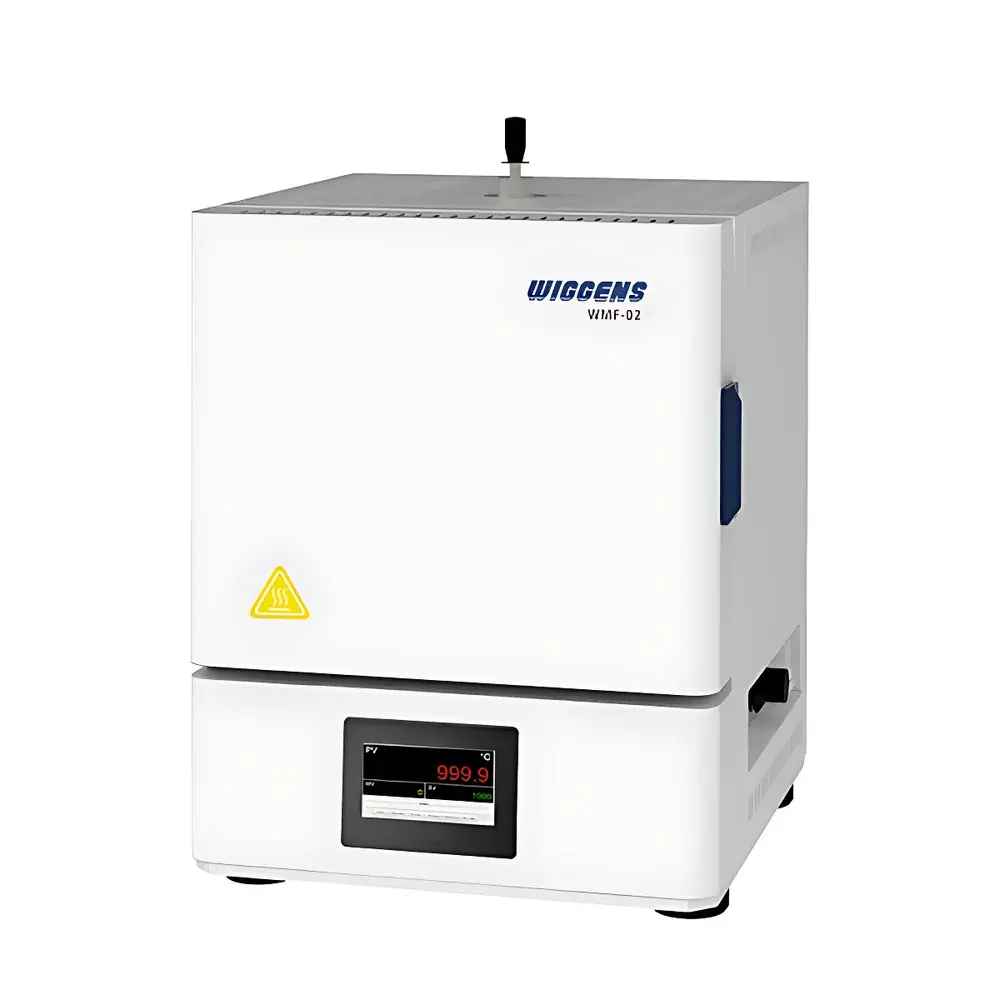
WIGGENS WMF-02 High-Temperature Box-Type Muffle Furnace
| Brand | WIGGENS |
|---|---|
| Origin | Germany |
| Model | WMF-02 / WMF-02H |
| Instrument Type | Box-Type Muffle Furnace |
| Maximum Temperature | 1600 °C |
| Temperature Control Accuracy | ±1.5 °C |
| Rated Power | 3 kW |
| Heating Rate | Ambient +15 °C to 1600 °C |
| Heating Configuration | Triple-Sided Heating |
| Internal Chamber Dimensions | 140 × 150 × 140 mm (W × D × H) |
| Temperature Uniformity | ±1.5 °C at 1600 °C (per ISO 9001-compliant validation protocol) |
| Control System | PID with Digital Setpoint & Dual-Layer Safety Logic |
| Data Interface | RS232, RS485, RJ45 Ethernet, USB Host for Data Export |
| Safety Features | Independent Overtemperature Cut-off, Leakage Current Protection, Overload Protection, Password-Protected Parameter Lock, Passive Pressure Relief Vent |
Overview
The WIGGENS WMF-02 is a precision-engineered high-temperature box-type muffle furnace designed for demanding thermal processing applications in research laboratories, quality control environments, and industrial R&D settings. Operating on the principle of resistive heating via embedded high-purity Kanthal A1 alloy heating elements, the furnace delivers stable, uniform thermal fields across its ceramic fiber-insulated chamber—enabling reproducible ashing, calcination, sintering, heat treatment, and gravimetric analysis up to 1600 °C. Its triple-sided heating configuration ensures superior temperature homogeneity compared to single- or dual-wall designs, minimizing axial and radial thermal gradients critical for ASTM E1142-compliant ash content determination and ISO 562-compliant volatile matter testing. The unit complies with IEC 61000-6-3 (EMC) and IEC 61010-1 (safety), and is constructed to meet GLP documentation requirements for traceable thermal validation.
Key Features
- Triple-sided heating architecture with optimized element placement for ±1.5 °C temperature uniformity across the full 140 × 150 × 140 mm working volume at 1600 °C
- Dual-layer safety system: digital PID controller with independent hardware-based overtemperature cut-off (settable up to 1650 °C), integrated residual-current device (RCD), and thermal overload protection
- Intuitive 5-inch color LCD interface with intelligent menu navigation—direct access to setpoint, real-time temperature, output power %, alarm history, and runtime logs
- Programmable thermal profiles: store up to 10 multi-segment programs (max. 30 steps each), with adjustable ramp rates, soak durations, and loop cycles—fully compatible with ISO/IEC 17025 method validation workflows
- Real-time graphical display of temperature vs. time curves during program execution, supporting immediate deviation detection and process troubleshooting
- Password-protected parameter lock prevents unauthorized modification during active operation—essential for FDA 21 CFR Part 11–aligned audit trails
- Passive pressure-relief vent integrated into the rear chamber wall, eliminating risk of internal overpressure during rapid gas evolution (e.g., carbonate decomposition)
Sample Compatibility & Compliance
The WMF-02 accommodates standard crucibles (alumina, platinum, silicon carbide) and ceramic boats up to 130 mm in length. Its inert alumina-fiber insulation and sealed muffle design prevent cross-contamination during sequential high-temperature treatments. The furnace meets key international standards for laboratory thermal equipment: EN 60519-1 (safety of industrial electroheating equipment), ASTM E1525 (standard test method for determining thermal stability), and ISO/IEC 17025 clause 6.4.4 (environmental conditions for equipment operation). All units undergo factory calibration at three points (800 °C, 1200 °C, 1600 °C) using NIST-traceable reference thermocouples; calibration certificates are provided upon request.
Software & Data Management
Data integrity and regulatory compliance are supported through native communication protocols: RS232/RS485 serial interfaces enable integration with LabVIEW, SCADA, or LIMS platforms; RJ45 Ethernet allows remote monitoring and control via TCP/IP. All operational data—including temperature logs, alarm timestamps, program execution status, and fault codes—are stored internally with timestamped UTC synchronization. Users may export CSV-formatted historical records directly to USB flash drives for archival or audit review. Audit trail functionality records user login events, parameter changes, and program starts/stops—fully aligned with FDA 21 CFR Part 11 electronic record requirements when deployed with validated third-party software.
Applications
- Gravimetric analysis per AOAC 923.03, ASTM D3174, and ISO 1171 (ash content in coal, biomass, food, and polymers)
- Calcination of metal oxides and catalyst precursors under controlled air or inert atmospheres
- Sintering of ceramic green bodies and dental prosthetic materials (ISO 6872)
- Thermal decomposition studies of pharmaceutical excipients (ICH Q5C stability protocols)
- Preparation of certified reference materials (CRMs) requiring precise thermal history control
- Residue-on-ignition testing in environmental soil and wastewater sludge analysis (EPA Method 9080)
FAQ
What thermocouple type is used for temperature sensing?
Type S (Platinum/Rhodium 10%) thermocouples are factory-installed for long-term stability and accuracy up to 1600 °C.
Is the furnace suitable for use under inert gas purging?
Yes—the sealed muffle design includes dedicated gas inlet/outlet ports (¼” NPT) compatible with nitrogen or argon purge setups; optional quartz viewing window available.
Can the WMF-02 be validated for GMP environments?
Yes—full IQ/OQ documentation templates, calibration procedures, and traceable test reports are available upon order; supports 21 CFR Part 11-compliant electronic signatures when paired with validated software.
What is the expected service life of the heating elements at 1600 °C?
Kanthal A1 elements maintain >5,000 hours of operational life at continuous 1600 °C when operated within recommended thermal cycling limits (≤3 cycles/day).
Does the unit include a cooling fan or forced-air cooling?
No—cooling is passive via insulated chamber walls and natural convection; optional external air-cooling module (W-COOL-01) is available for accelerated cooldown between runs.



