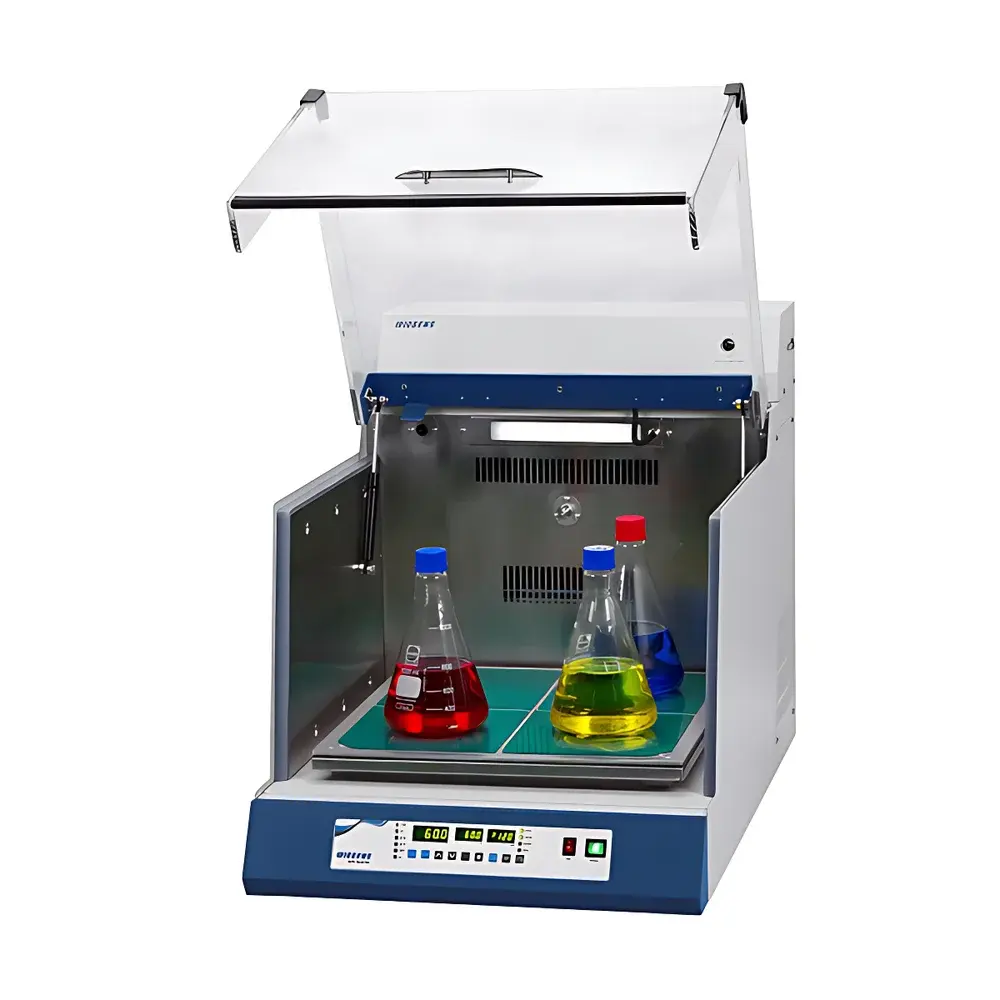
WIGGENS WS-600R Incubated Orbital and Reciprocating Shaker
| Brand | WIGGENS |
|---|---|
| Origin | Germany |
| Model | WS-600R |
| Shaker Type | Air-jacketed Temperature-Controlled Orbital/Reciprocating Shaker |
| Timer Range | 10 sec – 999 hr 59 min 59 sec |
| Oscillation Frequency | 30–300 rpm |
| Amplitude Options | 20 mm, 30 mm (standard), 40 mm |
| Temperature Range | 15–60 °C |
| Number of Platforms | 4 |
| Temperature Accuracy | ±0.1 °C (at 38 °C) |
| Temperature Uniformity | ±1.0 °C (at 38 °C) |
| Platform Size | 450 × 450 mm |
| Internal Chamber Dimensions | 510 × 510 × 320 mm |
| Net Weight | 102 kg |
| Max Load per Platform | 15 kg |
| Drive System | Brushless DC Motor |
| Speed Accuracy | ±1 rpm (at 150 rpm) |
| Heating Power | 600 W |
| Control Interface | Touch-sensitive PID controller |
Overview
The WIGGENS WS-600R is a high-performance, air-jacketed incubated shaker engineered for precision-controlled cell culture, microbial fermentation, molecular hybridization, and biochemical assay development in regulated laboratory environments. Unlike conventional water-bath or non-incubated shakers, the WS-600R integrates dual-mode orbital and reciprocating motion within a thermally stable, digitally controlled chamber—enabling simultaneous temperature regulation (15–60 °C) and programmable agitation across four independent platforms. Its core architecture employs a brushless DC motor coupled with closed-loop PID temperature and speed control, ensuring minimal thermal drift (<±0.1 °C at 38 °C) and mechanical consistency (±1 rpm at 150 rpm) under variable load conditions up to 15 kg per platform. The unit operates on the principle of forced-air convection heating combined with microprocessor-driven oscillation profiling, making it suitable for applications requiring strict adherence to ISO 13485, USP , and GLP-compliant workflows where reproducibility and auditability are critical.
Key Features
- Four independently accessible 450 × 450 mm platforms—each configurable for orbital or reciprocating motion via user-defined direction (clockwise/counterclockwise), dwell time, and stop-on-position sequencing.
- Triple-amplitude selection (20 / 30 / 40 mm) optimized for diverse vessel geometries—from Erlenmeyer flasks and baffled bioreactors to microtiter plates and separatory funnels.
- Extended timer resolution (10 seconds to 999 hours, 59 minutes, 59 seconds) supports long-duration experiments such as aerobic bacterial growth kinetics or slow enzymatic reactions.
- Intelligent load compensation algorithm maintains constant rotational velocity regardless of mass distribution—a feature validated across 0–15 kg loads without recalibration.
- Safety-integrated fail-safes: automatic motor and fan shutdown upon door opening; overtemperature cutoff with audible alarm; configurable power-resume behavior (auto-restart or auto-halt after outage).
- Touch-sensitive PID interface with real-time display of setpoint vs. actual temperature and RPM—designed for intuitive operation while retaining full parameter logging capability.
Sample Compatibility & Compliance
The WS-600R accommodates standard life science vessels including glass and plastic flasks (50–5000 mL), deep-well plates, serum bottles, and custom fixtures secured via optional accessories: universal clamping trays, pre-mounted spring clamps, rubber-damped platforms, separatory funnel holders, tube racks, microplate adapters, and adhesive mounting pads. All materials in contact with sample zones meet USP Class VI biocompatibility standards. The system complies with IEC 61010-1 (Safety Requirements for Electrical Equipment for Measurement, Control, and Laboratory Use) and carries CE marking for use in EU-based GMP and clinical research laboratories. Temperature uniformity (±1.0 °C at 38 °C) satisfies ASTM E145-22 requirements for gravity-convection incubators used in microbiological testing.
Software & Data Management
While the WS-600R operates as a standalone instrument with embedded firmware, its PID controller supports RS-232 serial output for integration into centralized lab monitoring systems (e.g., LabVantage, Thermo Fisher SampleManager). Logged parameters—including timestamped temperature, RPM, amplitude mode, and alarm events—are exportable in CSV format for traceability. Audit trail functionality meets FDA 21 CFR Part 11 requirements when paired with compliant third-party data acquisition software. No proprietary cloud service or vendor-hosted platform is required; all configuration and calibration data remain resident on-device and exportable via USB flash drive (optional accessory).
Applications
- High-yield aerobic cultivation of E. coli, S. cerevisiae, and mammalian suspension cells under tightly controlled O2 transfer conditions.
- Protein expression optimization using temperature-gradient shaking protocols during induction phases.
- Hybridization kinetics studies in DNA/RNA blotting workflows where uniform mixing and thermal stability prevent probe denaturation.
- Stability testing of biopharmaceutical formulations per ICH Q5C guidelines, leveraging precise 15–60 °C range and low-vibration operation.
- Environmental microbiology assays—including MPN enumeration and coliform screening—where reproducible agitation minimizes sedimentation bias.
- Enzyme kinetics and ligand-binding assays requiring multi-hour incubation with intermittent or continuous mixing.
FAQ
Does the WS-600R support both orbital and reciprocating motion on the same platform simultaneously?
No—each of the four platforms can be individually assigned to either orbital or reciprocating mode, but not both concurrently. Mode selection is configured per platform via the front-panel interface.
Is calibration documentation provided with the instrument?
Yes—factory calibration certificates for temperature and speed performance (traceable to NIST standards) are included. User-accessible calibration routines for offset adjustment are built into the firmware.
Can the unit be integrated into a BMS (Building Management System)?
Via optional RS-232-to-Modbus gateway hardware, the WS-600R can transmit status and alarm signals to industrial BMS platforms. Analog output modules are not natively supported.
What is the recommended maintenance interval for the brushless DC motor?
The motor requires no scheduled lubrication or replacement under normal operating conditions. WIGGENS specifies a minimum service life of 20,000 hours at rated load, with periodic inspection of fan filters every 6 months advised.
Are there validation protocols available for IQ/OQ/PQ execution?
WIGGENS provides a comprehensive Validation Support Package (VSP), including URS templates, test scripts aligned with ASTM E2500, and blank protocol forms for Installation Qualification (IQ), Operational Qualification (OQ), and Performance Qualification (PQ) execution.