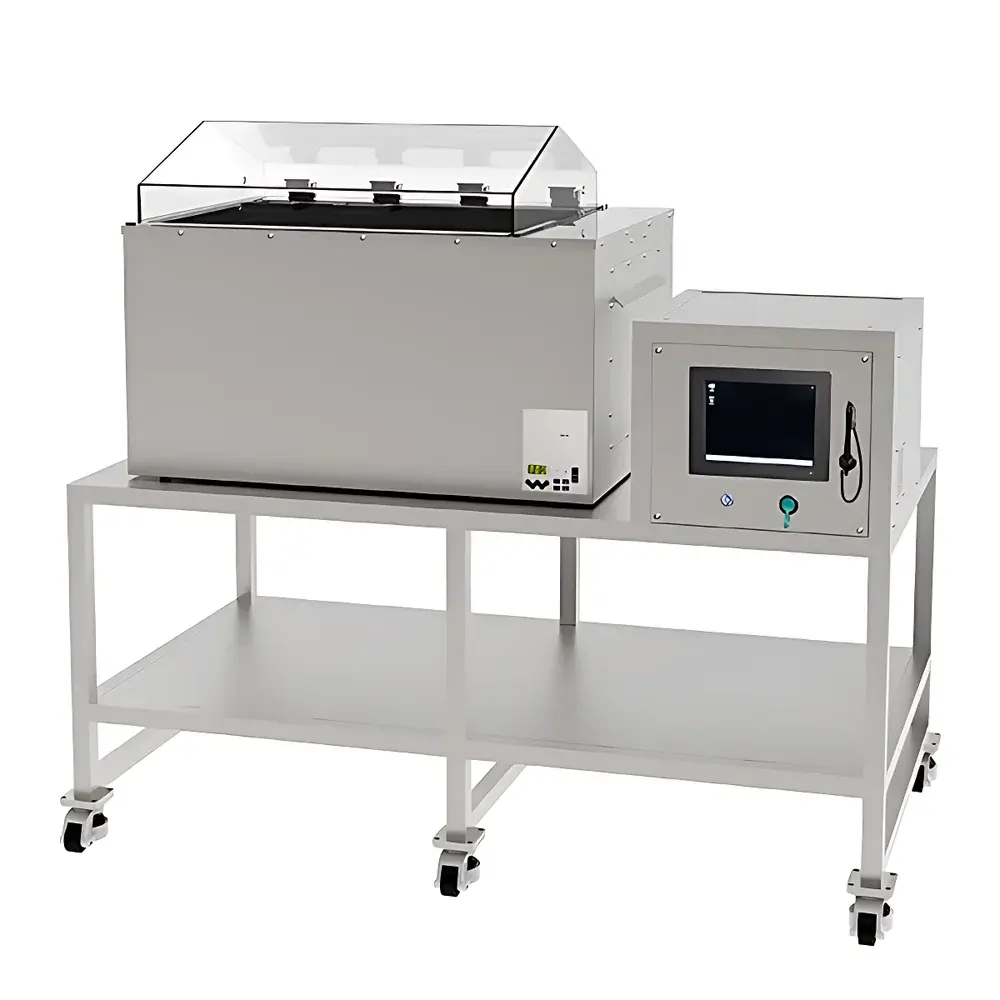
WIGGENS WS198 Cell Thawing Instrument (Large-Capacity Programmable Oscillating Water Bath)
| Brand | WIGGENS |
|---|---|
| Origin | Germany |
| Model | WS198 |
| Temperature Range | Ambient +5 to 40 °C |
| Temperature Control Accuracy | ±0.1 °C |
| Temperature Resolution | 0.1 °C |
| Oscillation Frequency Range | 20–100 rpm |
| Oscillation Amplitude | 15 / 25 mm |
| Heating Power | 4 kW |
| Chamber Opening Dimensions | 82 × 66 × 50 cm (W×L×D) |
| External Dimensions | 106 × 75 × 75 cm (W×L×H) |
| Working Volume | 50–200 L |
| Compatible Sample Volumes | 25 mL–12 L cryobags |
| Display Resolution | 0.1 °C / 1 rpm |
| Safety Features | Over-temperature, over-current, and low-water-level protection |
Overview
The WIGGENS WS198 Cell Thawing Instrument is a large-capacity, programmable oscillating water bath engineered specifically for standardized, reproducible thawing of cryopreserved biological cells in clinical, biopharmaceutical, and research-grade settings. Unlike conventional static water baths, the WS198 employs controlled convective heat transfer combined with gentle, uniform orbital oscillation to minimize thermal gradients and mechanical shear stress during thawing—critical factors influencing post-thaw cell viability, membrane integrity, and functional recovery. Its design adheres to the fundamental principles of controlled-rate warming (CRW), where precise temperature ramping and agitation kinetics are synchronized to replicate validated thawing protocols used in Good Manufacturing Practice (GMP) and Good Laboratory Practice (GLP) environments. The instrument operates within a tightly regulated temperature range of ambient +5 °C to 40 °C, with ±0.1 °C stability and 0.1 °C display resolution—enabling traceable, auditable thermal profiles required for regulatory submissions under FDA 21 CFR Part 11 and ISO 13485 frameworks.
Key Features
- Industrial-grade PLC control system with intuitive touchscreen HMI for full parameter programming—including target temperature, oscillation frequency (20–100 rpm), amplitude selection (15 mm or 25 mm), and dual-stage high/low temperature alarms.
- Programmable thawing algorithms compliant with standard operating procedures (SOPs) for cryobag-based cell products; supports user-defined protocol storage and recall for multi-product facilities.
- Robust stainless-steel water chamber (50–200 L usable volume) accommodating up to two standard 70 × 55 × 12.8 cm cryobags simultaneously—ideal for allogeneic or autologous cell therapy manufacturing workflows.
- Integrated safety architecture featuring real-time monitoring of water level, heater current draw, and thermal excursion events—with automatic shutdown and audible/visual alerts upon detection of over-temperature, over-current, or low-fluid conditions.
- Thermal uniformity optimized across the entire bath volume via submerged heating elements and forced convection from oscillatory motion—validated per ASTM E2251 for laboratory thermal equipment performance.
- Onboard thermal printout capability provides time-stamped records of setpoints, actual temperatures, oscillation parameters, and alarm events—supporting audit-ready documentation for QC release and regulatory inspections.
Sample Compatibility & Compliance
The WS198 is validated for use with commercially available cryopreservation bags from leading suppliers including CryoSeal®, MACS® GMP, BioLife Solutions CryoStor®, and Thermo Fisher Nunc™ Cryo•Bag™ systems. Its wide dynamic range (25 mL–12 L) enables consistent thawing performance across small-scale R&D vials and large-volume production bags without recalibration. All operational parameters comply with ISO 20387:2018 (Biobanking—General requirements for biobank operations) and support alignment with USP <1043> “Assessment of Cell Therapy Products” and ICH Q5D guidelines on characterization of biological starting materials. The instrument’s data logging and electronic signature functionality meet ALCOA+ principles (Attributable, Legible, Contemporaneous, Original, Accurate, Complete, Consistent, Enduring, Available) for data integrity in regulated environments.
Software & Data Management
While the WS198 operates as a standalone unit with embedded PLC firmware, its RS485 interface enables integration into facility-wide SCADA or MES platforms via Modbus RTU protocol. Thermal and motion logs are timestamped and stored internally for ≥30 days (configurable), with export options via USB flash drive in CSV format. Audit trail functionality includes operator ID entry (optional external keypad), session start/stop markers, and change history for all critical parameters—fully compatible with FDA 21 CFR Part 11 electronic record and signature requirements when deployed with appropriate access controls and validation documentation.
Applications
- Standardized thawing of hematopoietic stem cells (HSCs), mesenchymal stromal cells (MSCs), and CAR-T cell products prior to infusion or further expansion.
- Process development and scale-up of cryopreserved biologics in Phase II/III clinical manufacturing suites.
- Quality control release testing requiring documented, repeatable thawing conditions per batch record specifications.
- Biobank operations involving long-term storage and retrieval of primary human tissue-derived cell isolates.
- Academic and translational research labs conducting comparative studies on cryopreservation media efficacy and thawing kinetics.
FAQ
Does the WS198 support IQ/OQ/PQ validation documentation?
Yes—the instrument is supplied with a comprehensive validation support package including URS template, FAT/SAT checklists, calibration certificates for temperature and speed sensors, and blank IQ/OQ protocols aligned with ISO 13485 Annex A.
Can it be integrated into a cleanroom environment?
The WS198 meets IP54 ingress protection rating and features smooth, non-porous stainless-steel surfaces suitable for routine disinfection with ethanol or hydrogen peroxide vapor; optional HEPA-filtered air purge module available upon request.
Is remote monitoring possible?
Remote status viewing and alarm notification are supported via optional Ethernet-to-Modbus gateway and compatible SCADA software; full remote control requires additional cybersecurity assessment per IEC 62443.
What maintenance is required?
Scheduled maintenance includes quarterly verification of temperature uniformity (per ASTM E2251), annual calibration of PT100 sensors, and biannual inspection of water circulation seals and oscillation drive bearings.
How does oscillation improve thawing consistency compared to static water baths?
Orbital agitation eliminates stagnant boundary layers at the bag surface, ensuring uniform heat flux distribution and reducing localized ice recrystallization—key contributors to post-thaw apoptosis and loss of clonogenic potential.
Related Products