
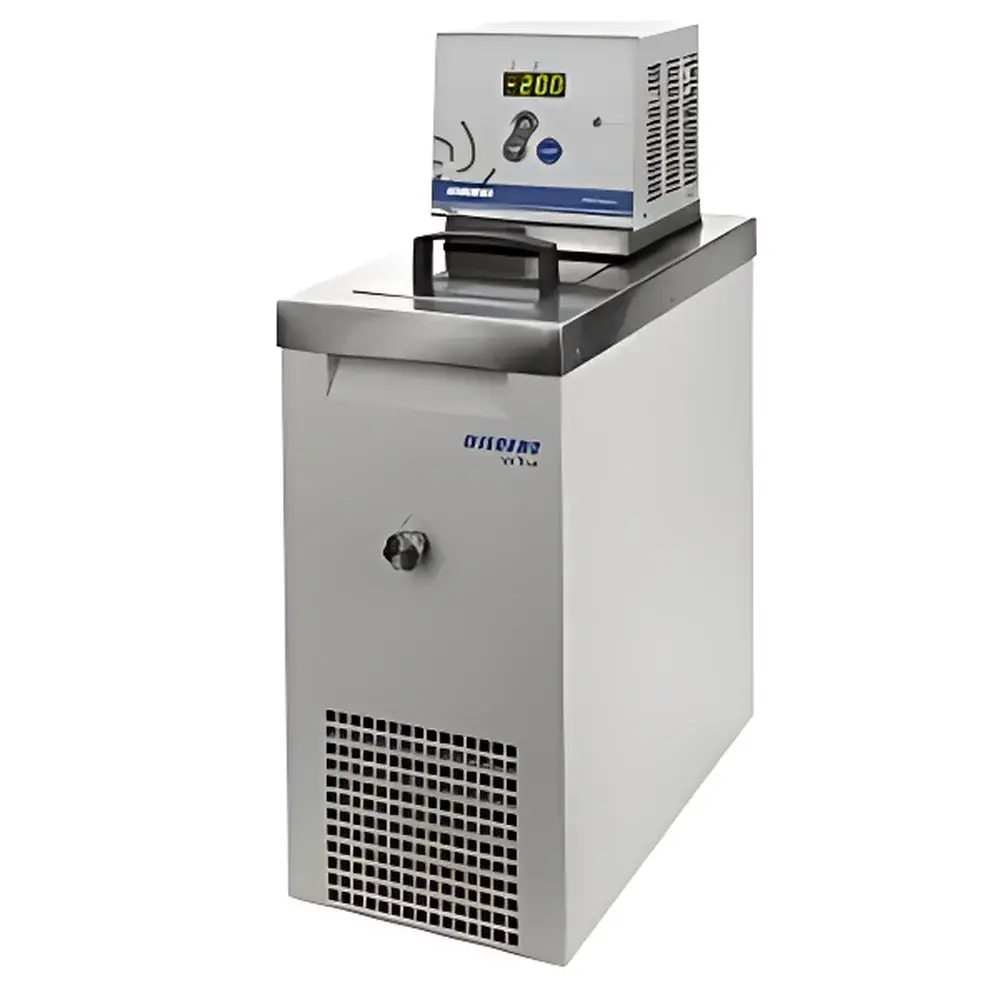
WIGGENS WT4 Heating and Cooling Circulator
| Brand | WIGGENS |
|---|---|
| Origin | Germany |
| Model | WT4 |
| Temperature Range | -25 °C to 100 °C |
| Temperature Stability | ±0.05 °C |
| Dimensions (W×D×H) | 22 cm × 42 cm × 64 cm |
| Heating Power | 1.5 kW |
| Pump Flow Rate | 10 L/min |
| Maximum Pump Pressure | 0.23 bar |
| Bath Capacity | 4–6 L |
| Weight | 24 kg |
Overview
The WIGGENS WT4 Heating and Cooling Circulator is a precision-engineered temperature control system designed for demanding life science and bioengineering applications requiring stable, bidirectional thermal regulation across an extended operating range of –25 °C to +100 °C. Based on a dual-mode thermoelectric and compressor-assisted cooling architecture combined with high-efficiency resistive heating, the WT4 delivers rapid thermal response and exceptional long-term stability (±0.05 °C) under dynamic load conditions. Its compact footprint (22 × 42 × 64 cm) and low-noise operation make it suitable for integration into benchtop laboratory environments—including analytical instrument suites, bioreactor support systems, and automated assay platforms—where spatial constraints and acoustic sensitivity are critical. The unit employs digital PID control logic with adaptive tuning algorithms to maintain setpoint accuracy across the full temperature span, while its Active Cooling Control technology ensures continuous refrigeration availability—regardless of ambient or bath temperature—enabling seamless transitions between heating and cooling phases without thermal lag or overshoot.
Key Features
- Integrated dual-mode thermal management: high-power 1.5 kW resistive heating element coupled with a multi-stage refrigeration circuit delivering up to 480 W cooling capacity at 20 °C ambient
- Precision temperature control with ±0.05 °C stability across the entire –25 °C to +100 °C range, verified per ISO/IEC 17025-accredited calibration protocols
- High-flow recirculation pump (10 L/min, max. 0.23 bar pressure) supporting both internal bath immersion and external jacketed equipment cooling/heating
- Dual-circuit flow ratio adjustment allows independent optimization of internal bath circulation versus external loop delivery
- Comprehensive safety architecture: overtemperature cutoff, low-level fluid detection via float switch with audible/visual alarm and automatic power disconnection, dry-run protection, and thermal fuse redundancy
- Ergonomic front-panel interface with three-button navigation and intuitive LED status indicators; supports both standby mode and scheduled auto-start functionality
- Corrosion-resistant stainless-steel heating coil and chemically inert fluid pathways compatible with water, water/glycol mixtures, and low-viscosity silicone oils
- Front-mounted drain valve enables rapid, spill-free bath fluid exchange without device relocation or disassembly
- Thermally optimized internal layout with dedicated airflow channels and oversized heat sinks ensuring sustained performance under continuous 24/7 operation
Sample Compatibility & Compliance
The WT4 is engineered to serve as a primary thermal interface for a broad spectrum of life science instrumentation—including rotary evaporators, HPLC and UHPLC column ovens, viscometers, rheometers, electrophoresis systems, polarimeters, spectrophotometers, and fermentation vessel jackets. Its bath opening (12 × 11 cm, 15 cm depth) accommodates standard labware and sensor probes, while its external circulation capability supports custom thermal manifolds and multi-zone temperature distribution networks. The device complies with IEC 61010-1:2010 for electrical safety in laboratory equipment and meets EMC requirements per EN 61326-1:2013. It supports GLP/GMP workflows through configurable event logging (start/stop cycles, temperature deviations, alarm triggers), and its firmware architecture is compatible with networked data acquisition systems that enforce FDA 21 CFR Part 11 audit trail requirements when integrated with compliant LIMS or ELN platforms.
Software & Data Management
While the WT4 operates autonomously via its embedded microcontroller and tactile interface, it includes an RS232 serial port (optional USB-to-serial adapter available) for remote parameter configuration, real-time temperature monitoring, and time-stamped data export. Communication follows ASCII-based command protocol compatible with LabVIEW™, MATLAB®, Python (pySerial), and common SCADA frameworks. Logged parameters—including setpoint, actual bath temperature, pump status, error codes, and safety event timestamps—can be streamed at user-defined intervals (1–60 s) and stored in CSV format for traceability and post-experiment analysis. Firmware updates are delivered via secure binary upload through the same interface, preserving configuration integrity and supporting version-controlled validation documentation required for regulated environments.
Applications
- Temperature-controlled sample preparation and storage in molecular biology workflows (e.g., enzyme kinetics, PCR master mix equilibration, protein crystallization screening)
- Stabilization of optical path components in spectroscopic and chromatographic instruments subject to thermal drift
- Active cooling of high-power detectors and lasers in imaging systems and flow cytometers
- Thermal conditioning of bioreactor feed streams and harvest lines to prevent microbial growth or precipitation during downstream processing
- Calibration verification of temperature-sensitive transducers (RTDs, thermistors, infrared sensors) across extended ranges
- Support of ASTM D445 (kinematic viscosity), ISO 3104 (petroleum products), and USP <797> compounding environment qualification protocols
- Long-duration stability testing of pharmaceutical formulations under accelerated aging conditions (ICH Q1A)
FAQ
What fluids are compatible with the WT4’s circulation system?
Deionized water, 30–50% aqueous ethylene or propylene glycol solutions, and low-volatility silicone oils (e.g., Dow Corning 200 Fluid) are approved. Avoid halogenated solvents, strong acids/bases, and high-viscosity media exceeding 50 cSt at 25 °C.
Can the WT4 be used for external cooling only—without internal bath operation?
Yes. The unit supports dedicated external-loop mode with independent flow rate and temperature setpoint control; internal bath can remain empty or filled with inert medium solely for thermal mass stabilization.
Is the ±0.05 °C stability specification valid at all temperatures within the –25 °C to +100 °C range?
Yes—this value reflects steady-state deviation under static load conditions per DIN 12876-1 Annex B test methodology, confirmed at five representative points (–20 °C, 0 °C, 25 °C, 60 °C, 95 °C) during factory acceptance testing.
Does the WT4 support external trigger inputs for synchronized start/stop with other instruments?
Not natively; however, the RS232 interface enables TTL-level handshake signaling via software-defined I/O commands, permitting integration into sequenced experimental protocols.
What maintenance intervals are recommended for optimal long-term reliability?
Annual inspection of refrigerant charge integrity, pump impeller wear, and fluid filter condition is advised. Glycol-based fluids should be replaced every 12 months; deionized water requires quarterly replacement and conductivity monitoring.






